

Key Takeaways:
- Generative AI creates context-aware responses instead of choosing scripted answers.
- Real-time and unified customer data creates the foundation of effective personalization.
- Traditional chatbots handle volume, while generative assistants manage nuanced, multi-step conversations.
- Sentiment analysis and predictive analytics help teams act before customers complain.
- Omnichannel context stops customers from repeating themselves across various support channels.
- Human oversight, privacy controls, and grounded data keep generative AI trustworthy.
Customers no longer compare your service only to your direct competitors. Instead, they judge you against the best digital experiences they have anywhere. That benchmark might be a streaming app that instantly recalls their choices or a bank that resolves an issue in a single text. Customer expectations rise every year, and older rule-based software finds it difficult to keep up.
Generative AI in customer experience changes how companies meet these expectations. Older AI tools could only route tickets, answer scripted questions, and spot basic trends. Generative AI goes much further. It creates original responses, understands context and tone, and tailors every interaction to the individual user. Service teams are already adopting these capabilities. According to the Salesforce State of Service report1 that surveyed 6,500 professionals, AI handles roughly 30% of customer service cases today. Teams expect that share to reach 50% by 2027.
Business leaders no longer ask if AI belongs in customer experience. They want to know where it delivers measurable value. This blog talks about the areas where AI customer experience programs pay off, from personalization and service automation to sentiment analysis, predictive engagement, content, omnichannel journeys, recommendations, and emotional AI. It also explains the risks that arise from using generative AI in customer experience and the steps that keep them in check.
What Makes Generative AI Different for Customer Experience
Generative AI differs from traditional AI, as it produces unique responses for every interaction. It does not choose from a fixed list of options. It is a branch of artificial intelligence where machines build new outputs based on the data they receive.
Traditional support bots work like flowcharts. They match customer words to a known intent and return a pre-set answer. No wonder, they fail when a question falls outside their script.
Large language models (LLMs) work as the engine behind generative AI CX. These models are trained on massive amounts of text, due to which they can understand vague requests and follow a conversation across several turns. They can even adjust their tone to match the situation. When connected to a company’s knowledge base, an LLM provides accurate and specific answers to each user.
Multimodal generative AI expands these capabilities further by processing text, voice, and images within a single conversation. For example, when a customer uploads a photo of a damaged product, the assistant identifies the issue, checks the warranty, and initiates a replacement order on its own. The customer does not need to describe the problem in detail.
This technology offers three major benefits to customer-facing teams. Human agents save time with drafted replies and summaries. Customers hit fewer dead ends. Marketing teams scale personalized content without hiring new staff. Personalization usually delivers the most immediate impact, making it the ideal starting point.
Explore Transformative Applications of Generative AI Across Industries
Hyper-Personalization at Scale: How Generative AI Reads Every Customer Differently
Generative AI for customer experience delivers hyper-personalization by combining live customer data with the ability to generate unique responses in real time. The technology helps create personalized interactions that appeal to individual users. This helps businesses offer an experience that feels tailored to every person, even when they serve millions.
The process starts at the data layer. Purchase history, browsing behavior, support tickets, loyalty status, and consent preferences usually sit in separate systems. A personalization program brings them together into a single customer profile. When a customer starts an interaction, a retrieval step pulls relevant facts from that profile and passes them to the model. The model then writes a response grounded in those facts. Every new interaction updates the profile, so the next one starts with a better context.
With that foundation established, generative AI personalization shows up in three main ways:
- Real-time data analysis: The system monitors live signals, such as items added to a cart or a delayed delivery. It responds to those signals within the same session, offering a size guide to a hesitant shopper or an update for a delayed shipment.
- Anticipating the next purchase: By studying broader customer patterns and the individual’s own history, the model predicts when a user needs an upgrade or a related product. These timely offers feel like helpful service instead of a sales pitch.
- Tailored content generation: Generative AI systems do not use fixed templates. These tools write messages, product descriptions, and help articles that match each customer’s language, past questions, and level of expertise. Beginners and experienced users thus receive explanations that suit their unique needs.
The business outcome of AI personalization in customer experience is clear. When customers feel understood, satisfaction scores rise. Churn also falls, because people have less reason to look elsewhere. Personalization also sets the tone for every service conversation that follows.
Generative AI in Customer Service: Chatbots, Virtual Assistants & 24/7 Automation
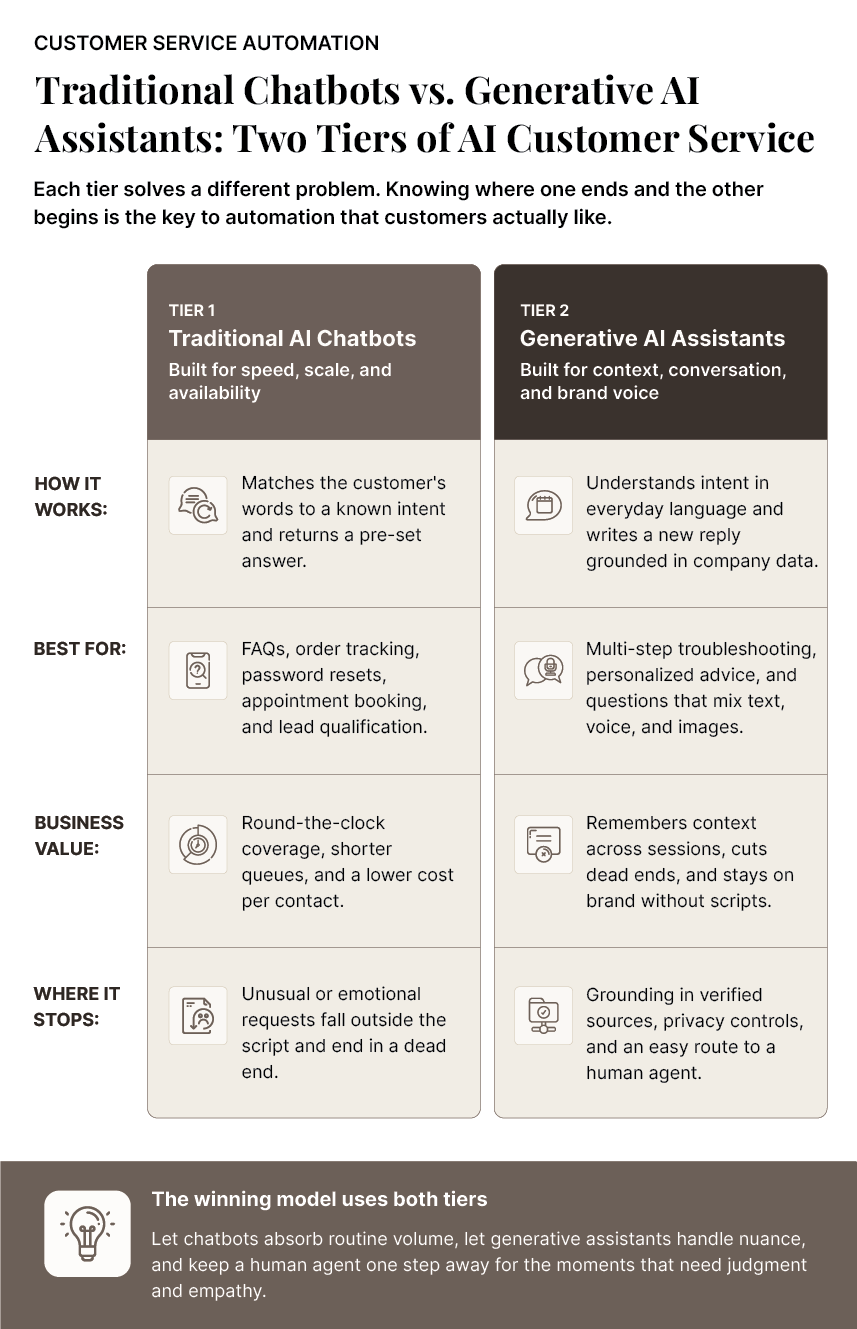
AI chatbots and virtual assistants transform customer service by taking on routine requests around the clock and freeing human agents to work on complex cases. This automation operates in two tiers.
The first tier uses rule-based chatbots, which focus on speed, availability, and cost. The second tier relies on generative AI-powered assistants, which focus on context, conversation, and brand voice. Many service operations use both, using conversational AI and chatbot technology as the foundation of CX automation.
1. Traditional AI Chatbots
Slow response times remain a major driver of customer churn. Traditional AI chatbots solve this problem well. They answer common questions, track orders, reset passwords, and book appointments at any hour, across channels. AI-powered chatbots can be used as the primary point of contact to handle customer queries and reduce the churn rate.
The return on investment in AI chatbot customer service comes from volume. Every conversation resolved by a bot is one that does not require a human agent, reducing cost per contact. AI-powered chatbots can not only provide lightning-fast customer support but also help businesses with high-quality leads. They can qualify prospects, answer pricing questions, and pass warm leads to sales teams. But their limits appear when a request becomes unusual, as a scripted bot can only offer preset answers.
2. Generative AI-Powered Assistants
The communication gap between customers and automated systems is one of the key challenges in conventional customer service interactions. Generative AI-powered assistants, from a generative AI chatbot on a website to a voice agent on a support line, close that gap. They keep track of context across a session and, when connected to customer records, across previous sessions too. They write new responses instead of falling back on “I didn’t understand that”. These systems can follow brand guidelines without requiring a script for every situation.
Companies that adopt generative AI customer service often see the impact within weeks. A single well-trained assistant can handle thousands of conversations at the same time. This lets human agents give more time to cases that need judgment and empathy.
“I think we should stop just thinking about customer support and start thinking about agent support with AI.”
– Shep Hyken, customer service expert and author
Sentiment Analysis & Real-Time Customer Feedback Intelligence
AI sentiment analysis improves customer feedback intelligence by reading the emotion and intent behind every call, chat, review, and social media post in real time. Teams can act on what customers feel rather than waiting for quarterly surveys. Older sentiment tools only labeled text as positive, negative, or neutral. Modern models pick up sarcasm, mixed emotions, and the specific product feature or policy that led to a reaction.
Because the analysis runs continuously across channels, it gives teams a far fuller picture than survey responses alone. A lot of customers do not fill out surveys. But nearly all of them leave emotional signals in their writing and speech. Sentiment analysis turns those signals into these capabilities:
- Issue resolution: When the system notices a sudden rise in negative comments about a billing change or a delivery partner, it alerts the right team within hours. As a result, problems get fixed while they affect a few hundred customers rather than thousands.
- NPS prediction: By scoring the sentiment of each interaction, AI can estimate how likely a customer is to recommend the brand without asking directly. Teams can then follow up with at-risk customers before a bad experience turns into a cancellation or a public complaint.
- Voice-of-customer analytics: Generative AI can summarize thousands of comments into clear themes, such as confusing return policies or praise for a specific agent. Product, marketing, and service leaders receive readable insights instead of raw data, which makes it easier to prioritize improvements.
AI sentiment analysis in customer experience tells a business how customers feel right now. The next step is using that insight, along with behavioral data, to predict their future needs.
Predictive Analytics: Anticipating Customer Needs Before They Ask
Predictive analytics helps businesses anticipate customer needs by finding patterns in past behavior and current signals, and then acting on those patterns before the customer asks. Generative AI uses predictive analytics to forecast customer preferences. The models study purchase histories, browsing patterns, product usage, support contacts, and payment behavior to estimate what each person will do next.
In customer experience, this approach proves valuable in three areas:
- Churn prediction: AI spots customers whose behavior matches past users who left, such as falling usage, repeated support tickets, or a downgrade in plan. Retention teams can then reach out to these people with offers to reduce the chances of churn.
- Next-best-action: For every customer, the system ranks the most useful next step, whether that is a service check, a loyalty reward, or no contact at all. Agents and automated channels follow these recommendations, so customers receive consistent guidance.
- Proactive outreach: Instead of waiting for complaints, businesses contact customers first. A subscription service, for example, can remind customers about unused benefits before renewal dates arrive.
Generative AI for Content Creation and Dynamic Marketing at Scale
Generative AI scales content creation by producing personalized emails, landing pages, product descriptions, and ad copy for individual customers or micro-segments in minutes. Marketing teams have long understood that tailored messages work better than generic ones. But they rarely had the time to write hundreds of versions of a single campaign. Generative AI marketing automation removes that bottleneck.
To give an example, a retailer can create product descriptions that emphasize durability for one shopper and style for another based on their browsing history. An email campaign can open by referencing a recent purchase and recommending similar items. Because every variation is created on demand, marketers spend their time on strategy and review instead of repetitive writing.
But scaling content without control can harm a brand. Businesses use these safeguards to keep generated content aligned with brand standards:
- A documented style guide that the model follows for tone, vocabulary, and formatting, supported by approved examples of on-brand copy, so the output sounds consistent across every channel and campaign. Teams should update this guide whenever the brand evolves and retest the model after each change.
- A library of approved claims covering pricing, product features, and legal statements, so the model never invents discounts or specifications. When a claim is missing from the library, the model should leave it out and flag the gap for the marketing team.
- Human review for sensitive content, especially in regulated industries where a single inaccurate sentence can create compliance issues. Reviewers do not need to read every variation. Checking samples from each batch can keep their workload manageable.
- Regular performance checks that compare engagement and complaint rates for generated content with human-written benchmarks, helping teams refine prompts and guidelines over time. If a version starts drawing unsubscribes or confused replies, teams can trace the problem to its prompt and fix it quickly.
Content only works if it reaches the customer in the right place and aligns with their past actions, which makes omnichannel orchestration a priority.
Omnichannel Experience Orchestration with Generative AI
Generative AI enables omnichannel customer experiences by carrying the same context, tone, and preferences across web, mobile app, phone, email, and in-store interactions, so customers do not have to repeat themselves. Customers clearly value this. The Zendesk CX Trends 2026 report2, based on more than 11,000 consumers and business leaders across 22 countries, found that 81% of consumers want service representatives to continue where they left off, and 74% get frustrated repeating information.
Delivering that continuity depends on two things. The first is data unification, where interaction records from every channel flow into a shared customer profile. The second is session continuity, where a conversation that begins in a chat window can move to a phone call or a store visit with its full history attached. When a customer calls about an order they asked about on chat that morning, the voice assistant or agent knows the order number, the issue, and the troubleshooting steps already tried.
Traditional customer data platforms could store this information, but they struggled to use it well. Rules had to be written for every scenario. And those rules broke whenever customers behaved in unexpected ways.
Generative AI reads the full history and decides what matters in real time. It can summarize a long thread for an agent or modify a reply to suit the channel the customer is using. This transforms AI customer journey orchestration from disconnected touchpoints into a continuous conversation.
AI-Powered Recommendation Engines: From Product Discovery to Loyalty
AI recommendation engines in CX drive product discovery and loyalty by showing each customer the items, content, or services they are most likely to value. This shortens the path to purchase and gives people a reason to return. Most recommendation systems rely on two established techniques, and generative AI is adding a third layer.
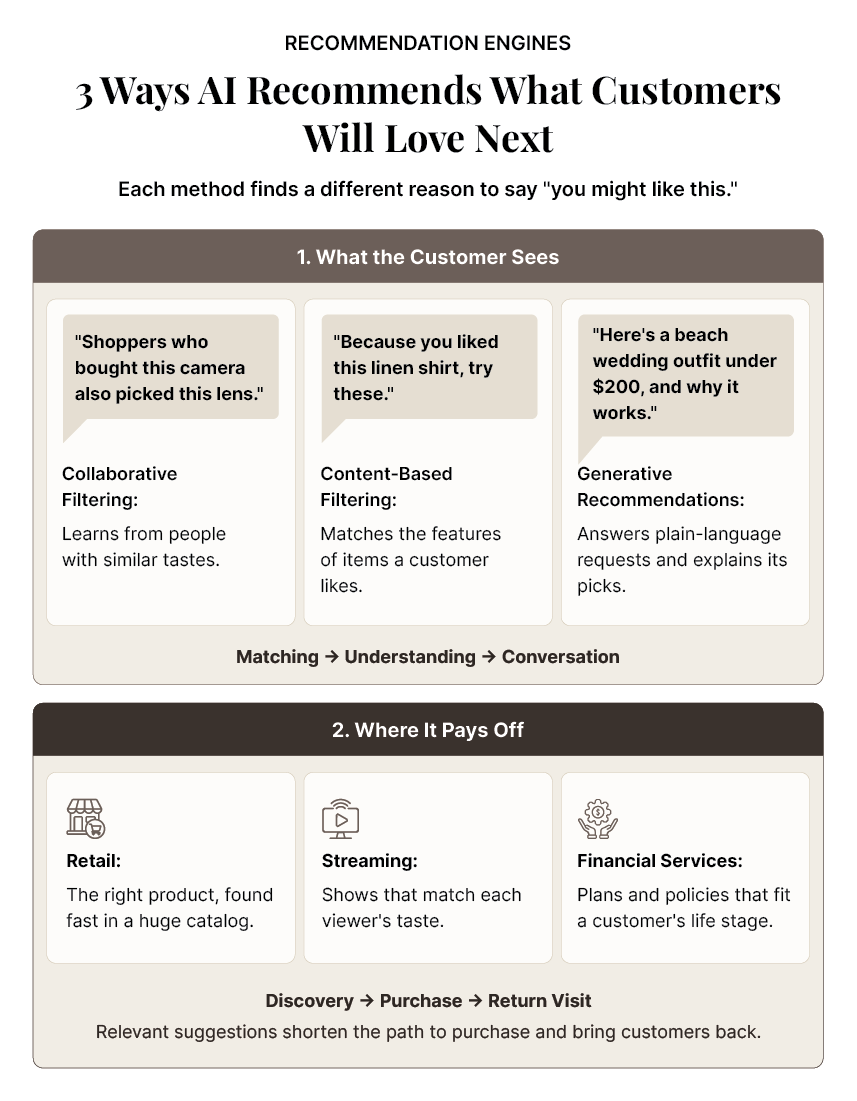
- Collaborative filtering: This method recommends items based on the preferences of similar buyers. If customers who bought a specific camera frequently purchased a matching lens, the system suggests that lens to the next camera buyer, even if the products share few obvious features.
- Content-based filtering: This method looks at attributes from products a customer likes and suggests items with similar features. It works well for new visitors with limited history and for niche products with very few buyers.
- Generative recommendations: Generative AI can explain why a product suits a customer, combine several items into a bundle, and respond to natural requests like “a gift under $200 for a wedding.”
The applications vary by industry. In retail, recommendations help shoppers find relevant products in large catalogs. Our guide to AI in retail and how personalization drives customer loyalty explores this in more detail. In streaming, they keep viewers engaged by surfacing shows that match their tastes. In financial services, they suggest savings plans, credit options, or insurance policies that fit a customer’s life stage and spending patterns.
An AI recommendation engine responds to what customers want. The next frontier is responding to how they feel.
Emotional AI: The Next Frontier of Empathetic Customer Experience
Emotional AI is technology that detects a customer’s emotional state from their words, tone of voice, and behavior, and then adjusts its response to suit that state. In customer experience, its purpose is to make automated interactions feel more considerate and to bring a human into the conversation at the right moment.
Tone detection serves as the starting point. The system notices when messages become sharper, or when a caller’s voice rises in pitch and speed. Sentiment-adaptive responses follow. A frustrated customer receives a direct apology and a clear next step instead of a cheerful script, while a confused customer receives a slower, simpler explanation. Voice AI can go a step further by recognizing growing frustration during a call and escalating to a live agent before the customer asks, passing along a summary so the agent can begin with a solution.
Because emotional AI deals with personal signals, it raises ethical questions. Customers should know when their tone or voice is being analyzed, and that analysis should serve their interests rather than pressure them into purchases. Emotional data needs the same protection as any other sensitive personal information. Handled with care, emotional AI makes service warmer, but handled poorly, it erodes trust.
Here’s How You Can Balance Generative AI Costs with Business Value
Key Challenges and Risks of Using Generative AI in Customer Experience
The main risks of using generative AI in customer experience include inaccurate answers, privacy breaches, over-automation, and biased personalization. Each one can be managed, but only if it is addressed during design rather than after launch. Our blog on generative AI challenges that impact CX strategy talks about these issues in detail.
- Hallucination in customer-facing conversations: Models can state incorrect refund policies or product details that sound convincing. The fix is grounding: connect the model to verified company sources through retrieval, limit it to answering from those sources, and route questions it cannot answer confidently to human agents.
- Data privacy and compliance: Personalization depends on customer data, and regulations such as GDPR and CCPA set strict rules on how that data is collected, stored, and used. Businesses should mask personal details before data reaches the model, honor consent choices, and keep data within approved regional servers.
- Over-automation eroding human connection: When every path leads to a bot, customers with complex issues feel abandoned. A visible, easy route to a human agent should be part of every design.
- Bias in personalization: Models trained on historical data can repeat old patterns, such as offering better deals to certain age groups. Regular audits of recommendation and pricing outcomes across customer segments, combined with diverse training data and clear fairness rules, help catch these problems early.
Responsible AI in customer service thus comes down to building guardrails that let the technology work safely.
Enable Generative AI in Customer Experience with a Reliable Partner
Generative AI for customer experience highlights a fundamental shift in how businesses handle customer interactions. The technology gives enterprises the power to understand their customers and improve experiences at every stage of the buying journey.
Damco Solutions helps businesses turn that potential into real results. Our generative AI services cover strategy, data preparation, model integration, and governance to build personalized customer experiences, while our AI CX services bring intelligent, brand-aligned assistants to every support channel. Talk to our experts to discover where generative AI can make the biggest difference in your customer experience.
- 1. Salesforce
- 2. Zendesk
Frequently Asked Questions
Generative AI improves customer experience by giving fast, personal answers at any hour. It understands questions written in everyday language, remembers earlier conversations, and writes replies that fit each customer. It also helps human agents by drafting responses and summarizing cases, so people get quicker help and fewer handoffs.
Traditional AI chatbots follow set scripts. They match a question to a known topic and return a stored answer, so they struggle with anything unusual. Generative AI assistants write new answers each time, follow the flow of a conversation, and adjust their tone, which lets them handle complex or unexpected requests.
AI personalization in retail combines a shopper's browsing history, past purchases, and current activity into one profile. The system uses that profile to suggest products, adjust prices or offers, and write messages that match each person's interests. Shoppers see items they actually want, which makes buying easier and encourages repeat visits..
The biggest risks are wrong answers, misuse of personal data, unfair treatment of some customer groups, and too little access to real people. Businesses can reduce these risks by linking AI to verified company information, protecting customer data, testing results for fairness, and always offering an easy way to reach a human.
Businesses measure AI customer experience ROI by comparing results before and after AI goes live. Common measures include cost per contact, the share of issues solved without an agent, average handling time, customer satisfaction scores, and customer retention. Many also track revenue from AI recommendations, then weigh these gains against the cost of building and running the system.


