

Executive Summary:
- The bottleneck: Enterprise AI ROI is being throttled by an unglamorous input, i.e., labeled data. Inconsistent or non-compliant annotation quietly inflates cost, delays launches, and creates regulatory exposure.
- The opportunity: Data annotation outsourcing, done through a vetted partner, compresses that cost curve and cuts delivery time from months to weeks.
- The risk to manage: Poor labeling doesn’t fail loudly. It produces confidently wrong model outputs that surface later as P&L, compliance, and reputational risk.
- The recommended first move: Run a bounded, KPI-defined pilot with one qualified partner in parallel with the existing in-house pipeline before committing to enterprise-wide scale.
As AI initiatives move from pilot phases to enterprise-wide deployment, the demand for high-quality annotated data increases exponentially, across text for natural language processing (NLP) annotation, images and video for computer vision dataset labeling, and structured records for fraud, risk, and claims models. What begins as a manageable internal process quickly becomes a resource-intensive challenge involving quality control, compliance oversight, and scalability constraints.
This has pushed business leaders to reevaluate the economics of annotation and consider whether specialized outsourcing partners can deliver better outcomes. The answer depends on far more than cost. It requires balancing speed, risk, quality, and long-term total cost of ownership.

This guide breaks down why annotation has become the single point of failure for AI ROI, the operational and financial risks poor labeling introduces, and the industries capturing the fastest returns from getting it right. It walks through the core decision every scaling AI program eventually faces build annotation capability in-house or outsource it to a vetted partner, and how to model total cost of ownership either way.
It also covers how to vet an outsourcing partner, which service model fits different scaling strategies, and how a hybrid approach combines outsourced scale with in-house governance. It closes with a KPI-driven framework CFOs and CTOs can use to move from a bounded pilot to an enterprise-wide scale.
Why Is Data Annotation the Single Point of Failure for Enterprise AI ROI?
Data annotation quality directly determines AI model accuracy and reliability. It is quietly powering AI breakthrough. Poor labeling produces confidently wrong predictions in production, turning a data-pipeline issue into a P&L, compliance, and reputational risk for the enterprise.
Machine learning models inherit every flaw in their training data. An algorithm trained on inconsistent or mislabeled data doesn’t degrade gracefully. It makes decisive, incorrect calls in production, whether that’s a fraud model flagging the wrong transaction or a diagnostic tool missing an anomaly. Because the error is baked in at the training stage, it rarely trips an alert; it simply ships.
The reverse is equally true. Consistent, well-governed annotation shortens the path from prototype to production, reduces retraining cycles, and gives model owners defensible evidence of how the system learned what it learned. That is why annotation has moved from a back-office task to a board-level input into AI ROI.
This single point of failure rarely stays contained to one model or one team. Left unmanaged, the same labeling gaps compound across every AI initiative running through the enterprise pipeline, surfacing as a distinct set of operational risks.
“A lot of times, the failings are not in AI. They’re human failings, and we’re not willing to address the fact that there isn’t a lot of diversity in the teams building the systems in the first place. And somewhat innocently, they aren’t as thoughtful about balancing training sets to get the thing to work correctly. But then teams let that occur again and again. And you realize, if you’re not thinking about the human problem, then AI isn’t going to solve it for you.”
– Vivienne Ming, CEO, Socos Labs
What Are the Key Data Annotation Challenges at Enterprise Scale?
Five risks recur across enterprise annotation programs: inconsistent labeling across teams, data privacy and compliance exposure, ambiguous label definitions, annotator bias, and an inability to scale without eroding accuracy.
These challenges rarely appear in isolation. Instead, they compound as annotation volume grows, and more teams, vendors, and geographies enter the pipeline. Recognizing each one early is what separates a program that scales cleanly from one that needs costly rework later.
1. Maintaining Consistency Across Large Teams
Multiple annotators interpreting the same guidelines differently erodes model accuracy over time. Without a shared style guide and periodic calibration sessions, inter-annotator agreement drifts as the team grows, and that drift shows up as inconsistent model behavior long after the labeling work is done.
2. Data Privacy and Compliance
Annotation often touches PII, financial, and medical data, wherein a single governance gap risks regulatory penalties. Regulated sectors such as healthcare, finance, and insurance carry the highest exposure, since a single mishandled PII or PHI record can trigger breach-notification obligations under GDPR, HIPAA, or CCPA. A documented data security and compliance framework, covering access controls, data residency, and annotator vetting, is the minimum bar before any sensitive dataset leaves the enterprise’s perimeter.
3. Managing Ambiguous Labeling Cases
Data with multiple valid interpretations increases mislabeling and degrades downstream predictions. Edge cases, such as sarcasm in text, occluded objects in images, and borderline fraud patterns, are where most disagreements originate. They need documented tie-breaking rules rather than case-by-case annotator judgment.
4. Keeping Annotator Bias at Bay
Subjective judgment calls introduce skewed labels that carry directly into model behavior. Bias introduced at the labeling stage is difficult to catch downstream, since the model simply learns it as ground truth. This makes it one of the hardest annotation risks to audit after deployment.
5. Scaling Without Losing Quality
Data volume growth strains accuracy, storage, and process efficiency simultaneously, which is the core challenge in building scalable annotation pipelines. Programs that scale headcount without scaling QA infrastructure typically see accuracy dip just as volume peaks. And, this is the exact moment the business can least afford it.
Each of these risks eventually resolves into a number on a spreadsheet. The next question for finance and engineering leaders alike is what that number costs the business.
What Is the True P&L Impact of Poor Data Annotation?
Poor annotation raises operational expenditure through rework, slows model development cycles, and delays project timelines. This cost compounds over time and rarely appears on the original project budget line.
In other words, the impact of poor data annotation surfaces quietly across engineering hours, delayed launches, and rework cycles that get absorbed into “the cost of doing AI” rather than tied back to their root cause. This is exactly why they’re so easy for leadership to underestimate.
i. Increased Operational Expenditure
Rework and specialized tooling add up fast on large-scale AI/ML initiatives. Rework typically means re-labeling entire batches rather than isolated records, since a systemic labeling error tends to repeat across every file a given annotator or team touched.
ii. Slower Model Development
Inconsistent data quality delays training cycles. This is a real disadvantage in time-sensitive markets. Every additional QA and re-training cycle pushes back the production date, and in competitive categories, a delayed launch can mean ceding first-mover advantage to a competitor running a cleaner pipeline.
iii. Delayed Project Timelines
Correcting biased annotations erodes first-mover advantage, particularly costly for autonomous vehicle and security/surveillance programs. Beyond the direct cost of correction, repeated delays erode stakeholder confidence in the AI roadmap. This makes the next budget cycle for AI investment harder to defend.
iv. Hidden Vendor and Tooling Costs
Emergency re-annotation often forces last-minute vendor switches at premium rates, undermining any cost advantage the original vendor selection was meant to deliver.
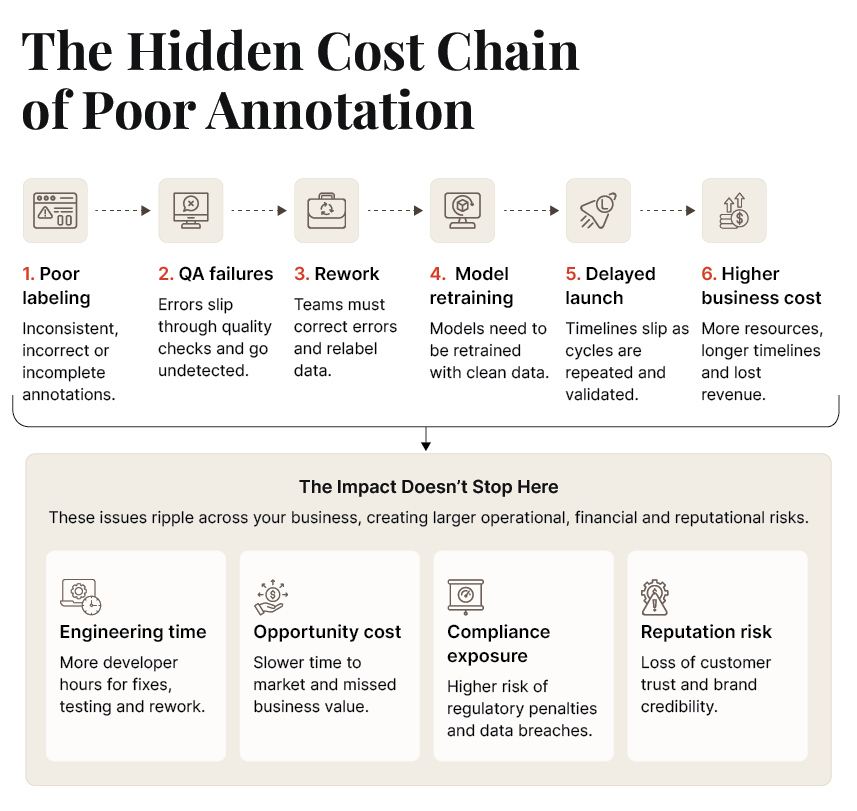
Once these costs are visible on a P&L, the conversation shifts from “can we afford to fix annotation” to “can we afford not to.” That shift is exactly what’s driving CFOs and CTOs toward outsourcing in FY26.
Why Are CXOs Prioritizing Data Annotation Outsourcing in FY26?
CXOs are outsourcing annotation to convert a fixed, hard-to-scale internal cost center into a variable, elastic capacity model. This way, they can gain trained annotators, mature QA, and faster delivery without upfront infrastructure investment.
The shift changes how data annotation in machine learning shows up on the balance sheet, moving it from a fixed cost center with unpredictable overruns to a variable, demand-based line the CFO can plan around.
a. Quality and Continuity
Dedicated annotators and subject-matter experts outperform stretched internal teams on accuracy. Internal teams juggling annotation alongside other priorities see accuracy degrade under competing deadlines; a dedicated partner treats it as the core deliverable, not a side task.
b. Faster AI Project Delivery
A partner already calibrated on similar data types can often begin production within days, compared with the weeks typically needed to hire, train, and align an internal team. That head start compounds across every retraining cycle that follows.
c. Elastic Scalability
Providers scale capacity up or down without internal hiring lag. This matters most around model retraining cycles or new feature launches, when annotation demand can spike several times over baseline for a matter of weeks, and scalable annotation pipelines absorb the surge without a permanent headcount increase.
d. Data Readiness and Compliance Readiness
Established partners offer VPN-based or air-gapped delivery models with a documented data security and compliance framework aligned to GDPR, HIPAA, and CCPA requirements for PII and PHI requirements. Mature partners can produce audit trails and compliance documentation on demand, which shortens the enterprise procurement and security-review cycle considerably.
e. Focus on Core Competencies
Offloading annotation frees internal teams for strategic, revenue-generating work. Every hour an ML engineer spends manually checking labels is an hour not spent on model architecture, feature engineering, or the next release.
f. Adaptability to Technology Advances
Annotation tooling is moving quickly, from model-assisted pre-labeling to multimodal and synthetic data workflows. An AI data annotation outsourcing partner absorbs the cost of evaluating, licensing, and retraining on each new capability, so the enterprise benefits from the improvement without carrying the R&D overhead itself.
Not every industry captures this value at the same speed. Some sectors are converting outsourced annotation into ROI faster than others, largely because of what’s at stake if labeling goes wrong.
In-House or Outsourced: Which Model Minimizes Total Cost of Ownership?
Outsourcing minimizes total cost of ownership for most scaling AI initiatives through flexible, pay-as-you-go pricing and faster turnaround; in-house remains preferable only for narrowly scoped, highly sensitive projects requiring direct control.
The table below compares the two models on the factors that drive TCO over a multi-year AI program.
| Factor | In-House | Outsourced |
|---|---|---|
| Workforce Availability | Limited internal resources and hard to hire for specialized data types | Access to large, trained annotation teams across data types and industries |
| Scalability | Difficult to scale quickly; hiring lag of weeks to months | Scales up or down on demand around retraining cycles and launches |
| Cost Structure | High upfront infrastructure and training cost; lower marginal cost only at very high, steady volume | Flexible, pay-as-you-go pricing with no fixed overhead |
| Turnaround Time | Slower, limited by internal staff and competing priorities | Faster project delivery |
| Expertise | May lack specialized skills | Access to trained, experienced annotators |
| Security & Control | Direct control; data stays in-house | Shared control, backed by GDPR/CCPA/HIPAA-aligned protocols |
In-house is the right call when direct control outweighs speed. For most scaling AI initiatives, outsourcing’s flexibility and cost-efficiency win, provided the partner is properly vetted.
Choosing to outsource the task is the easy half of the decision. The harder and more consequential half is choosing the right data annotation partner that can operate to enterprise-grade standards for security, quality, and cost transparency.
How Do You Vet a Data Annotation Outsourcing Partner for Enterprise-Grade Risk?
Vet partners on five dimensions: proven industry experience, modern AI-assisted tooling, transparent cost structure, certified security protocols, and multi-level quality control. Price alone is not a valid selection criterion.
This is closer to a security and operations audit than a procurement exercise. Treating it as a simple RFQ comparison is where most enterprises get burned.
i. Experience and Expertise
A proven track record in your industry and data type reduces onboarding friction. Ask for anonymized samples from a comparable project and check the partner’s ramp-up time on unfamiliar data types before committing to volume.
ii. Technology and Tools
Modern, AI-assisted annotation tools improve accuracy and efficiency. In fact, many professional companies are harnessing gen AI genie to enhance annotation efficiency. AI-assisted pre-labeling combined with human review typically cuts turnaround time significantly while still routing genuinely ambiguous cases to trained annotators. Ask which tools the partner uses, whether they integrate with your data pipeline, and how model-assisted output is validated before it counts as a finished label.
iii. Cost Structure and Transparency
Clear pricing avoids hidden-cost surprises during scale-up. Request a breakdown by per-label, per-hour, and QA overhead costs upfront, since bundled pricing can obscure where volume discounts actually apply.
iv. Security
Strict protocols and compliance certifications are non-negotiable for sensitive datasets. Look for SOC 2, ISO 27001, or equivalent certifications, plus a documented incident-response process, not just a general compliance statement.
v. Quality Control
Multi-level review and human-in-the-loop (HITL) workflows guarantee usable training data. A credible partner can show inter-annotator agreement scores and a defined escalation path for disputed labels, not just a final accuracy percentage.
“There’s a real danger of systematizing the discrimination we have in society [through AI technologies]. What I think we need to do, as we’re moving into this world full of invisible algorithms everywhere, is that we have to be very explicit, or have a disclaimer, about what our error rates are like.”
– Timnit Gebru, Founder & Executive Director, The Distributed AI Research Institute
Vetting tells you whether a partner is trustworthy. The next decision is structural: which engagement model actually fits how your organization plans to scale.
Build an Annotation Pipeline That Scales Without Compromising Quality, Security, or Control
Which Service Model Aligns with Your FY26 Scaling Strategy?
Dedicated teams suit long-term, consistent-standard projects; managed services suit organizations offloading the entire pipeline. Matching vendor domain expertise to project type, and weighing long-term value over sticker price, determines fit. The choice between models determines how much internal oversight the organization retains and how much it hands off.
1. Dedicated Teams vs. Managed Services
Data annotation outsourcing services are typically packaged one of two ways. Dedicated teams work well when the organization wants a stable, named group that learns its data and guidelines over time. Managed services fit organizations that want to hand off the entire operational burden, including project management, throughput planning, and first-line QA. A third route, crowdsourced or marketplace labeling, offers low unit cost but rarely meets the security and consistency bar for regulated enterprise data.
2. Matching Vendor Capabilities
Image/video specialists suit computer vision; text specialists suit NLP; healthcare or AV projects need domain-specific expertise. A generalist vendor spread thin across many data types rarely matches the accuracy of a specialist that has built calibrated workflows for one domain.
3. Cost and Long-Term Value
The cheapest bid isn’t the best value if it leads to rework. Weigh accuracy benchmarks alongside price. Ask any shortlisted vendor for their historical rework rate. A low headline price paired with a high rework rate erases the savings within one or two delivery cycles.
Neither model has to be chosen in isolation. A growing number of enterprises are blending the two to capture outsourced scale without giving up internal control.
Does a Hybrid Annotation Model Deliver Better Governance Than Full Outsourcing?
A hybrid model, outsourced labeling paired with in-house quality assurance, delivers stronger governance than full outsourcing by combining vendor scale with internal validation against business-specific standards and use cases.
Rather than choosing one model exclusively, many enterprises now split the work by function. The outsourced partner owns first-pass labeling and throughput. A smaller internal team owns the guidelines, runs spot audits on a defined sample, resolves edge cases, and signs off before data enters the training pipeline. The result is a human-in-the-loop (HITL) workflow in which the people closest to the business decide what “correct” means and the partner supplies the capacity to apply it at volume.
The model has one recurring failure mode. When both sides run QA without a written split of responsibilities, accuracy disputes stall delivery and nobody owns the fix. Define upfront which party owns guideline changes, what sampling rate the internal team applies, and what the acceptance gate is, and the hybrid model gives you outsourced scale without surrendering oversight.
Whichever model an organization lands on, the decision ultimately needs to be defensible in financial terms. That’s where a formal ROI framework comes in.
How Do You Model the ROI of Data Annotation Outsourcing?
Annotation ROI is modeled as total cost of ownership savings plus the value of accelerated time-to-market, divided by outsourced spend. Expressed with real inputs, that formula turns a qualitative vendor decision into a board-ready business case.
The Inputs
- In-house TCO baseline: annotator and reviewer labor, tooling licenses, infrastructure, QA overhead, and the management time spent coordinating it.
- Outsourced spend: per-label or per-hour fees, QA overhead, onboarding, and internal governance time under the chosen model.
- Rework avoided: re-labeling and retraining cycles eliminated, priced at engineering hours.
- Time-to-market value: revenue or cost impact of shipping the model earlier, per week saved.
ROI = (In-house TCO minus Outsourced spend, plus Rework avoided, plus Time-to-market value) divided by Outsourced spend.
Strategic Framework: From Pilot to Enterprise Scale
| Phase | Objective | Key Actions | Success Metric |
|---|---|---|---|
| 1. Diagnose | Quantify current in-house TCO and quality gaps | Audit annotation spend, error rates, and cycle time | Baseline TCO and accuracy benchmark established |
| 2. Select | Shortlist and vet outsourcing partners | Score vendors on experience, security, QC, and cost transparency | Two to three vendors cleared on security and compliance review |
| 3. Pilot | De-risk with a bounded pilot engagement | Run a fixed-scope pilot against defined KPIs (accuracy, turnaround, cost per label) | Pilot meets or exceeds in-house accuracy benchmark at lower cost per label |
| 4. Scale | Expand engagement with governance in place | Formalize SLAs, implement hybrid QA, set audit cadence | TCO reduction realized; inter-annotator agreement tracked quarterly |
A strong framework only pays off if execution avoids the recurring mistakes that quietly erode ROI at each phase of the rollout.
What Strategic Mistakes Erode ROI in Data Annotation Outsourcing?
The costliest mistakes of data annotation outsourcing are selecting a vendor on price alone, skipping documented annotation guidelines, ignoring security certifications, failing to plan for scale, and treating quality audits as optional rather than continuous.
These mistakes tend to surface at predictable points in the engagement. This is mostly during vendor selection, some after the first quality audit, and the rest whenever volume scales faster than governance does.
- 1. Choosing a Vendor on Price Alone: Enterprises compare headline rates without checking accuracy benchmarks or QC processes. The gap typically shows up in the first delivery cycle, when a supposedly cheaper vendor’s rework rate erases the discount within weeks.
- 2. Skipping Detailed Annotation Guidelines: Leaving room for ambiguity and inconsistent labeling. Guidelines should be treated as living documents, updated every time an edge case forces a judgment call, not written once and left untouched.
- 3. Ignoring Security Certifications: Skipping security certifications and compliance track record during evaluation. A security gap discovered after data has already been shared is far more costly, both reputationally and legally, than the extra diligence spent screening for it upfront.
- 4. Not Planning for Scale: Volume spikes arrive before capacity has been contracted, forcing last-minute vendor switches. Emergency vendor switches under time pressure rarely get the same security and quality vetting as the original selection process, quietly reintroducing the very risks the first vendor was chosen to avoid.
- 5. Treating Quality Audits as Optional: Instead of an ongoing part of the engagement. Quarterly or milestone-based audits, benchmarked against a fixed accuracy target, catch quality drift long before it reaches a production model.
Avoiding these mistakes is a start. Sustaining quality at cost over the life of the engagement takes an operating discipline, not a one-time checklist.
How Do You Operationalize Cost-Quality Balance in Data Annotation Outsourcing?
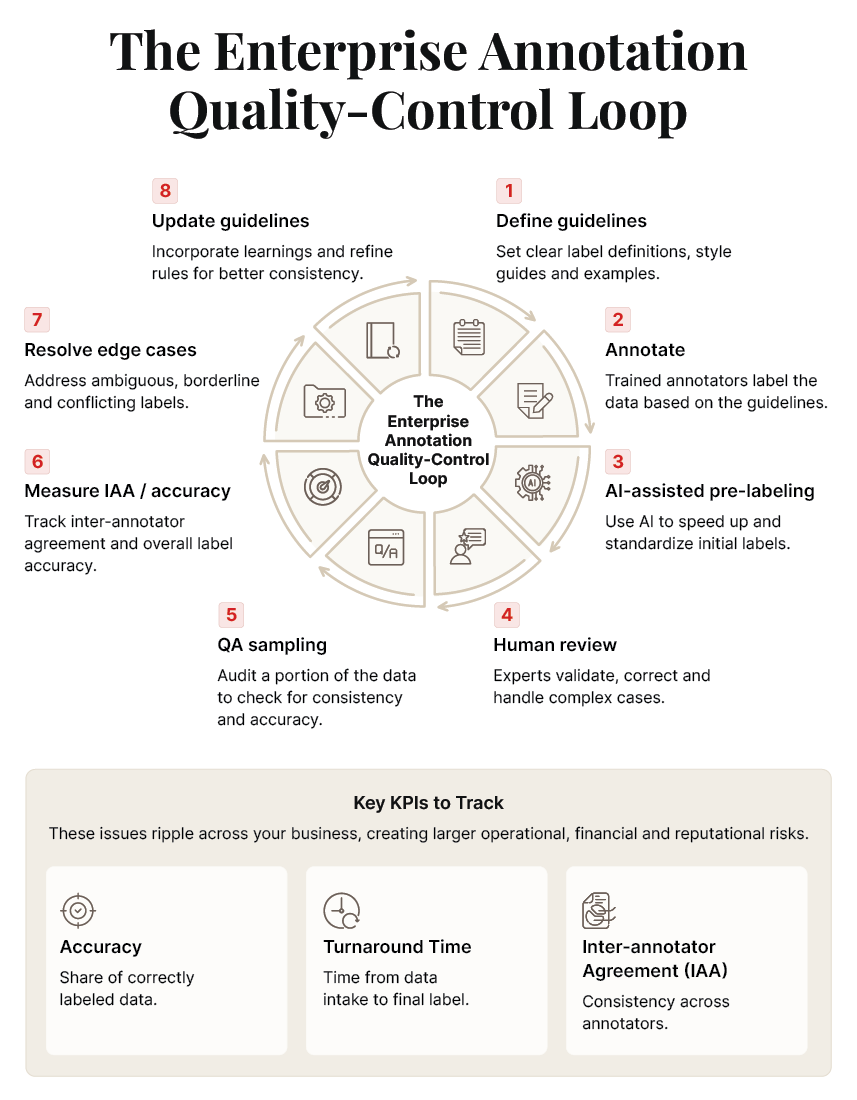
Operationalize cost-quality balance through three disciplines: documented annotation guidelines with feedback loops, AI-assisted pre-annotation tooling, and recurring audits tracking accuracy, turnaround, and inter-annotator agreement as standing KPIs.
None of these disciplines work as a one-off exercise. They need to be built into the engagement’s operating rhythm from day one, with clear ownership on both the enterprise and vendor side.
- Define clear annotation guidelines: Documented rules and continuous feedback loops reduce interpretation errors and rework. Version-controlled guideline documents, reviewed after every major audit, keep annotators and QA reviewers working from the same standard as edge cases accumulate.
- Use AI-assisted annotation: Pre-annotation tools help human annotators work faster and more accurately. Pre-annotation works best on well-defined categories with clear boundaries; ambiguous or high-stakes categories should still route through full human review rather than AI-assisted shortcuts.
- Run regular audits: Track accuracy, turnaround, and inter-annotator agreement as ongoing KPIs, not one-time checks. Publishing these metrics to both the internal stakeholder and the vendor creates shared accountability, rather than leaving quality as a one-sided vendor obligation.
With the operating model defined, most of what’s left are the specific questions that come up when this decision reaches the executive committee.
Turn Your Annotation Strategy Into a Measurable AI Advantage
What Is the First Move?
The first move is a bounded pilot: select one vetted partner, define accuracy and turnaround KPIs upfront, run it against the existing in-house baseline, and use the result to build the board-level case for scaling the engagement.
High-quality data annotation is a direct input into AI model performance, time-to-market, and compliance posture. The businesses capturing the most value aren’t outsourcing by default; they’re vetting partners on experience, security, and quality control, and increasingly blending outsourced labeling with in-house oversight through a hybrid model.
For FY26, the sequence matters more than the scale: diagnose the current TCO baseline, pilot with one partner, prove the model against defined KPIs, then scale. That order is what separates a defensible AI investment from an expensive rework cycle.
References:
Frequently Asked Questions
In-house annotation keeps data, tooling, and control entirely internal, giving full visibility into how labels are created but requiring upfront investment in hiring, training, and infrastructure that's slow to scale. Outsourced annotation shifts execution to a specialized partner with trained annotators and mature QA processes, trading some direct control for speed, elastic capacity, and lower fixed cost with governance managed through contracted, compliance-aligned processes.
For most scaling initiatives, yes. Outsourcing shortens delivery timelines from months to weeks, reduces the burden on internal ML teams, and gives access to annotators already calibrated on similar data types. That benefit only holds if the vendor has verified quality control, documented security practices, and a track record in the relevant data domain. Skipping that diligence can erase the speed advantage through costly rework.
Evaluate five dimensions together, not in isolation: proven experience in your specific data type and industry, modern AI-assisted tooling, transparent and itemized pricing, certified security protocols such as SOC 2 or ISO 27001, and documented multi-level quality control. Ask for sample work and inter-annotator agreement scores from comparable projects. Price should factor into the decision, but it should never be the deciding criterion alone.
Increasingly, yes. A growing share of enterprises now pair outsourced labeling with in-house quality assurance rather than choosing one model exclusively. The outsourced partner handles volume-heavy annotation work while an internal team defines edge-case rules, runs spot audits, and signs off before data enters the training pipeline, delivering the scale and cost advantages of outsourcing without fully giving up internal oversight.


