

Key Takeaways:
- Manual annotation wastes data scientists’ time on repetitive labeling tasks.
- LLM-powered labeling cuts annotation time from days to minutes reliably.
- Data labeling maturity spans four levels: manual, human-in-the-loop, automated, adaptive.
- Higher maturity levels deliver faster timelines and more consistent labeling quality.
- LLMs support enterprise use cases like text classification and named entity recognition.
- Successful automated labeling still requires human oversight for quality and edge cases.
Automated data labeling has become the deciding factor in whether enterprise AI initiatives reach production or stall in pilot mode.
Enterprises invest heavily in advanced algorithms and infrastructure, yet the process that determines time-to-value sits earlier in the pipeline: preparing accurately labeled training data. Manual annotation delivers accuracy, but at the expense of speed and scale, a trade-off that fast-moving sectors such as financial services, healthcare, and retail cannot afford.

The market reflects pressure. The data labeling solution and services market is projected to grow from $18.66 billion in 2024 to $118.85 billion by 2034[1], a 20.34% CAGR. Demand for labeled data is outpacing what human teams can produce, and automated data labeling with large language models (LLMs) is how enterprises are closing that gap: LLMs handle initial labeling at machine speed while human experts validate the outputs that matter most.
“Artificial intelligence holds immense promise for tackling some of society’s most pressing challenges, from climate change to healthcare disparities. Let’s leverage AI responsibly to create a more equitable world.”
– Katherine Gorman[2], Co-Founder and Executive Producer, Talking Machines
What Is Automated Data Labeling and Why Does It Matter?
Data labeling involves adding useful tags to raw data, e.g., marking objects in photos, flagging keywords in text, or labeling actions in videos. This is often used interchangeably with data annotation, though data annotation vs. data labeling describes distinct steps in enterprise AI with different scopes and requirements. It matters because these tags give machine learning models the context; they need to comprehend inputs and make correct predictions at scale.
While the task was historically performed by humans, many companies have now switched to automated labeling, where AI-powered software and, in many cases, LLMs are employed to speed up work. Apart from boosting efficiency, automation cuts manual effort and delivers more consistent results at scale.
The Hidden Cost of Manual Data Annotation
Other than the obvious labor expenses, manual data annotation costs a fortune in terms of inefficiencies. There’s limited scalability, inconsistent labeling, and slow project velocity, all of which eat up the entire AI value proposition. Let’s discuss these costs in detail.
1. Misallocated Talent
The salary of enterprise data scientists is somewhere between $80,000 and $200,000[3] annually. They are hired to analyze data, but they spend around 50-80% of their time aggregating, cleaning, and organizing it. And that causes companies to lose millions of dollars in strategic analysis and model development capabilities.
2. Slow Project Velocity
Manual annotation processes, especially the ones involving month-long annotation cycles, may introduce unpredictable delays that slow the entire AI project’s lifecycle. Each delay is a lost competitive advantage, late revenue realization, and missed market opportunity.
3. Limited Scalability
Manual annotation limits the AI project’s scope. For instance, labeling 10,000 images manually is still achievable through dedicated annotation teams. But when it comes to labeling 10 million images, the task becomes economically and operationally impossible. This is when scalability hits the tipping point and compels businesses to limit their AI initiatives to small-scale pilots rather than realizing full-scale benefits.
4. Inconsistent Labels
The varying points of view among human annotators may result in inconsistent annotations, which can unintentionally introduce data quality issues. These issues multiply during model training, resulting in fragile and unreliable models that perform poorly in the real world.
Manual labeling is not the only option enterprises have tried. Rule-based systems, active learning, and crowdsourcing platforms automate parts of the workflow, and they work well for simple, well-defined pattern matching. Their limits show where nuance matters: rule-based tools cannot interpret ambiguous language, adapt to new label types without new rules, or apply context the way a human reader does. LLMs close to that gap. Pre-trained on vast and varied text, they combine the scale of automation with a level of language understanding that rule-based systems cannot reach.
Manual vs. Rule-Based vs. LLM-Powered Labeling: A Quick Comparison
| Aspect | Manual Annotation | Rule-Based Annotation | LLM-Powered Annotation |
|---|---|---|---|
Speed |
Slow; hours to days depending on dataset size |
Fast for predefined patterns |
Very fast; labels large datasets in minutes to hours |
Cost |
High labor costs that increase with scale |
Low operational cost after rule creation |
Lower cost at scale after model deployment; Model costs apply |
Accuracy |
High for complex and nuanced tasks |
High only for repetitive tasks |
High across diverse tasks; human review recommended for critical data |
Scalability |
Limited by available annotators |
Highly scalable for rule-based workflows |
Highly scalable across millions of records and multiple data types |
Handling Context & Ambiguity |
Excellent human judgment for ambiguous cases |
Poor; cannot interpret context beyond predefined rules |
Strong contextual understanding; handles most ambiguous language but may require human validation for edge cases |
Flexibility |
Easily adapts to new annotation guidelines |
Low; every change requires writing and maintaining new rules |
High; adapts quickly through prompt engineering or fine-tuning without extensive rule rewriting |
Maintenance Effort |
Continuous hiring, training, and quality reviews |
Ongoing rule updates as data patterns evolve |
Requires prompt optimization, monitoring, and periodic model updates |
Best Use Cases |
Medical imaging, legal review, highly specialized datasets |
Structured forms, keyword extraction, invoice fields, fixed taxonomies |
Text classification, sentiment analysis, named entity recognition (NER), document labeling |
As is evident, the annotation industry needs a powerful solution to overcome the limitations of speed, scalability, and cost without sacrificing language understanding. That’s where LLMs as annotators outshine. Let’s explore the factors that make LLMs the most appropriate candidates for data labeling projects.
Why Are LLMs the Next Evolution in Enterprise Data Annotation?
LLMs understand language deeply from broad pre-training, so they interpret complex guidelines, handle unstructured data, and produce structured outputs faster and more consistently than older automation methods.
For leadership evaluating this shift, Damco’s strategic primer for LLM data annotation breaks down the executive-level case; here, let’s take a look at the specific factors that build a strong case for LLM data annotation.
I. Pre-Training Advantage
LLMs understand multiple domains and patterns, as these models are first trained on diverse datasets. These models learn from millions of text documents, code repositories, academic papers, and web content.
This broad exposure provides them with detailed knowledge and contextual understanding of natural language, which is invaluable for data annotation tasks. Had the task of labeling immense volumes of data been assigned to a human annotator, they would have had to start from scratch!
II. Unmatched Speed and Efficiency
LLM-driven data labeling pipelines can easily convert a small-scale AI project into an industry-level product through rapid iteration cycles. This capability allows enterprises to test multiple model variants and experiment with different approaches.
They can also implement updates as they occur without waiting for annotation cycles to complete. The outcome? An AI factory model where machine learning capabilities are built, refined, and implemented with manufacturing-like efficiency.
III. Transparency in AI Portfolio
LLM-based annotation ensures algorithmic transparency by providing clear visibility into how an AI model is trained and developed. The automated pipelines also have built-in governance checkpoints, regulatory compliance validations, and quality assurance protocols, which are almost impossible to achieve in manual labeling.
IV. Continuous Feedback Loop
Data labeling with LLMs creates a self-learning cycle where the deployed models generate new training data. These training datasets are then automatically fed back into the annotation pipeline, creating a closed loop. Here, errors become opportunities for improvement, empowering AI models to perform better gradually. And the best part is that all this is done with minimal to no human intervention.
V. Unstructured Data Processing Capabilities
Most of the datasets generated today are unstructured, such as social media posts, multimedia files, sensor data, log files, etc. Thanks to the LLM’s ability to handle unstructured data formats, companies can utilize these to build and train multimodal AI. LLM-based data annotation pipelines can also handle multi-layered contexts that would have challenged traditional methods.
VI. Complex Guideline Interpretation
Different individuals may interpret detailed annotation guidelines differently. Their biases, experience levels, and fatigue may cause annotation quality to slip. LLMs do not have these vulnerabilities. What makes LLMs appropriate for data labeling is their ability to understand and apply these guidelines, including multiple criteria, conditional rules, and edge cases, without extensive training.
VII. Structured Output Mastery
Machine learning models have to be fed with structured data formats. The LLMs can generate consistent JSON objects, maintain proper formatting standards, and follow the predefined schemas to create the right input sets for ML algorithms. This capability is important for applications where downstream systems require specific data structures and formats.
In other words, LLM-based labeling tools remove an entire step from the annotation workflow by generating outputs in JSON, XML, and other machine-readable formats. Labeled datasets can be ingested directly into AI training pipelines.
Having explored what makes LLMs suitable for enterprise data annotation, the next step is to understand the different data labeling maturity models. Based on this understanding, leaders can make the right call and scale their AI initiatives without bearing a loss.
What Are the Different Levels of a Data Labeling Maturity Model?
There are four levels of data labeling maturity, including manual, human-in-the-loop integration, automated and orchestrated pipelines, and continuous adaptive systems. These maturity models provide a roadmap for scaling enterprise AI, and identifying your current level is the first step toward planning what to automate next.

Level 1: Manual and Artisanal Phase
This is the basic level where AI projects are usually small-scale pilots and have limited scope, and human annotators work with basic annotation tools and processes. A lack of standardized quality control processes results in labeling inconsistencies, which impact the project timelines. In short, production challenges prevent companies from scaling beyond proof-of-concept demonstrations.
Level 2: Human-in-the-Loop Integration
Companies at data labeling maturity level two benefit from both human oversight and validation and the speed of automated labeling platforms. Here, pre-trained models provide initial annotation suggestions, which are then reviewed and refined by human annotators. This reduces annotation time while upholding quality standards. The downside here is limited scalability and inconsistent quality due to large teams of human reviewers involved.
Level 3: Automated and Orchestrated Pipelines
At level three, human annotators take care of edge cases and quality validation issues, and the rest is left to automated annotation pipelines. Advanced orchestration platforms handle multi-step annotation workflows and support effortless model development and deployment cycles.
Level 4: Continuous and Adaptive
Organizations at this level are the most mature ones, as these have self-healing data pipelines where annotation, training, and deployment form a continuous cycle. Models automatically spot areas that need additional training data and orchestrate annotation of workflows.
Advanced techniques, such as synthetic data generation, transfer learning, and few-shot learning, help refine model performance while minimizing annotation requirements. Besides, the timelines at level four are predictable, and the quality is consistent.
Understanding these maturity levels enables business leaders to scale their AI efforts deliberately rather than reactively. Moving up a level, however, requires addressing technical integration, organizational change management, and measurement frameworks, which is where implementation strategy comes in.
Perform ROI Analysis of Data Annotation for AI
What Are the Enterprise Use Cases of Automated Data Labeling with LLMs?
Enterprises use LLMs for text classification, sentiment analysis, conversational data labeling, named entity recognition, and multimodal annotation. Business leaders familiar with these use cases can easily identify where LLM data annotation can deliver the most value.
“Rather than wringing our hands about robots taking over the world, smart organizations will embrace strategic automation use cases. Strategic decisions will be based on how the technology will free up time to do the types of tasks that humans are uniquely positioned to perform.”
– Clara Shih[4], Advisor and founder of Meta Business AI
I. Text Classification and Sentiment Analysis
LLMs can process customer reviews, support tickets, social media posts, and survey responses. They can differentiate between subtle sentiment variations and identify emotional undertones. Even more, they can categorize content across multiple dimensions simultaneously.
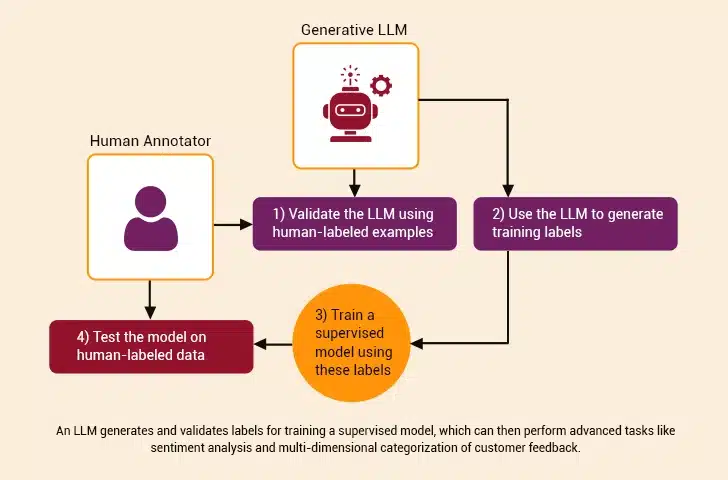
LLMs can classify product reviews based on sentiments, feature mentions, and purchase intent on ecommerce platforms. Given this capability, ecommerce businesses can build more advanced recommendation systems and utilize them to optimize customer experience.
II. Conversational Data Labeling
Extensively annotated chat transcripts, dialogue flows, and customer service interactions are necessary to build high-performing conversational AI models. It is through these datasets that an AI model produces human-like responses. Here, LLMs identify user intent and extract key information from the interactions. They can also classify conversation outcomes and map dialogue states.
This detailed annotation helps with conversational data analysis and is essential to developing chatbots, virtual assistants, and automated customer support systems.
III. Named Entity Recognition
Named entity recognition is an important natural language processing technique that identifies named entities in datasets. In essence, it includes extracting custom entity types, such as people, organizations, locations, dates, monetary values, and more, from data.
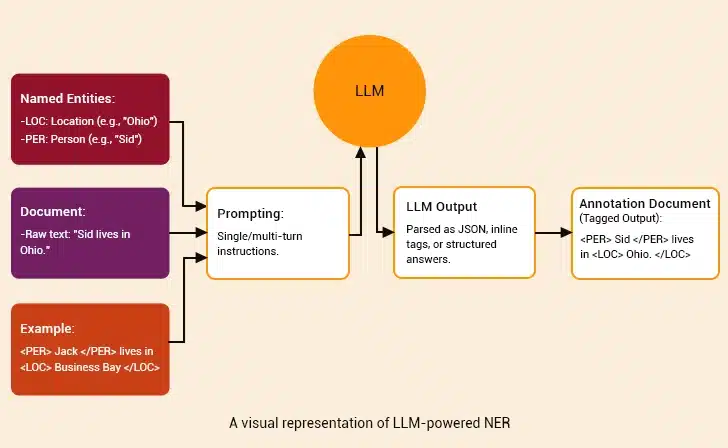
An area where LLM-based NER delivers value is legal document processing. Here, automated annotation tools identify contract parties, dates, financial terms, and regulatory references. Another instance is medical text analysis, where LLM-driven NER is used to extract patient information, identify drugs, and detect diseases.
IV. Multimodal Annotation Support
Multimodal AI is gradually becoming mainstream, and LLMs are the best bet for labeling training datasets for such models. When combined with computer vision models, LLMs can provide detailed image captions and annotate visual content such as images, videos, and graphics with contextual information. They can also create structured metadata for multimedia datasets.
In the context of audio transcription, LLM-based automated annotation tools can identify speakers and add semantic formatting to the transcriptions.
For example, Zalando built a framework where a multimodal LLM generates context-specific annotation guidelines and then judges product relevance using both text and images across search-query or product pairs.
The company evaluated the system on 20,000 examples and reported human-comparable accuracy, with annotations produced up to 1,000 times cheaper and much faster than human-only labeling.
Why Data Labeling Is an Indispensable Factor in Your AI Investment
What Are the Key Benefits of Automated Data Labeling with LLMs?
LLM-based labeling boosts speed and scalability, lowers costs, delivers consistent results, and adapts easily across text, image, and audio data without the need to build separate tools for each.
Here’s how these systems benefit businesses.
1. Speed and Scalability
Automated systems reduce annotation time considerably, and this frees teams for the edge cases that require human judgment. This is part of a broader pattern where teams enhance data annotation efficiency with Gen AI across formats, not just text. Annotation projects that once consumed weeks can now be finished in days. Studies show task completion times dropping from ten minutes to six minutes[5] with AI-augmented annotation. This throughput advantage becomes more significant at scale.
2. Cost Reduction
Manual labeling requires large teams working for hours at a stretch, and that raises budgets fast. LLMs change this by handling the bulk of routine, repetitive labels. Instead of paying humans for every single record, businesses only pay them for the small fraction that the model finds tricky or uncertain. Expensive rework also gets reduced because automated labels are consistent, so fewer errors slip through to later stages.
3. Consistency
Human annotators get tired fast. Their interpretations drift, and guidelines get applied unevenly during a long annotation session. Automated systems do not have this problem.
LLM-based labeling applies identical logic across every annotation decision, producing uniform bounding boxes, categories, and segmentation masks. This uniformity reduces random errors raises dataset quality in ways that manual processes cannot sustain at scale.
4. Flexibility Across Domains
LLMs can handle text, images, and audio without requiring separate annotation frameworks for each. They adjust quickly across languages and modalities and show versatility that rigid annotation tools lack. The adaptation generally happens through prompt engineering rather than full retraining cycles. This degree of flexibility allows companies to deploy annotation capabilities across different business units and use cases without rebuilding the infrastructure each time.
These were some of the benefits businesses realize with LLM annotation. That said, AI data labeling is not without challenges and considerations. The next section provides a closer look at these issues.
What Are the Risks and Limitations of LLM Annotation?
LLMs can hallucinate, inherit training bias, lack transparency, and struggle with highly specialized domains. Data privacy is also a concern, so human oversight remains essential for accuracy.
i. Accuracy and Hallucination Risks
LLMs may generate plausible but factually incorrect annotations at times, particularly in specialized domains or edge cases. These hallucinations can be minute and difficult to detect through automated quality checks.
For instance, the LLM can misclassify technical terminology in legal documents, or it may incorrectly attribute a sentiment in a sarcastic text. It can also make entity recognition errors in domain-specific content that requires specialized knowledge going beyond the model’s training boundaries.
ii. Bias in Pre-Trained Models
Bias is an important concern in data labeling, and LLM annotation systems may unintentionally inherit it from the training data. If this goes unnoticed, the bias can multiply. It can manifest in the form of demographic disparities in classification accuracy, cultural insensitivity in content categorization, or systematic errors in entity recognition for underrepresented groups. In short, bias can widen the already existing societal gap. Addressing this requires the same rigor discussed in broader ethical considerations in AI data annotation, proactive bias audits rather than after-the-fact fixes.
iii. Domain-Specific Knowledge Gaps
Even though LLMs undergo extensive pre-training, they may struggle to label datasets in specialized domains without additional fine-tuning. That is because every industry has different requirements. For instance, a general-purpose LLM often struggles to understand industry-specific jargon, such as medical terminology, legal precedents, scientific nomenclature, etc.
Moreover, industries like financial services, healthcare, and legal applications require domain expertise when labeling datasets. Organizations cannot find such capabilities in off-the-shelf LLMs.
iv. Lack of Explainability
LLM annotation decisions often lack transparency. This makes it difficult to understand why specific labels were assigned. Such opacity becomes challenging for compliance-heavy industries where auditable annotation processes are mandatory.
Companies operating under regulatory frameworks must track and document their annotations to maintain accountability for labeling decisions. This is harder when using black-box LLM systems for data processing.
v. Data Privacy Concerns
The most pressing concern is data privacy and security, as sensitive data is processed through third-party LLM APIs. Healthcare records, financial information, and personal data should be handled carefully to maintain compliance with regulations like HIPAA, GDPR, CCPA, and other data protection frameworks.
None of these risks disqualifies LLM annotation, but none disappears on its own either. Each is managed through deliberate mitigation, and above all through human oversight at the points where errors carry the highest cost. How to build that oversight into an automated pipeline is an implementation question, which brings us to the roadmap.
Top Challenges in Data Labeling and How to Overcome Them
How Do You Implement Automated Data Labeling in the Enterprise?
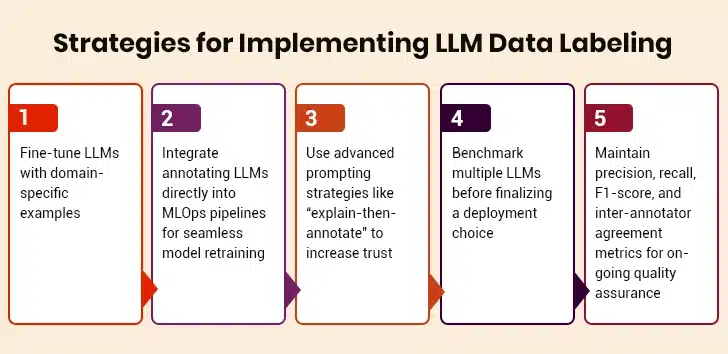
It’s important to start with high-ROI use cases, choose tools that integrate with existing systems, keep humans in the loop for review, and track metrics like throughput, cost, and accuracy.
Let’s explore these steps in detail:
Step 1: Begin with Use Cases That Yield Measurable ROI
Instead of going for a full-fledged AI makeover all at once, stakeholders should identify specific areas where manual annotation creates issues and success is easily measurable. For instance, computer vision applications in manufacturing quality control.
Another use case is NLP in customer service automation, which offers immediate and quantifiable ROI. When businesses can measure the ROI of such initiatives, their confidence increases, and they look forward to broader automation initiatives.
Step 2: Assess for Integration, Not Just Features
While features are enticing, businesses should choose an automated annotation platform that connects well with cloud storage systems, model training environments, experiment tracking platforms, and deployment pipelines.
That’s because feature richness won’t help if the automated annotation platform doesn’t connect with existing tech stack, such as data formats, APIs, security requirements, and regulatory compliance standards.
Step 3: Prioritize Human-in-the-Loop Data Labeling
Complete automation, while tempting from an efficiency perspective, rarely represents the optimal solution for annotation projects. Smart companies adopt a “review and approve” workflow, where language models handle initial labeling while human experts step in to validate and refine the outputs through rigorous quality assurance.
This human-AI collaboration helps balance speed with accuracy. It also frees up subject matter experts to concentrate on activities that require genuine human judgment, such as edge case identification and bias detection. The approach, however, demands change management. Annotation teams need to understand what their new role looks like and gain the skills that they now require.
Step 4: Metrics That Matter for Success Measurement
To ensure that the implementation of automated data labeling is successful, businesses should have metrics that capture both operational efficiency and strategic impact. Their KPIs should include:
- Annotation throughput measured in items processed per hour
- Cost per labeled item including infrastructure and personnel expenses
- Reduction in time-to-market for new models
- Improvement in model accuracy metrics such as F1 scores and precision-recall curves
Additionally, organizations should track strategic metrics, such as the number of new use cases enabled and improvement in model deployment frequency. Together, these four steps turn automated data labeling from a tooling decision into an operating model, one that compounds as the organization moves up the maturity curve.
Improve model performance with scalable, human-verified data labeling services tailored to your industry.
Conclusion
As the annotation market expands at double-digit annual growth rates, the ability to scale without compromising quality is a necessity for businesses. The proven way to label datasets at scale without letting the costs spiral up is to partner with an experienced data annotation outsourcing company like Damco.
Organizations that know how to harness the strengths of LLMs and human annotators in the data annotation process will lead the race! That’s because LLMs do heavy lifting while humans provide the necessary sight and judgment to keep AI systems fair, accurate, and adaptable. When implemented correctly, this hybrid model can unlock faster, more reliable, and more equitable AI across various industries.
References:


