

Key Takeaways
- Outsource data processing to reduce manual workloads and access specialized expertise.
- Common services include data entry, cleansing, ETL/ELT, validation, and AI data annotation.
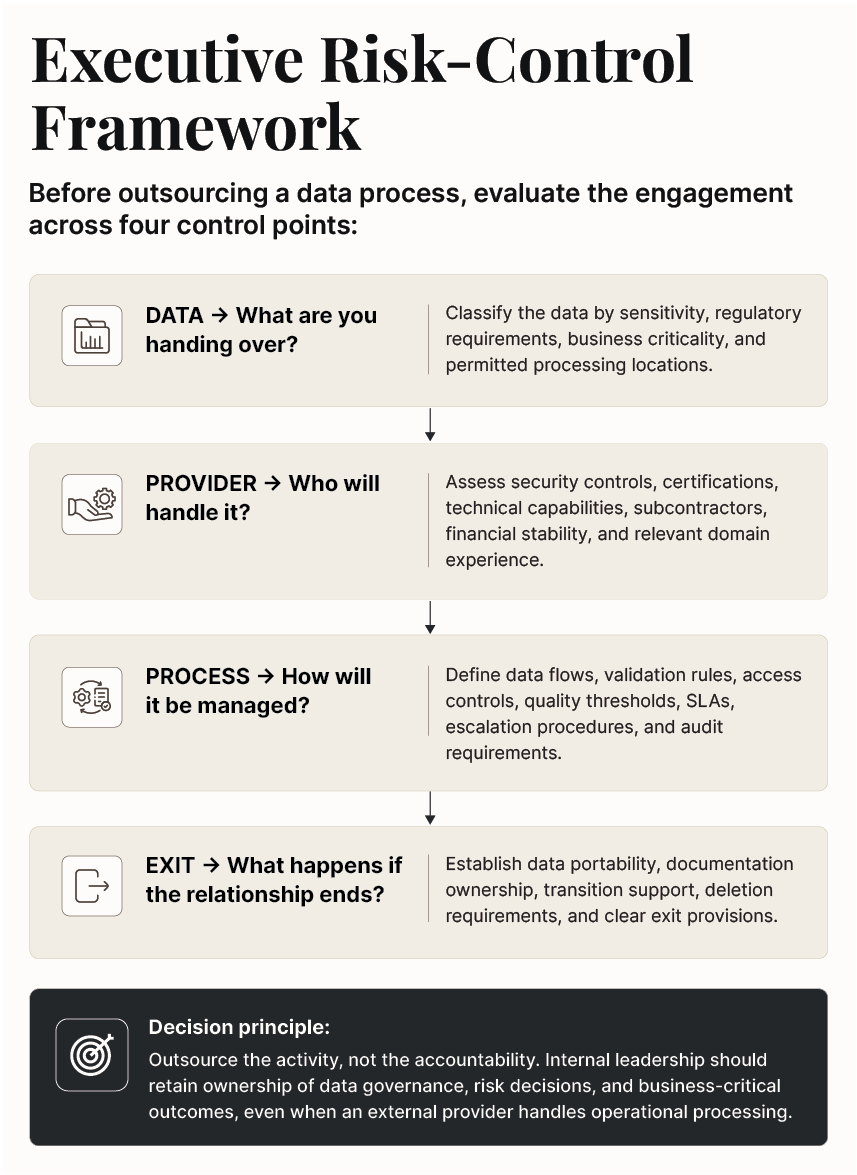
- Manage security, compliance, data quality, and vendor risks through clear controls.
- Choose between in-house, outsourced, or hybrid models based on business needs.
- Evaluate providers on capability, security, quality, scalability, SLAs, and total cost.
- Outsource the activity, not the accountability.
Businesses are generating more data than ever, but collecting it is only the first step. Data must be captured, validated, cleansed, transformed, and made accessible before it becomes useful to the business. As data volumes increase and AI, automation, and analytics become embedded in operations, inefficient or fragmented data processing creates bottlenecks, increases manual effort, and affects the quality of downstream decisions.
For many organizations, this raises a fundamental operating-model question: which data processing activities should remain in-house, and which should an external provider handle?

This guide examines what data processing outsourcing involves, the services businesses typically outsource, the risks that require management, and the factors leadership should consider when determining the right sourcing model.
What Is Data Processing Outsourcing?
Data processing outsourcing is the practice of engaging an external provider to perform defined activities to collect, organize, validate, transform, or manage data on a business’s behalf.
The outsourced scope may include activities such as data entry and document processing, data cleansing and normalization, data validation, ETL/ELT, data preparation, and AI data annotation. The provider performs these activities according to agreed processes, quality standards, security requirements, and service levels.
In practical terms, the organization transfers responsibility for executing specific data processing activities to a third party while retaining ownership of its data, governance requirements, and business outcomes. The scope may range from a discrete back-office process to a broader managed data processing operation.
Make Your Data More Accurate, Accessible, and Actionable
Why Companies Outsource Data Processing
Companies outsource data processing to address specific operational requirements, such as reducing the cost of repetitive work, accessing specialist capabilities, or handling variable workloads without expanding internal capacity. The value extends beyond labor savings to include technology, scalability, productivity, and access to established operational capabilities. Deloitte’s 2026 research1 found that adoption of outcome-based sourcing strategies increased from 45% to 67% in two years, reflecting a broader shift away from measuring outsourcing by activity or headcount alone.
“Effective data leadership is a foundational element of AI success.”
– Ashish Verma, Chief Data and Analytics Officer, Deloitte
1. Cost Savings
Managing data processing in-house involves more than employee salaries. Organizations also incur costs for recruitment, training, technology, infrastructure, quality controls, and process management. These costs can be hard to justify when workloads fluctuate, or data processing isn’t a core business capability.
Outsourcing it reduces the need for these upfront and ongoing investments by giving organizations access to established teams, technology, and processes. Evaluate the business case against total cost of ownership, processing volumes, service levels, quality requirements, and internal resource needs, not labor costs alone.
2. Technology & Expertise
Data processing increasingly involves multiple data sources, complex formats, automation, validation, and data quality controls. Building and maintaining these capabilities internally requires specialized skills and continuous technology investment.
A specialized provider can bring established workflows, trained professionals, automation capabilities, and quality assurance processes to the engagement. This can help organizations address changing processing requirements without developing every capability internally.
The outsourcing market itself is also becoming more technology-led. McKinsey2 reports that 78% of general business organizations use AI in at least one business function (with service operations ranking among the top functional areas), pointing to a shift toward models that combine human expertise with automation and AI-enabled operations.
3. Scalability & Flexibility
Data workloads can change with seasonal demand, business expansion, acquisitions, new products, or new regulatory requirements. An internal team sized for peak demand can leave the organization carrying excess capacity during slower periods.
Outsourcing data processing allows organizations to adjust processing capacity as requirements change. Providers can support higher volumes, additional data formats, or new workflows without requiring a proportional increase in internal headcount or infrastructure.
For leadership, the benefit is aligning processing capacity more closely with actual business demand while maintaining defined turnaround times and service levels.
4. Improved Productivity
Routine data capture, cleansing, validation, reconciliation, and formatting can consume substantial employee time. Outsourcing appropriate activities allows internal teams to focus on work that requires business context, judgment, and domain expertise.
The productivity benefit is therefore not simply about processing data faster. It is about allocating internal resources to higher-value work. Finance teams can focus on analysis and control, operations teams on process improvement, and business leaders on strategic priorities rather than routine data handling.
Consistent and structured data can also reduce time spent locating information, correcting errors, and reconciling inconsistent records. This can improve workflow efficiency and provide teams with more reliable information for analysis and decision-making.
5. Access to Security and Compliance Capabilities
Managing data processing internally requires investment in security controls, data-handling procedures, quality checks, and compliance processes. For organizations without mature capabilities in these areas, building and maintaining them requires additional expertise, technology, and oversight.
A specialized provider brings established security controls, trained personnel, documented processes, and quality frameworks to the engagement. This provides access to capabilities that may otherwise require significant internal investment, particularly in complex or regulated environments.
However, outsourcing does not transfer accountability for security or compliance. Organizations should conduct thorough vendor due diligence and define security, compliance, data-handling, incident response, and audit requirements in the outsourcing agreement.
Real-World Example: Automated Data Processing in Action
A global SaaS-based RegTech company outsourced its data processing operations to manage large volumes of multilingual, unstructured regulatory data across 180 jurisdictions and 60 languages.
The engagement delivered:
- Faster Processing: Automated data ingestion and processing pipelines helped the team handle more than 80,000 pages within seven days.
- Lower Manual Effort: AI, ML, OCR, automated algorithms, and data parsers reduced manual work across data extraction, transformation, and processing.
- Improved Data Accuracy: Automated validation and reconciliation processes strengthened data quality and reliability.
- Greater Compliance Responsiveness: Automated monitoring of regulatory sources helped identify updates and changes more quickly.
- Scalable Processing: A dedicated data processing team and automation supported large and fluctuating workloads without requiring the client to build equivalent internal capacity.
- Cost Savings: The engagement reduced manual labor costs while improving operational efficiency.
Types of Data Processing Services You Can Outsource
Data processing outsourcing covers a broad range of activities, from document capture and data entry to cleansing, transformation, validation, analytics preparation, and AI data annotation. The right service depends on the data and the processing needed to make it accurate, structured, and usable.
Data Processing at a Glance
| Service | What It Involves | Business Value |
|---|---|---|
| Data Entry & Document Processing | Capture, extraction, classification, verification | Reduces manual processing |
| Data Cleansing & Normalization | Deduplication, correction, standardization | Improves data quality |
| Data Transformation & ETL/ELT | Extraction, mapping, transformation, loading | Makes data usable across systems |
| Data Validation | Business-rule and quality checks | Reduces downstream errors |
| Analytics Support | Aggregation, reconciliation, dataset preparation | Frees analysts for higher-value work |
| AI Data Annotation | Classification and labeling of AI datasets | Supports AI model development |
I. Data Entry and Document Processing
Organizations can outsource high-volume data capture from forms, invoices, applications, contracts, claims, and other business documents. Depending on the workflow, this may involve OCR, information extraction, document classification, indexing, and manual verification.
This is particularly useful when processing volumes are high, but the work is standardized. Outsourcing can reduce backlogs and free internal employees to focus on activities that require domain expertise or decision-making.
II. Data Cleansing and Normalization
Data cleansing and normalization involve identifying and correcting inaccurate, incomplete, duplicated, or inconsistent records. Typical activities include standardizing formats, removing duplicate entries, correcting inconsistencies, and enriching records where appropriate.
This becomes especially important during system migrations, acquisitions, CRM or ERP consolidation, and other initiatives that bring data from multiple sources into a common environment. Clean, standardized data also provides a stronger foundation for analytics, automation, and AI applications.
III. Data Transformation and ETL/ELT
Organizations often need to move data between applications, databases, warehouses, and other platforms. Outsourced teams can support ETL and data pipeline management, including data extraction, mapping, transformation, format conversion, and loading.
The objective is to make information consistent and usable across the technology environment. For organizations modernizing their data architecture, external capacity can also supplement internal data engineering teams during migrations, integrations, and periods of increased workload.
IV. Data Validation
Data validation checks whether information meets defined business rules, quality standards, formats, and completeness requirements. Providers can validate customer records, financial information, transactions, documents, and other business-critical datasets before they enter downstream systems.
Validation is more than a final accuracy check. It can form part of an organization’s data quality governance framework, helping identify errors earlier and reduce the operational cost of correcting them later.
V. Data Preparation and Analytics Support
Businesses can outsource repeatable activities involved in preparing data for reporting, business intelligence, dashboards, and analytical workflows. These may include data aggregation, categorization, reconciliation, formatting, and dataset preparation.
Strategic analysis and decisions that require deep business knowledge can remain with internal teams. Outsourcing the underlying preparation work allows analysts and decision-makers to spend more time interpreting results rather than locating, cleaning, and restructuring data.
VI. AI Data Annotation
Organizations increasingly require large volumes of labeled data for model training and evaluation. Outsourced teams support annotating and classifying text, images, audio, and video, along with quality checks and human review.
Effective AI data annotation requires clear labeling standards, quality thresholds, privacy controls, and review processes, especially when the underlying data is sensitive.
The common thread across these outsourced data processing is the need to turn raw, fragmented, or unstructured information into accurate, consistent, usable data. Organizations should therefore evaluate potential providers not only on processing capacity, but also on data quality controls, security, technology capabilities, domain expertise, and their ability to meet defined service levels.
What Are the Risks of Outsourcing Data Processing and How to Mitigate Them
Moving data processing outside the organization adds exposure that requires active management. The key areas are security and privacy, vendor dependency, data quality, integration, and operational control.
1. Data Security and Privacy Risks
When sensitive business or customer data is processed externally, the organization becomes dependent on the provider’s security controls. Risks can arise from excessive access privileges, insecure data transfers, weak authentication, or inadequate subcontractor controls.
How to mitigate?
Before selecting a data processing partner, assess its security architecture, access controls, encryption practices, incident response capabilities, and relevant certifications such as ISO 27001 or SOC 2. Crucially, pair these certifications with verified compliance mechanisms for data sovereignty, permitted processing locations, and applicable privacy regulations, such as EU GDPR, US HIPAA/CCPA, or regional data protection laws, to ensure lawful cross-border handling. Contracts should define requirements for data handling, breach notification, retention, and deletion.
2. Vendor Dependency and Loss of Control
Outsourcing can create operational dependency when workflows, documentation, or data formats become closely tied to a provider. This can make switching vendors costly and disruptive.
How to mitigate?
Organizations can limit this exposure by retaining ownership of data and process documentation, defining data portability requirements, and establishing clear exit provisions. Service-level agreements should also set measurable performance standards and escalation procedures.
3. Integration and Data Silos
“With a focus on data stewardship, rather than data ownership, employees are freed to focus on generating new value from data, rather than struggling to access information trapped in silos.”
– Haynes Cooney, Research Director, IBM Institute for Business Value
Poorly integrated outsourced workflows can fragment data across external and internal systems, resulting in duplicate records, inconsistent information, or delays in making processed data available.
How to mitigate?
Define the data flow and integration architecture upfront. Standardized schemas, secure data transfers, APIs where appropriate, reconciliation procedures, and clear system-of-record ownership can help maintain continuity between the provider and internal systems.
Ultimately, effective data processing requires more than transferring operational tasks to a third party. Organizations need clear ownership, measurable service levels, and appropriate controls over security, compliance, data quality, and business-critical processes.
Is In-House or Outsourcing Right for You?
The right data processing model depends on the work’s strategic value, data sensitivity, workload profile, internal capabilities, and economics. For many organizations, the strongest model is selective sourcing, with strategic capabilities retained internally and specialized, standardized, or variable workloads handled externally.
When In-House Makes Sense
Keep processing capabilities in-house when they involve proprietary business logic, highly sensitive data, or activities that directly support competitive advantage. Internal ownership can also make sense when the organization already has the required talent, infrastructure, and stable workload.
When Outsourcing Makes Sense
Data processing outsourcing often fits best for standardized, high-volume, specialized, or fluctuating workloads. It can provide additional capacity or expertise without requiring permanent investment in people and infrastructure.
Use A Hybrid Operating Model Where It Creates More Value
A hybrid model separates ownership from execution. Internal teams retain data governance, architecture, strategic decision-making, and accountability. At the same time, an external provider handles defined processing activities such as data entry, cleansing, validation, document processing, or AI data annotation.
A simple allocation framework can help:
| Decision Factor | Favor In-House | Favor Outsourcing |
|---|---|---|
| Strategic Value | Core or differentiating capability | Supporting operational activity |
| Business Logic | Proprietary or frequently changing | Standardized and rules-based |
| Workload | Stable and predictable | Variable, seasonal, or high-volume |
| Expertise | Strong capability already exists | Specialist skills are difficult to build |
| Technology | Existing infrastructure is well utilized | New capability requires significant investment |
| Control | Tight, direct control is essential | Controls can be established through governance and SLAs |
| Economics | Internal TCO is competitive | External delivery provides better value or capacity |
The business case should go beyond comparing internal salaries with provider fees. Assess total cost of ownership, data quality, turnaround time, scalability, technology requirements, governance overhead, and SLA performance.
The objective is not to outsource as much as possible. It is to place each activity in the operating model that delivers the best combination of control, capability, scalability, and value.
Why Should Financial Services Companies Outsource Automated Data Processing?
How to Choose the Right Data Processing Outsourcing Partner
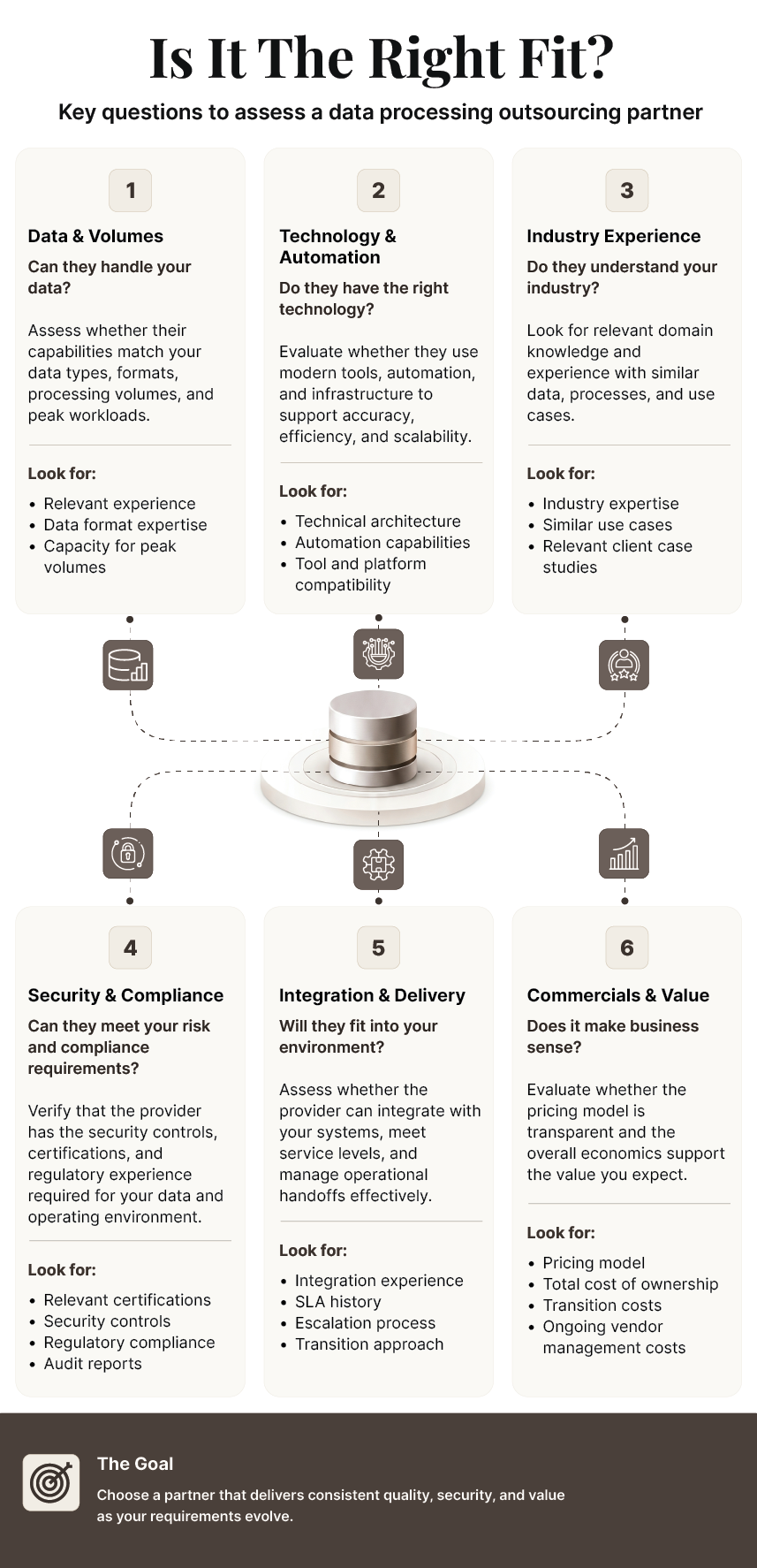
The right data processing provider should align with your business requirements, quality standards, security expectations, and growth plans. Evaluate providers on proven capabilities and measurable performance, rather than price alone.
1. Discover the Right Fit
Assess whether the provider’s data processing capabilities match your data types, processing volumes, technology environment, and industry requirements. Review relevant expertise, AI and automation capabilities, infrastructure, security controls, integration experience, and client case studies.
Evaluate pricing against total cost of ownership, including transition, integration, quality assurance, and ongoing vendor management costs.
2. Assess Delivery and SLA Performance
Define turnaround time as a measurable service commitment. Before signing, establish SLAs for processing time, accuracy, exception handling, escalation, and peak-volume requirements.
Ask how the provider will respond when volumes increase or an operational issue threatens delivery. A capable data processing outsourcing partner should have sufficient capacity, documented processes, and business continuity measures to maintain service levels.
3. Validate The Provider’s Track Record
Assess a provider’s reputation through evidence, not marketing claims. Review client references, relevant case studies, security certifications, quality metrics, years of experience, and its track record with comparable data volumes and complexity.
Also assess the provider’s communication and governance model. Clear reporting, escalation paths, executive oversight, and regular performance reviews are essential for maintaining accountability after implementation.
The objective is to select a provider that delivers consistent quality and measurable business value as requirements evolve, rather than simply the lowest-cost option.
Conclusion
Data processing outsourcing requires leadership to decide where each data-processing capability belongs. Rather than evaluating outsourcing as a blanket cost-reduction initiative, organizations should assess individual processes against strategic value, risk, workload, internal capability, technology requirements, and total cost of ownership.
The next step is to map current data-processing activities, identify which processes are suitable for external delivery, define the required controls and service levels, and build the business case for the preferred operating model. Where external support is appropriate, organizations can explore Damco Solutions’ data processing services as part of that evaluation.
References
Frequently Asked Questions
Data processing outsourcing involves engaging an external provider to handle defined data processing activities. Companies use it to reduce manual workloads, access specialized expertise, manage fluctuating volumes, and improve operational efficiency.
Common outsourced data processing solutions include data entry and document processing, data cleansing and normalization, data validation, ETL/ELT, data preparation for analytics, and AI data annotation.
The risks of outsourcing data processing include data security and privacy exposure, compliance issues, vendor dependency, data quality problems, and integration challenges. Organizations should address these risks through vendor due diligence, defined security controls, quality standards, SLAs, audit requirements, and clear exit provisions.
The in-house vs outsourcing decision should consider total cost of ownership rather than salaries or provider fees alone. Organizations should account for infrastructure, technology, staffing, quality assurance, security, integration, training, and ongoing vendor management costs.
Evaluate a data processing provider based on relevant expertise, technical capabilities, security controls, quality metrics, scalability, SLA performance, integration experience, client references, and commercial terms.
Yes. A hybrid model allows organizations to outsource data processing activities that are standardized, high-volume, specialized, or variable while retaining strategic capabilities, data governance, and critical business processes in-house.


