

Key Takeaways:
- Traditional healthcare analytics only review past data to explain what happened. By contrast, predictive analytics uses artificial intelligence and machine learning to forecast future trends, patient risks, and medical outcomes.
- Predictive analytics in healthcare uses artificial intelligence (AI), machine learning (ML), and historical clinical data to forecast patient outcomes, identify disease risks, optimize hospital operations, and support personalized treatment decisions.
- By analyzing complex clinical data, predictive tools help doctors spot life-threatening diseases before obvious symptoms appear and create highly customized treatment plans.
- Healthcare providers use predictive modeling to forecast patient admission rates as well as staffing needs. This reduces wait times and eliminates operational waste.
- On a larger scale, predictive analytics shifts the focus from treating sickness to preventing it by mapping broad community health trends and detecting potential disease outbreaks early.
- The technology accelerates drug discovery and clinical trials by using advanced modeling techniques to spot suitable drug candidates and human participants.
- Though predictive analytics lowers administrative costs and hospital readmission rates, organizations need to overcome significant challenges to succeed, including data silos, algorithmic biases, and high implementation costs.
- This guide explores how predictive analytics works, its key benefits and use cases, implementation best practices, common challenges, emerging technology trends, and the steps healthcare organizations can take to build scalable, data-driven care delivery.
Modern healthcare systems are buried under the weight of increasing costs and systemic inefficiencies. A rapidly aging population only adds to their burden. The rise of chronic diseases further compounds these problems.
Predictive analytics changes this by turning data into foresight. It helps identify risks earlier, personalize treatments, and use resources effectively. This intelligence is critical for healthcare providers who aim to enhance patient care while strengthening financial performance. Organizations often build these capabilities on a strong foundation of data analytics services that transform healthcare data into actionable business and clinical insights.
This blog explains the essential applications of predictive analytics in the healthcare domain. It also talks about the issues commonly faced during its implementation and their possible solutions. Let’s get started.
What Is Predictive Analytics in Healthcare?
“Information is the oil of the 21st century, and analytics is the combustion engine.”
– Peter Sondergaard, Founder, The Sondergaard Group
Predictive analytics is a discipline where healthcare data is analyzed to forecast events, spot trends, and predict patient outcomes. Traditional data analytics only processes past data. But predictive analytics looks ahead to answer a key question: what comes next?
This field combines statistics, data mining, artificial intelligence, and machine learning techniques. Healthcare organizations use these advanced tools to process massive amounts of data. The analysis produces insights that inform key decisions.
The benefits of predictive modeling in healthcare are many. Organizations using it see better patient outcomes, more accurate diagnoses, and improved efficiency. All this helps them meet performance goals.
Predictive analytics helps healthcare organizations understand what might happen next. It can predict how well patients will respond to treatments. These findings help build personalized care plans. It’s no surprise that the market for healthcare predictive analytics is estimated to reach USD 67,255 million 1 by 2030.
Despite its potential, challenges remain. Data quality issues can limit predictive models. Concerns about the ethical use of patient data create impediments for many organizations.
Yet, healthcare continues to embrace predictive analytics. As patient data grows exponentially, this technology helps make sense of it.
Global Enterprise Modernized Financial Reporting with Advanced Analytics
How Predictive Analytics Works in the Healthcare Domain
Predictive analytics identifies patterns in clinical data to forecast future health outcomes, disease progression, and treatment responses. This process involves four stages: data collection, preparation, modeling, and interpretation of results.
I. Data Collection and Integration
Healthcare organizations gather data from various sources to build predictive models. Electronic health records provide structured data such as demographics, lab test results, and vital signs. Unstructured information comes from clinical notes, radiology images, and pathology reports.
Integrating this data can be challenging. Patient information often remains stuck across disconnected systems and creates silos that prevent proper health assessments. Hospitals use custom software connections to combine these disparate sources into unified datasets.
II. Model Development and Training
Teams build predictive models after they have prepared the data. They split the data into training, validation, and test sets. The training set teaches the model basic patterns. The validation set fine-tunes. The test set checks if the model works on new data.
Healthcare organizations use different modeling techniques. Logistic regression predicts binary outcomes, like whether a patient will be readmitted. Cox models predict the time until an event, such as death or disease progression. Machine learning methods like random forests handle complex relationships. The choice of the technique depends on the clinical task, data type, and interpretability requirements.
III. Risk Scoring and Prediction
The model produces a risk score for each patient by assigning point values to factors like age, lab values, and medical history. These scores measure the probability of adverse outcomes, such as mortality, readmission, or disease progression. For example, a patient might get a score of 8 out of 10 for heart failure within six months.
These models must be validated in two ways. Internal validation checks the model on the same dataset on which it was developed. External validation tests it on a different hospital’s data or a different patient group.
IV. Clinical Use and Continuous Improvement
The final stage embeds predictive models into healthcare staff’s workflows. This way, risk scores appear inside the electronic health record during patient visits. Alert systems notify clinicians when patients show high-risk factors.
Because these models are not perfect, they keep learning from new data and adapt their algorithms to improve accuracy over time. The process incorporates clinician feedback and updates made to clinical guidelines. This prevents predictive models from decaying over time as healthcare environments change.
V. Model Deployment, Monitoring, and Governance
Once validated, predictive models are deployed into clinical systems such as electronic health records (EHRs) and decision support platforms, allowing clinicians to access real-time insights within their workflows. Healthcare organizations continuously monitor model accuracy because changes in patient populations or clinical practices can reduce prediction quality over time.
Regular retraining with updated data helps maintain performance. Strong governance through model validation, audit trails, regulatory compliance, and human oversight ensures predictive analytics remains reliable, transparent, and aligned with clinical and organizational requirements.
What Are the Key Healthcare Data Sources Used in Predictive Analytics?
The accuracy of predictive analytics depends on the quality and diversity of the data used to train predictive models. Healthcare organizations combine information from multiple clinical and operational systems to generate comprehensive insights that support informed decision-making.
- Electronic Health Records (EHRs): EHRs provide structured patient information, including demographics, diagnoses, medications, allergies, vital signs, laboratory results, and treatment history. They form the foundation of most predictive models.
- Medical Imaging and Clinical Notes: Radiology images, pathology reports, physician notes, and discharge summaries contain valuable unstructured data. Natural language processing (NLP) and computer vision technologies help extract meaningful insights from these sources.
- Claims and Administrative Data: Insurance claims, billing records, and hospital administration data help predict readmissions, healthcare utilization, treatment costs, and revenue cycle performance.
- Wearables and Remote Monitoring Devices: Smartwatches, fitness trackers, continuous glucose monitors, and other connected devices generate real-time patient data that supports early risk detection and chronic disease management.
- Population Health and Genomic Data: Public health records, social determinants of health, and genomic information enable healthcare organizations to identify disease patterns, assess population-level risks, and advance precision medicine initiatives.
While data forms the foundation of predictive analytics, understanding what tech stacks power it is equally important. Let’s explore this in the next section.
What Technology Stack Powers Predictive Analytics in Healthcare?
Healthcare organizations rely on a combination of data platforms, AI technologies, and cloud infrastructure to build, deploy, and scale predictive analytics solutions. A well-integrated technology stack ensures predictive models generate accurate insights while meeting stringent security and compliance requirements.
- Data Management Platforms: Data warehouses, data lakes, and integration platforms consolidate information from electronic health records (EHRs), claims systems, imaging platforms, and connected medical devices into a unified environment for analysis.
- Artificial Intelligence and Machine Learning Frameworks: Machine learning frameworks and statistical modeling tools help data scientists develop, train, and validate predictive models for disease risk prediction, patient stratification, and operational forecasting.
- Cloud and Data Engineering Infrastructure: Cloud platforms provide the scalability and computing power required to process large healthcare datasets. Modern data engineering pipelines automate data ingestion, transformation, and preparation to ensure predictive models receive reliable, high-quality data.
- Business Intelligence and Governance Tools: Dashboards and visualization platforms enable clinicians and administrators to interpret predictive insights, while governance, security, and monitoring tools help maintain data quality, regulatory compliance, and model performance throughout the analytics lifecycle.
Technology and data provide the foundation for predictive analytics, but their true value depends on how organizations use them to answer different business and clinical questions. The next section explains how predictive analytics compares with other healthcare analytics approaches and where each delivers the greatest value.
How Predictive Healthcare Analytics Differs from Other Analytics
Traditional healthcare analytics focuses on describing what has already happened. This method uncovers patterns in historical data, but it does not explain why those patterns occurred.
Predictive analytics takes a different path. Rather than looking backward, it uses historical data and statistical models to forecast future outcomes. The difference lies in orientation. Descriptive analytics answers “what happened?” while predictive analytics addresses “what is likely to happen next?”.
For instance, a traditional dashboard tells you last month’s infection rate by unit. A predictive model warns you that a specific patient has an 85% chance of developing a blood infection next week.
These approaches use different tools. Traditional analytics relies on simple statistics, averages, and historical summaries. Predictive analytics uses machine learning, artificial intelligence, and forecasting models that learn from past data to estimate future risks. Computing work is heavier for predictive analytics because it deals with probabilities and not just facts.
And their users are different, too.
- Hospital analysts and managers use traditional analytics for performance reviews.
- Clinicians and operational leads use predictive outputs for action. They might get an alert that a patient is likely to be readmitted, which helps them intervene early.
Ultimately, these two approaches work together. Descriptive analytics provides the foundation by identifying that problems exist in the first place. Predictive analytics helps determine where to act. A successful healthcare provider needs both historical reviews to evaluate its current health and forward-looking forecasts to prepare for tomorrow’s patients.
A Side-by-Side Comparison of Predictive vs. Other Healthcare Analytics
| Analytics Type | Primary Question Answered | Focus | Typical Healthcare Example | Business Value |
|---|---|---|---|---|
| Descriptive Analytics | What happened? | Summarizes historical data and trends | Reporting monthly patient admissions, hospital occupancy, or infection rates | Provides visibility into past performance and operational metrics. |
| Diagnostic Analytics | Why did it happen? | Identifies root causes by analyzing relationships and patterns | Investigating why emergency department wait times increased or why readmission rates rose | Helps healthcare organizations understand performance gaps and improve clinical and operational processes. |
| Predictive Analytics | What is likely to happen? | Uses statistical models, AI, and machine learning to forecast future outcomes | Predicting disease progression, patient readmission risk, sepsis, or appointment no-shows | Enables proactive clinical interventions, optimized resource planning, and personalized patient care. |
| Prescriptive Analytics | What should we do next? | Recommends optimal actions based on predictive insights | Suggesting personalized treatment plans, optimizing staff scheduling, or recommending interventions for high-risk patients | Supports data-driven decision-making by identifying the best course of action to improve patient and operational outcomes. |
Together, these four types of healthcare analytics form a connected decision-making framework. Descriptive and diagnostic analytics explain past performance, predictive analytics anticipates future outcomes, and prescriptive analytics recommends the most effective actions. Organizations that combine these capabilities can make faster, more informed clinical and operational decisions while continuously improving patient care.
What Are the Key Use Cases and Benefits of Predictive Analytics in the Healthcare Industry?
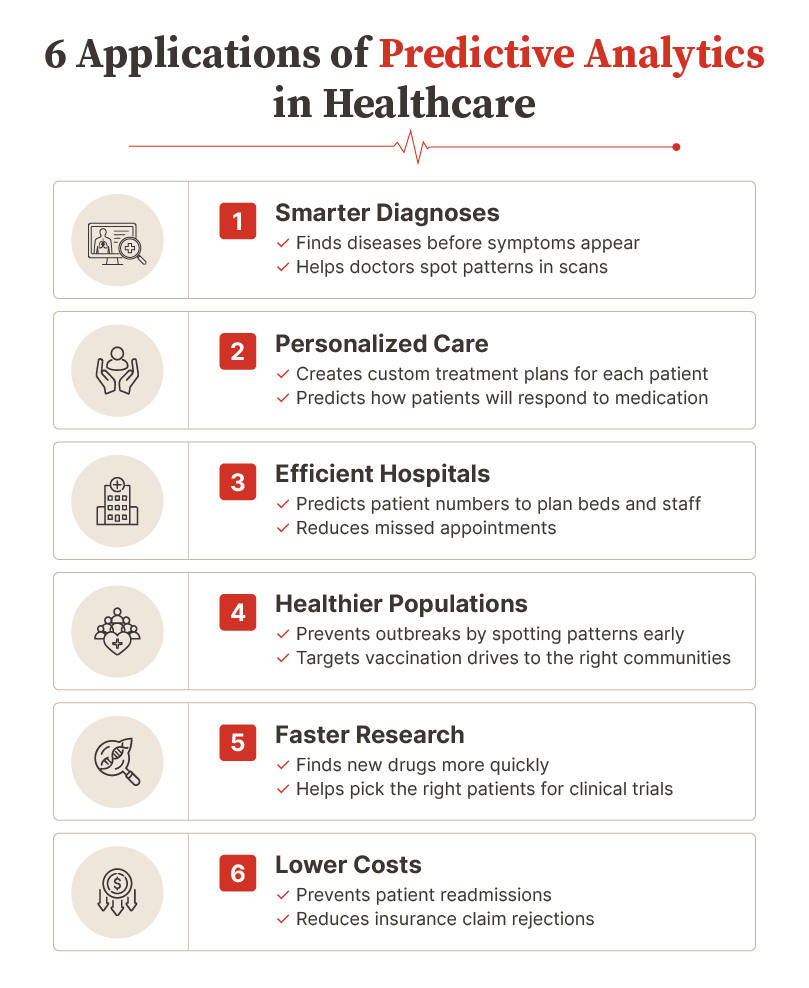
Healthcare providers are using predictive analytics in many key areas. These use cases provide benefits to patients, medical staff, and health systems. Organizations now use data visualization tools that improve the quality of care at every step of a patient’s journey.
1. Improvement in Diagnostic Accuracy
Accurate early diagnosis is a perennial challenge in the healthcare industry. Predictive analytics fixes this. It gives clinicians evidence-backed insights to support their judgment.
Medical predictive analytics gives healthcare providers tools to spot diseases much before symptoms appear. Machine learning systems analyze patient profiles. This helps them find individuals at risk of illness even when no obvious signs are present.
AI algorithms improve medical imaging. These systems spot abnormalities in scans. They also highlight areas that doctors should review. This offers doctors computational support that enhances their expertise and makes diagnoses more accurate.
2. Personalized Treatment Plans
Predictive analytics is helping healthcare move toward personalized medicine. Doctors can now customize care to each patient’s health profile, rather than using the same treatment for everyone.
AI analyzes electronic health records to predict how patients will react to treatments. It also helps determine the right drug dosages and anticipate patient outcomes. This enables the creation of highly effective treatment plans for each person.
Chronic diseases account for most of healthcare spending in the USA. Management of these illnesses depends on how well healthcare teams can prevent these conditions and control them in sick patients. Predictive analytics helps by finding patients who would benefit most from intervention.
AI spots cardiovascular patients at the highest risk of hospitalization. These patients are then given personalized support to avoid costly hospitalization and improve their quality of life.
AI tools are also helping people manage diabetes more effectively. These technologies provide daily monitoring and tailored guidance. This allows patients to take control of their health while receiving more responsive care.
3. Streamlined Hospital Operations
Allocating resources becomes easy with predictive analytics. An important use case is capacity planning. Models forecast patient admission rates. This allows management to plan bed availability and staff assignments with greater accuracy. The result? Reduced wait times and less crowded facilities.
Missed appointments are a major financial burden in healthcare. They cost the industry billions every year. Predictive tools address this by identifying patients with a high probability of missing a scheduled visit. Clinics can then take steps to improve attendance rates.
Predictive analytics can also be used for workforce management. It analyzes past data, patient flow, and seasonal trends to project staffing needs. This helps providers maintain correct staffing levels and control labor expenses.
4. Enhanced Population Health Management
Predictive analytics has redefined population health management. It makes healthcare systems more proactive. Providers analyze broad health trends and address community issues before they grow bigger.
These tools identify behavioral patterns and project their health outcomes. This allows public health officials to create targeted programs for communities that are at risk. The approach changes focus from treating illness to preventing it.
Predictive analytics helps with the early detection of epidemics. Analytics company BlueDot detected an unusual spike in pneumonia cases in Wuhan in December 2019. This alert came much before the formal announcement of the outbreak by the WHO. Such warnings give health authorities ample time to mount a coordinated response.
Predictive analytics also improves vaccination campaigns. Tools process data on demographics and risk factors to identify which groups need urgent immunization. This leads to more efficient and effective public health programs.
The technology also supports long-term healthcare planning. The University of Pennsylvania Health System studies demographic shifts to forecast service needs. This allows them to plan facilities and staff requirements beforehand and meet the changing needs of their community.
5. Better Research and Drug Development
Medical research and drug development processes have historically been slow, expensive, and inefficient. Predictive analytics changes this through its modeling techniques.
Discovery of new drugs is a challenging process. Predictive analytics provides researchers with tools to identify the most promising drug candidates. Pharmaceutical companies use these tools to accelerate development timelines and bring new treatments to patients quickly.
Use of predictive analytics benefits clinical trials. AI tools predict which patients will respond best to experimental treatments. This helps spot suitable participants for trials and results in more reliable trial results and shorter timelines. The result? Medications reach patients much faster.
Predictive analytics for healthcare uncovers new biomarkers and explains how genetics and lifestyle affect drug effectiveness. It does this by examining large collections of genetic data, treatment results, and patient responses to drugs.
To give an example, research teams in the USA have built a machine learning model that predicts outcomes for multiple myeloma patients. The tool analyzes tumor genomics and the prescribed treatment plans to help researchers understand how the disease progresses and how patients respond to therapy.
6. Reduced Waste and Avoidable Costs
Predictive analytics helps healthcare organizations improve their financial performance. This is particularly valuable as more providers shift to value-based care models that reward quality outcomes over service volume.
Hospital readmissions create high costs for healthcare systems. Predictive analytics helps by identifying patients with the highest risk of readmission. Care teams provide support to these individuals, reducing avoidable returns to the hospital.
To give an example, Corewell Health used predictive analytics to spot patients with a high probability of readmission. Their team studied patients who struggled after discharge and developed personalized recovery plans. The initiative prevented 200 readmissions and saved $5 million in 2 costs.
Predictive analytics improves insurance claims processing by identifying claims with a high probability of denial. It studies past data and rejection patterns to spot errors in billing codes and suggests corrections before submission. This significantly reduces claim rejection rates and speeds up revenue cycles.
7. Fraud Detection and Revenue Cycle Optimization
Healthcare organizations process millions of claims and financial transactions every year, making fraud detection and revenue management increasingly complex. Predictive analytics helps providers identify unusual billing patterns, duplicate claims, coding errors, and potentially fraudulent activities before they result in financial losses.
By analyzing historical claims data and payment trends, predictive models can flag high-risk transactions for further investigation and recommend corrective actions. These insights also improve claims accuracy, reduce denial rates, and accelerate reimbursement cycles.
As healthcare organizations continue to adopt value-based care models, predictive analytics enables stronger financial governance while ensuring compliance with payer requirements and healthcare regulations.
8. Remote Patient Monitoring and Preventive Care
Remote patient monitoring has become an important part of modern healthcare, especially for managing chronic diseases and supporting aging populations. Predictive analytics enhances these programs by analyzing continuous data from wearable devices, connected medical equipment, and mobile health applications.
These models identify subtle changes in vital signs and patient behavior that may indicate deteriorating health before serious complications arise. Clinicians receive timely alerts, enabling earlier interventions and reducing avoidable emergency visits or hospital admissions.
Beyond improving patient outcomes, predictive analytics helps healthcare providers deliver proactive, continuous care while reducing the burden on hospitals and improving long-term disease management.
9. Smarter Supply Chain and Inventory Management
Maintaining the right inventory levels is essential for ensuring uninterrupted patient care while controlling operational costs. Predictive analytics helps healthcare organizations forecast demand for medicines, medical devices, surgical supplies, and other critical resources by analyzing historical consumption patterns, patient volumes, and seasonal trends.
These insights enable hospitals to optimize procurement decisions, minimize stock shortages, and reduce excess inventory that contributes to waste. During periods of fluctuating demand, predictive models also support better resource allocation across departments and facilities.
As a result, healthcare providers improve operational resilience, strengthen supply chain efficiency, and ensure critical medical supplies remain available when patients need them most.
These applications show how predictive analytics can deliver measurable value across healthcare. It supports better clinical decisions, simplifies operations, and accelerates medical research. These applications are changing how healthcare systems provide services and manage their resources.
How Power BI Applications Forge the Future of the Healthcare Industry
What Are the Challenges and Ethical Considerations in Implementing Predictive Analytics in the Healthcare Sector?
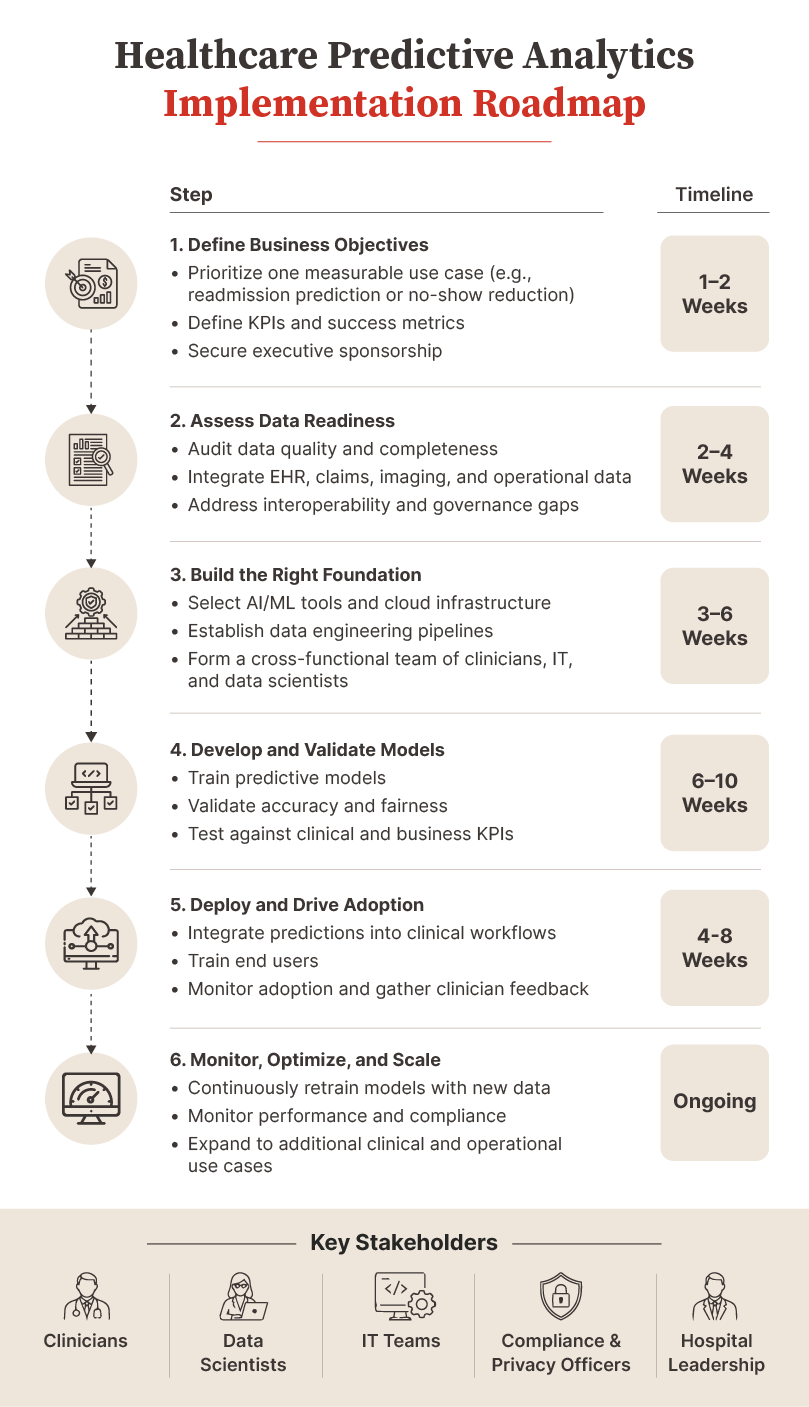
Organizations face several challenges when they implement predictive modeling in healthcare. They must address these challenges effectively to realize the full benefits of these tools.
I. Data Quality and Interoperability
High-quality data forms the foundation of predictive analytics. But many healthcare organizations struggle with issues related to data. Patient data is often stored across multiple disconnected systems. These systems create data silos that prevent a complete view of patient health. This limits the accuracy of predictive models.
Poor interoperability also delays real-time data exchange across clinical systems, limiting an organization’s ability to generate timely and actionable predictive insights.
The factors that affect the quality of healthcare data include:
- Missing information
- Data mismatch between different sources
- Non-standard or incorrect entries
- Fragmentation of data across systems
Healthcare data brings additional complications. About 80% 3 of electronic healthcare data exists in unstructured formats. Clinical notes and imaging reports contain valuable insights but need processing to extract meaningful information.
As a solution, healthcare providers can create data management plans to make their data usable. They can also combine different data sources using custom APIs.
II. Model Bias and Fairness
AI algorithms can make existing disparities worse if their training data does not represent diverse patient populations properly. This is a serious concern in healthcare.
These biases show up in many ways, including racial, sex, and socioeconomic biases. Research shows that diagnostic models may systematically disadvantage certain groups. For example, Black patients may need to show worse kidney function than White patients to access the same treatments. These biases reduce trust in medical systems.
Organizations must also prioritize explainable AI so clinicians understand how predictions are generated and can confidently incorporate them into patient care decisions.
The root cause of bias may lie in the training data itself. Historical healthcare data often reflects existing inequalities in care delivery and access. Predictive models may learn from this biased information and make these disparities worse.
Healthcare organizations should implement measures to remove bias. They must select diverse and representative training data. They should use fairness-aware algorithms that detect and correct biased patterns. Regular reviews and human oversight also help deal with the problem.
III. High Implementation Costs and Change Management
High costs impede the adoption of predictive analytics. Many academic medical centers report that their predictive modeling initiatives receive no dedicated funding. Other projects stall due to insufficient resources.
Implementation costs extend far beyond initial development. These include expenses for specialized staff, system integration, and model expansion. Data infrastructure requirements also create financial challenges. Organizations need large investments to ensure their data flows consistently across platforms.
Long-term success also depends on establishing governance frameworks that continuously monitor model performance, security, regulatory compliance, and changing clinical requirements.
Workforce challenges make these financial pressures worse. Healthcare workers already juggle patient care with administrative duties. New predictive systems can create additional strain, especially when they involve collecting more data during patient interactions.
Staff turnover creates another challenge. Organizations struggle when team members with specialized machine learning expertise depart. These knowledge gaps can stall projects and create operational risks.
Organizations must create strategies for knowledge preservation and succession planning to fix these issues. They should get their staff involved in the development process and use their feedback to overcome resistance and ensure predictive tools fulfil actual needs.
That said, here are five principles that help healthcare organizations maximize ROI, improve adoption, and ensure sustainable outcomes.
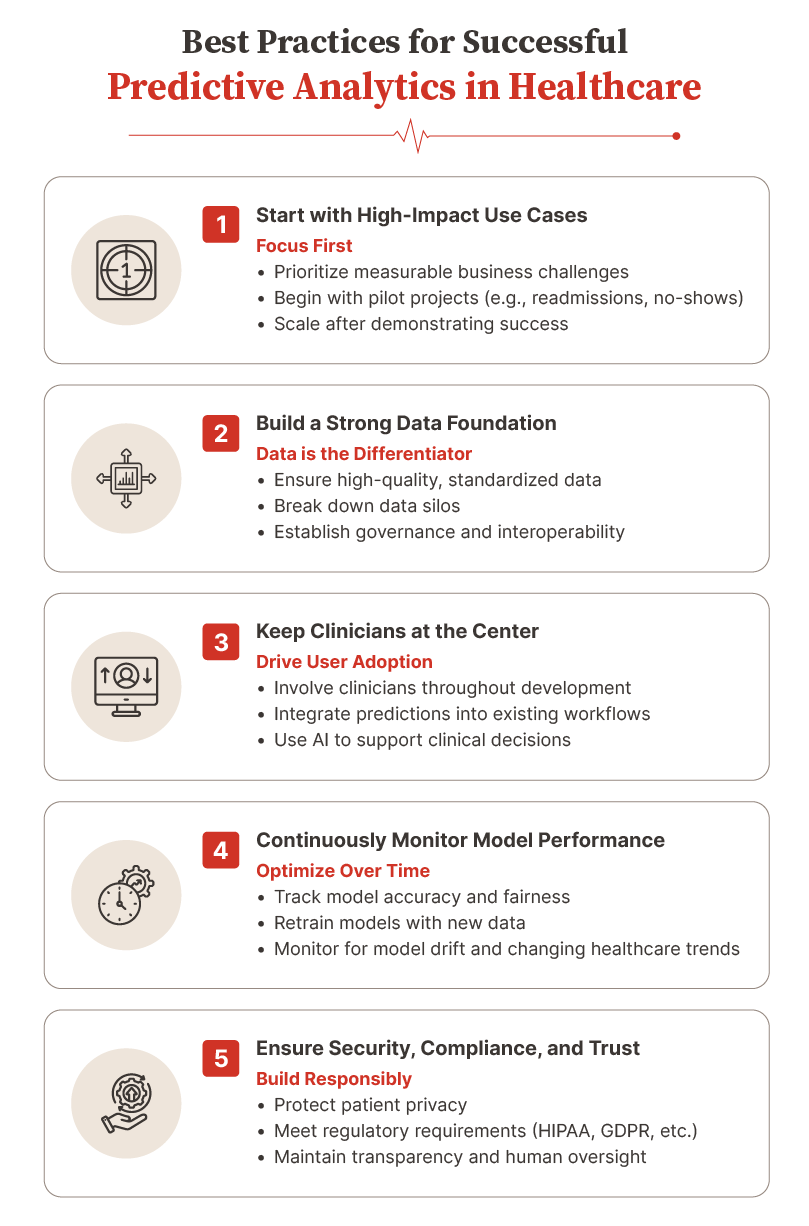
Successful predictive analytics is not just about building accurate models, it requires trusted data, clinical collaboration, continuous optimization, and responsible AI governance.
What Does the Future of Healthcare Predictive Analytics Look Like in 2026
New technologies are allowing predictive healthcare solutions to deliver more precise and useful insights. Three major innovations stand out.
1. Generative AI and Predictive Healthcare
Generative AI can create synthetic patient data that mimics real human data. Because it contains no private records, teams can share it freely without breaking privacy laws. This capability proves valuable in rare disease research where actual patient data remains scarce. With synthetic data, researchers can run simulated clinical trials and test how a disease might progress.
Generative AI also speeds up drug development. It helps find promising drug compounds and design better clinical trials. For example, AI tools can suggest how many patients are needed and identify suitable candidates. This reduces inconsistencies and saves time.
2. Real-Time Predictive Monitoring
Wearable devices like smartwatches and medical patches have become powerful diagnostic tools. When equipped with predictive AI, they scan a patient’s vital signs every few seconds to timely catch respiratory failure, sepsis, or hemorrhage.
For example, an AI trained on ECG and oxygen level data can spot early signs of heart failure. For a diabetic patient, the system can forecast blood sugar spikes based on what they ate, how much they moved, and how much insulin they took. In clinical trials, these tools cut hospital readmissions by up to 25% 4.
3. Predictive Population Health Ecosystems
Right now, medical data is trapped in separate silos. The local hospital and public health agencies cannot easily see each other’s files. The future relies on connecting these networks securely.
Hospitals have adopted new data standards (like FHIR) that let different computer systems talk to each other instantly. At the same time, advanced reading software scans messy, handwritten doctor notes to find early signs of a health crisis.
These networks use federated learning to protect privacy. Instead of sending private patient records to one central server, the AI model travels to and learns from local hospital data to improve its predictive capabilities. The model sends its learnings in encrypted form back to the server. The patient files never leave the hospital walls.
This allows healthcare providers worldwide to collaborate and build highly accurate prediction tools while keeping every patient’s identity completely safe.
4. Multimodal AI for Clinical Decision Support
Healthcare organizations are increasingly combining structured records, medical images, laboratory results, genomic data, and physician notes within a single AI model.
This multimodal approach provides a more comprehensive understanding of patient health, enabling earlier disease detection, improved diagnostic accuracy, and more personalized treatment recommendations.
As healthcare data becomes increasingly interconnected, multimodal AI will play a central role in supporting faster and more informed clinical decisions.
5. Agentic AI and Intelligent Care Coordination
The next generation of predictive analytics will move beyond forecasting to proactively supporting healthcare teams. Agentic AI systems can monitor patient data continuously, prioritize high-risk cases, recommend next-best actions, and automate routine administrative workflows while keeping clinicians in control.
By reducing manual effort and improving care coordination across departments, these intelligent assistants will help healthcare organizations deliver more responsive, efficient, and patient-centric care.
Conclusion
There’s no doubt that predictive analytics is transforming healthcare delivery. Healthcare organizations that utilize these systems properly gain many advantages. Personalized patient care. Better-informed clinical decisions. Improved use of resources. Predictive analytics keeps getting popular, as it delivers measurable value.
The future of healthcare needs a lot more than data collection. It needs the ability to pull out insights that lead to smarter decisions. Organizations that solve implementation challenges and zero in on high-value use cases will reap the greatest benefits from predictive analytics in the coming years.
References:
- 1. https://www.grandviewresearch.com/industry-analysis/healthcare-predictive-analytics-market
- 2. https://newsroom.corewellhealth.org/2023-02-02-Corewell-Health-Study-Determines-Keys-to-Reducing-Hospital-Readmissions
- 3. https://h1.co/blog/the-challenges-of-unstructured-healthcare-data/
- 4. https://www.delveinsight.com/blog/artificial-intelligence-in-remote-patient-monitoring
Frequently Asked Questions
Predictive analytics helps doctors diagnose and treat diseases faster. It also helps healthcare providers speed up their workflows. They can reduce their readmission rates to a considerable degree. They can also save money by improving resource allocation and streamlining hospital operations. Predictive analytics improves diagnostic accuracy, which helps clinicians make better decisions and boost therapy success rates.
Allina Health used machine learning to find patient safety issues. Their system caught problems that traditional reporting usually misses. Likewise, UnityPoint Health cut readmissions by 40% within 18 months using predictive tools.
Also, a company called BlueDot spotted an unusual cluster of pneumonia cases in Wuhan, China, in December 2019. That was nine days before the World Health Organization made its official statement. These examples prove the technology delivers good outcomes when properly implemented.
Organizations adhere to several security practices to safeguard patient data. They encrypt data at rest and when transmitted between systems. Their role-based access controls allow only approved people to view and edit the data. Every access is logged to maintain audit trails. They also sign legal agreements with any vendor that touches patient data.
Businesses often remove patients’ names, addresses, and other identifying information when building predictive models. They also perform regular risk assessments.
Data analytics is used in healthcare to analyze clinical and operational data, improve patient care, optimize resource utilization, and support informed decision-making. It helps healthcare organizations identify trends, enhance care delivery, streamline operations, strengthen population health management, and improve overall organizational performance.


