

Key Takeaways:
- Policy administration processes every major policy event as a dated transaction against a single system of record.
- Each transaction changes the policy state and triggers downstream updates.
- Effective dating keeps policy history accurate and traceable.
- Endorsements require re-rating, pro-ration, document updates, and billing adjustments.
- Out-of-sequence transactions test the PAS’s ability to reconstruct and replay policy history.
- Reliable transaction records keep billing, claims, commissions, documents, and audits aligned.
Most explanations of insurance policy administration stop at the stage names: issuance, endorsement, renewal, cancellation, and reinstatement. They tell you where a policy goes, but not what happens inside the system when it gets there. This article goes one level lower, inside the system, to examine the transactions behind those stages. It focuses on the mechanics of administration rather than strategy or system selection: what triggers each transaction, what the system recalculates, which records and documents change, and what gets posted downstream.
To understand how insurance policy administration works, you need to look at the transactions behind those stage names. A policy change is not an updated field on a screen. It recalculates premium, regenerates documents, adjusts billing and commissions, posts consequences to downstream systems, and writes a new entry in the audit trail. By following these transactions, you can trace a policy through the machine yourself: what changed, why it changed, what the system recalculated, and where the consequences landed.
So, rather than treating policy administration as a buying decision, a technology strategy, or a list of system features, the sections that follow trace a policy through the machine. What triggers each transaction? What does the system recalculate? Which records and documents change? What posts to billing, claims, commissions, or reporting? And what happens when the transaction is processed incorrectly?
The result is a transaction-level view of the insurance policy lifecycle, from the moment a bound quote becomes an in-force policy through the endorsements, renewals, cancellations, and reinstatements that follow.
By the end, you should be able to follow any policy transaction through the system yourself: name what triggered it, anticipate what the system recalculates, and know where the consequences land. The lifecycle stops being a sequence of labels and becomes something you can reason about.

What Policy Administration in Insurance Means, and Where to Read What
Policy administration in insurance is the processing of every event in a policy’s life, including issuance, mid-term changes, renewals, cancellations, and reinstatements, as dated transactions against a single system of record. Each transaction keeps the premium, policy documents, billing, and audit trail together, so the record stays consistent as the policy changes.
The terms policy administration and policy management substantially overlap and are often used interchangeably. What differs is scope: this article covers how individual policy transactions are processed and recorded, not how organizations evaluate, select, or modernize, or evaluate a policy administration system.
Those are three different questions, and they have three different answers. Here is where each one lives:
| If You Want to Understand | Read |
|---|---|
| Modernization strategy, AI direction, and the future of policy administration | |
| How to choose and evaluate a policy administration system | |
| How policy transactions actually work inside the system | This Article |
Each of those resources assumes a different starting point. The two guides above are written for readers making decisions about a policy administration system: whether to replace one, where AI fits in the roadmap, which platform suits the book of business.
This article assumes you already have a system, or are about to work inside one, and need to know what it does when a policy moves. That is the operations analyst reconciling a billing discrepancy, the new underwriting hire trying to understand why a backdated endorsement caused a re-rate, and the implementation associate mapping a carrier’s workflows for the first time.
The next section maps the lifecycle those transactions run through.
What Happens at Each Stage of the Insurance Policy Lifecycle?
The insurance policy lifecycle is best understood as a sequence of dated transactions rather than a simple circular process. Each transaction changes the policy’s state and posts consequences to premium, documents, billing, commissions, claims, and reporting.
| Lifecycle Stage | Trigger | What Recalculates or Changes | What Posts Downstream |
|---|---|---|---|
| Issuance | Bound quote | Final premium, policy terms, effective dates | Policy documents, billing schedule, commissions, reporting |
| Endorsement | Mid-term change request | Premium, affected coverages and policy terms | Revised documents, billing adjustments, commissions adjustment |
| Renewal | Approaching term expiry | Rates, eligibility, underwriting information, new-term details | Renewal/non-renewal documents, new billing schedule or billing stop, reporting |
| Cancellation | Insured or carrier request | Policy status, earned/unearned premium, refund | Billing stops or adjustment, coverage status, claims eligibility end date |
| Reinstatement | Request after cancellation or lapse | Coverage status, applicable premium and policy terms | Billing restart, reinstatement documents, claims eligibility restored |
1. Issuance
Issuance is the transaction that creates the record everything else builds on. Get the effective date wrong here and every transaction that follows inherits the error.
2. Endorsement
Endorsements are the only transactions that change a policy while it is in force, which is why they carry the most complex date handling in the system.
3. Renewal
Renewal is a decision point, not a continuation. The system produces a new term with its own record, rates, and billing schedule, or it processes a lapse.
4. Cancellation
Cancellation stops coverage on a specific date and settles the money. Who initiated it determines how the refund is calculated.
5. Reinstatement
Reinstatement restores a lapsed or cancelled policy without erasing the gap. The lapse period remains part of the policy’s history and its claims record.
In practical terms, policy lifecycle management means keeping every one of these transactions consistent on the same policy record, with the correct dates, financial effects, documents, and downstream postings.
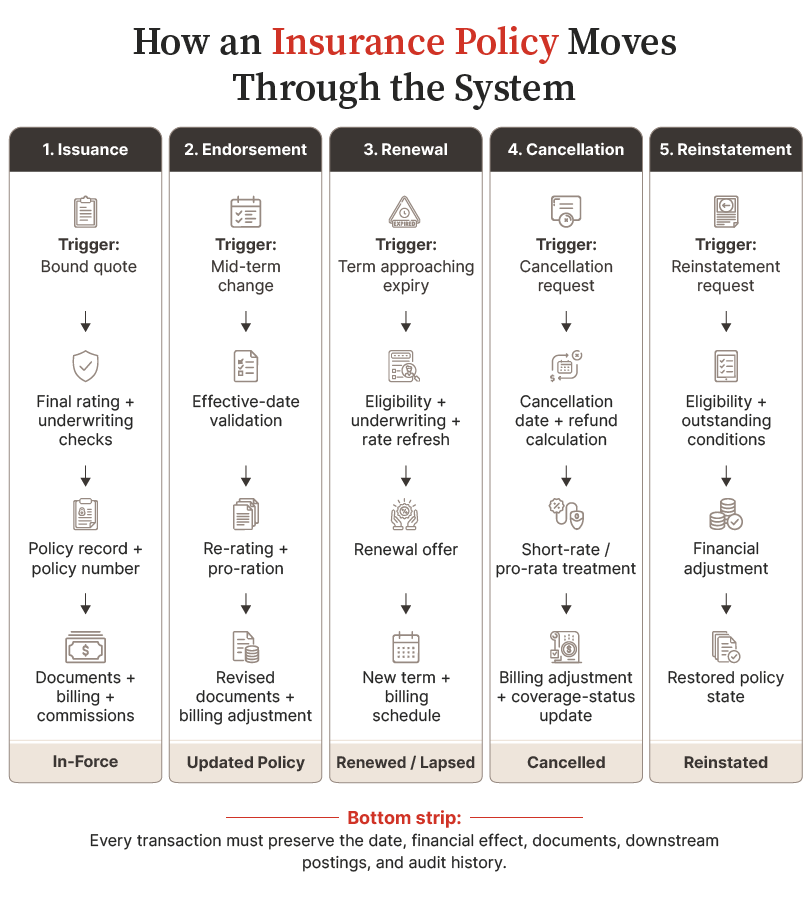
The next three sections go inside these transactions in detail, starting with issuance, then moving through mid-term endorsements and finally renewal, cancellation, and reinstatement.
How Does a Policy Go from Quote to In-Force?
The policy issuance process begins when a quote is bound. This is the transaction that turns an accepted quote into an in-force policy and creates the record that every subsequent policy transaction will build on.
What Triggers Issuance?
The trigger is typically a bound quote or an issuance instruction from a connect system. Before creating the final record, the system validates the submission data and runs the applicable underwriting and business-rules.
Those rules vary by product and line of business, but the objective is the same: confirm that the bound risk, coverage, pricing, dates, and other required information are complete and consistent enough to become a contact.
What Does the System Do?
The system makes a final call to the rating engine and locks the premium against the issued terms. That lock matters. From this point forward, the premium cannot be changed by editing a field. It can only be changed by another dated transaction, which is why every mid-term change is an endorsement rather than an edit.
The system then creates the policy number and policy record, including the effective and expiration dates, insured information, coverages, limits, and other contractual details.
The policy record is also the foundation for the systems and processes that depend on it.
“Analyzing a transformation for an insurer they need to be able to have this focal point that brings together all of these different disparate systems, these policy administration systems, claim systems, reinsurance systems, commissions, all these other systems that are generating, business transactions.”
– Seth Hedlund, CIO / Senior Vice President, Corebridge Financial
The effective date is especially important because it becomes a reference point for later transactions. A policy issued with the wrong effective date can create incorrect downstream calculations months later.
The system then generates the required policy documents and delivers them through the applicable channels. Those documents represent the terms that were issued and become the first entry in the policy’s documentary history.
What Happens Downstream?
Issuance also creates consequences outside the core policy record.
The system creates the billing schedule from the issued premium and payment terms, calculates commission on the transaction, and feeds reporting and statutory submissions where the product requires them.
These downstream processes do not necessarily live in the same physical database as the policy administration system. What matters is that they read from the same authoritative record, so billing, commissions, and reporting cannot drift from the policy.
What Does the Audit Trail Record?
The audit trail records the issuance transaction, including when it was processed, what policy state resulted, and the relevant changes or actors associated with the transaction. A strong history should allow an operator to establish how the policy reached its issued state rather than relying on the latest record alone.
What Can Go Wrong?
A mis-keyed effective date does not fail loudly. It produces a policy that looks correct and then miscalculates for the rest of its life: wrong pro-ration on the first endorsement, wrong earned premium at month-end close, wrong refund at cancellation. The correction is rarely a single edit, because every transaction that inherited the date has to be reworked.
An unlinked or failed billing handoff leaves the policy correctly issued while invoices go out late, go out wrong, or never go out. Coverage is in force and unbilled, and the gap usually surfaces at reconciliation rather than at issuance.
The issuance workflow varies across P&C, Life, Health, and MGA business. The transaction pattern remains consistent: validate, rate, record, document, post, and audit.
How Policy Administration Systems Transform Insurance Customer Experience
How Are Mid-Term Policy Changes Processed Through Endorsements?
Mid-term policy changes are processed as endorsements that update an existing policy from a specific effective date. The system re-rates the policy, applies pro-ration, regenerates documents, adjusts billing, recalculates commissions, and records the change in the audit trail.
What Triggers Endorsement Processing?
The trigger is a policy change request: a vehicle added to a commercial auto schedule, a coverage limit raised, a named insured corrected, an address moved. The system identifies what is changing, determines the applicable effective date, validates the requested change against product and underwriting rules, and evaluates how the new information affects the existing policy.
The effective date is critical input because the change usually applies to part of the policy term rather than all of it.
Did You Know? date a transaction is processed can be different from the date it takes effect. Endorsements are routinely entered days or weeks after the change they record.
How Does the System Recalculate the Premium?
The updated risk and coverage information goes back through the applicable rating logic. Because the premium was locked at issuance, the endorsement does not overwrite it. It calculates a new premium for the changed terms and produces the difference.
That difference is then pro-rated to the effective date. If an endorsement adds $1,200 of annual premium six months into a 12-month term, the insured is charged for the six months the change is actually in force, roughly $600, not the full annual amount. Products with minimum premiums, flat charges, or their own pro-ration rules will vary the arithmetic.
The result is an additional premium, credit, or other financial adjustment associated with the endorsement.
What Happens to Documents and Billing?
An endorsement is a contract amendment, so the system generates the applicable endorsement documentation or revised policy documents. The document history should show which terms applied during which part of the term, not just the terms in force today.
The financial change then flows to billing as an additional invoice or a credit, and commission is recalculated on the changed premium.
The transaction and its effects are recorded in the audit trail.
Did You Know? An endorsement is effectively a contract amendment, which is why document lineage matters alongside the financial change.
What Happens with an Out-of-Sequence Transaction?
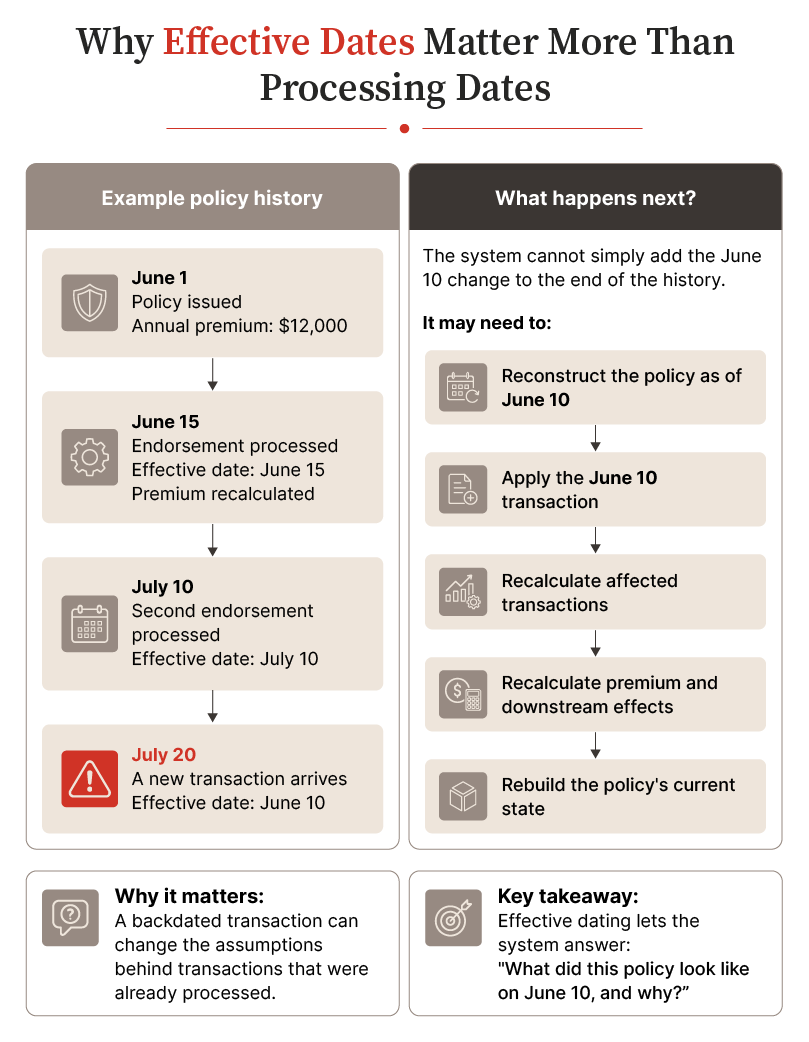
An out-of-sequence transaction occurs when a transaction arrives with an effective date earlier than transactions the system has already processed.
Take a policy issued June 1. An endorsement is processed effective June 15, and a second effective July 10. On July 20, a change request arrives with an effective date of June 10.
The system cannot append it. The June 15 and July 10 endorsements were rated against a policy state that no longer existed as of June 10, so their premium, their pro-ration, and the invoices and commissions they generated were all calculated on assumptions that are now false. The system has to reconstruct the policy as it stood on June 10, apply the new transaction, then recalculate every dependent transaction in effective-date order and rebuild the current state from the result.
This is the hardest thing for a policy administration system. It is also the clearest test of whether a system stores policy history or merely stores the latest policy version.
Spreadsheet-based processes are particularly difficult to reconcile in these situations. They may capture the latest amendment, but maintaining a reliable chronological transaction history and recalculating every affected downstream consequence becomes increasingly difficult as the policy accumulates changes.
What Can Go Wrong?
A mis-dated endorsement charges the wrong premium for the wrong period, and the error compounds at renewal when earned premium feeds the rate. An endorsement that never reaches billing is worse, because the policy record and the invoice disagree while both look internally correct. Coverage has changed, the customer is billed on the old terms, and nothing surfaces until someone reconciles the two.
How Do Renewal, Cancellation, and Reinstatement Work?
Endorsements change what a policy covers. Renewal, cancellation, and reinstatement change whether it exists. Each is a dated transaction, and each carries its own financial treatment, notice obligations, and downstream stops or restarts.
I. Renewal Processing
Renewal processing begins as the policy approaches its term expiry. The system opens the renewal well before expiration because notice timelines have to be met. The system applies the relevant re-underwriting rules, refreshes rates and policy information, and generates the renewal offer within applicable notice timelines. Three outcomes follow. The carrier offers renewal and the insured accepts, which creates a new term with its own policy record, effective dates, documents, and billing schedule. The carrier declines to renew, which is a non-renewal and carries its own notice requirements. Or the offer is made and never accepted, which is a lapse.
Non-renewal and lapse both end coverage, but they originate on opposite sides of the transaction, and the system records them differently because the notice obligations differ.
II. Cancellation
Cancellation ends coverage on a specific date before its scheduled expiration and triggers different financial treatment depending on who initiated it.
When the insured requests cancellation, a short-rate cancellation may apply, meaning the refund is reduced by a penalty or adjustment for ending the policy early. In a pro-rata cancellation, the refund generally reflects the unused portion of the premium calculated through the cancellation date. The exact treatment depends on the policy and applicable jurisdiction.
The system calculates the refund, updates the policy status, stops billing, and communicates the change to downstream processes, including claims eligibility where applicable. Required cancellation notices and the transaction itself are also recorded in the audit trail.
III. Reinstatement
Reinstatement restores a canceled or lapsed policy when the applicable conditions are met. It is not a deletion of the cancellation. The system preserves the lapse history, applies any required conditions and financial adjustments, and creates a new transaction establishing the restored policy state.
Did You Know? A backdated endorsement can force a PAS to recalculate or replay transactions that were already processed.
What Can Go Wrong?
Incorrect refund calculations can create financial discrepancies and customer disputes. A cancellation that updates the policy record but never reaches billing can leave invoices running after coverage has ended.
Across all three transactions, the system must preserve the same core pattern: date the event, calculate its financial effect, update the record, post the consequences, and retain the history.
How Do Policy Records Keep the Lifecycle Accurate and Auditable?
Policy lifecycle management is ultimately about keeping every transaction accurate, traceable, and connected to the same policy record. Issuance, endorsements, renewals, cancellations, and reinstatements only work reliably when the system can preserve what changed, when it changed, and what that change affected.
The Transaction Log
The transaction log provides the chronological history of the policy. Each event is dated, attributed, and retained so the system can establish how the policy moved from one state to another. This history should not be overwritten simply because a newer transaction exists.
Effective Dating as a Time Machine
Effective dating allows the system to answer a deceptively simple question:
What did this policy look like on March 3, and why?
The date a transaction is processed is not always the date its effect begins. An endorsement entered on March 10 may have an effective date of March 3. The system therefore needs to reconstruct the policy as it existed on the relevant date, including the transactions that affected it.
That capability matters for audits, disputes, regulatory reviews, and any situation where the organization needs to establish exactly what coverage or terms were in force at a particular point in time.
Documents and Downstream Records
Document lineage preserves each version of the policy documents associated with its transactions. At the same time, billing, claims, commissions, and reporting need to receive the consequences of those transactions from the same underlying record.
This upstream consistency is what makes downstream processing more efficient.
“All of that data coming in has to be made immediately relevant. And the more relevant we can make it the further upstream, the more insurers can automate the inputs being done by legions of actuaries, accountants and data analysts.”
– Robert Ried, Principal at Deloitte Consulting
The downstream impact is ultimately visible to policyholders. JD Power’s 2025 U.S. Claims Digital Experience Study found that 52% of customers with poor or just-OK digital claims experiences were at risk of leaving or not renewing, compared with just 4% of those reporting excellent or perfect experiences.[1]
Without this connective tissue, administration can become fragmented. Spreadsheets and email may handle the straightforward cases, but they make it difficult to reconstruct the policy’s state after multiple changes, particularly when transactions are backdated or processed out of sequence.
The result is an audit problem: the organization may know the policy’s current state but cannot reliably explain how it got there.
A trustworthy administration system therefore does more than store the latest policy version. It preserves the transaction history, effective dates, document lineage, and downstream consequences needed to reconstruct the policy at any point in its lifecycle.
How Policy Administration Systems for Insurers Are Evolving in 2026
Where Does AI Fit into Insurance Policy Administration?
AI adoption is no longer the question. Scaling it is. BCG found that only 7% of insurance companies surveyed have successfully brought AI systems to scale, while roughly two-thirds remain in the pilot stage.[2] This makes the underlying policy administration architecture increasingly important: AI cannot scale efficiently when core processes remain fragmented.
AI in insurance policy administration is increasingly being applied at specific points across the policy lifecycle rather than replacing the underlying transaction process. At issuance, AI can extract information from submissions and policy documents. During endorsements, it can flag anomalies or identify changes that may need review. At renewal, it can surface risk signals, while service teams can use AI to assist with drafting routine communications.
In each case, the output still needs to connect to the same policy record and audit trail. AI can help identify, extract, summarize, or recommend, but the resulting action must remain traceable to the transaction that produced it.
Human judgment remains essential for decisions involving underwriting, coverage, eligibility, and other areas where context and accountability matter.
How Does InsureEdge Handle Policy Administration?
The mechanics of policy administration become easier to manage when every transaction works against a consistent policy record. InsureEdge is designed around that principle, supporting the policy lifecycle from issuance through endorsements, renewal, cancellation, and reinstatement.
The platform connects these transactions through a unified record, with capabilities for effective dating, document lineage, and downstream postings. This allows policy changes to remain connected to their financial and operational consequences rather than being handled as isolated updates.
InsureEdge supports P&C, Life, Health, and MGA configurations, with AI-enabled assistance for defined activities while keeping underwriting, coverage, and other insurance judgments with the appropriate human decision-makers.
Backed by more than 30 years of insurance delivery experience, Damco helps insurance organizations address the operational mechanics behind policy administration.
See how InsureEdge supports these transactions on one record, or talk to Damco’ insurance team about the policy administration mechanics your operation needs to get right.
References:
- [1]: https://www.jdpower.com/business/press-releases/2025-us-claims-digital-experience-study/
- [2]: https://www.bcg.com/publications/2025/insurance-leads-ai-adoption-now-time-to-scale
Frequently Asked Questions
Policy administration in insurance is the processing of events throughout a policy's life, including issuance, endorsements, renewals, cancellations, and reinstatements, as dated transactions against a system of record. Each transaction keeps the policy, premium, documents, billing, and audit history consistent.
The typical stages are issuance, endorsements, renewal, cancellation, and reinstatement. Each stage represents a transaction that can change the policy record and trigger related updates to documents, billing, commissions, claims, or reporting.
An endorsement is a transaction that changes an existing policy during its term. The system applies the change from its effective date, recalculates the premium, updates documents, adjusts billing where required, and records the transaction in the audit trail.
A pro-rata cancellation generally calculates the refund based on the unused portion of the premium through the cancellation date. A short-rate cancellation generally applies an additional penalty or adjustment when the insured ends the policy early. The applicable treatment depends on the policy, product, and jurisdiction.
An out-of-sequence transaction occurs when a policy transaction has an effective date earlier than another transaction that has already been processed. The system may need to unwind and replay subsequent transactions in the correct order so the policy record, premium, documents, and downstream records remain accurate.


