

Executive Summary:
- AI-powered policy administration should augment the PAS, not bypass it. The PAS remains the system of record for policy data, transactions, rules, and audit history.
- AI adds value across the policy lifecycle. Quote and bind, issuance, endorsements, renewals, cancellation and reinstatement, servicing, and premium audit each support different AI capabilities. The coverage decision stays human at every stage.
- Integration architecture determines how AI operates. Carriers can use embedded platform AI, an augmentation layer beside the PAS, or an emerging agent layer. The right choice depends on PAS capability, workflow requirements, and the control environment.
- AI outputs are signals, not decisions, and require defined governance controls. Model versions, inputs, outputs, human reviews, decisions, overrides, and policy events should be reconstructable through controls designed into the integration.
- Autonomy should increase with evidence. Carriers can progress from document intake to triage, drafting with approval, and bounded servicing automation as measured accuracy and override rates justify each step.
- AI cannot fix weak foundations. Poor data quality, fragmented systems, legacy PAS constraints, and unclear operating processes can limit the value of AI regardless of model capability.
AI in insurance policy administration works on the system that records an insurer’s obligations. The policy administration system (PAS) decides what the insurer has promised, what coverage applies, what changes are recorded, and what premium is billed. Errors at this layer move downstream. An error in document intake can propagate into issuance. An incorrect endorsement interpretation can alter coverage. A flawed renewal signal can direct underwriters at the wrong accounts. AI here needs tighter control than a typical productivity pilot.
Recent industry guidance agrees on three rules for this work.
- The PAS stays the system of record that AI augments and never bypasses.
- AI outputs enter as signals rather than decisions.
- A human closes the gate on anything touching coverage or money.
However, what current guidance still lacks is structure, and this guide supplies three pieces of it. The first is a lifecycle-stage map showing where AI genuinely works from quote to premium audit, the evidence each use needs, and the judgment gate each stage keeps. The second is a set of three integration patterns for connecting AI to a PAS, each with its win conditions and its real cost. The third is a governance spine that treats the audit trail as architecture rather than paperwork. An adoption path then shows how carriers can expand AI autonomy as performance data supports it.

What Is a Policy Administration System, and How Is AI Changing It?
A policy administration system (PAS) is the system of record for managing the policy lifecycle. It captures the transactions that move a policy from quote and bind through issuance, endorsements, renewal, cancellation, and reinstatement. Each event changes the insurer’s contractual or financial position, so the PAS must remain authoritative even as AI is introduced around it.
The strategic question for insurers has therefore shifted from “Does the PAS have AI?” to “Where does AI sit in the policy administration architecture, and what authority does it have?”
That distinction becomes clearer when responsibilities are separated:
| PAS Remains Responsible For | AI Can Assist With | Control Principle |
|---|---|---|
| Policy state and transactions | Data extraction and classification | AI output is validated before entering the record |
| Rules and policy logic | Triage, prioritization, and anomaly detection | Rules remain authoritative |
| Policy changes and servicing actions | Summaries, recommendations, and drafting | Authorized users retain control |
| Policy and premium records | Data quality and exception identification | The PAS remains the system of record |
| Audit history | Evidence capture and workflow support | AI activity remains traceable |
The second principle follows from this architecture: AI augments the PAS; it does not bypass it. AI can process unstructured correspondence, surface exceptions, or prepare information for a service or underwriting team. The resulting signal must still pass through the insurer’s established rules, workflows, permissions, and human controls before it reaches the policy record.
These principles create the structure for the rest of the guide. The lifecycle-stage map examines where AI delivers value across policy administration and what evidence each use requires, and which judgments stay with people. The integration patterns then show how those capabilities connect to the PAS through embedded platform AI, an augmentation layer, or an agent layer.
For technology and operations leaders, the distinction matters: evaluate AI capability by where it sits, what it can influence, and how the insurer retains control over the resulting policy event.
How Should Insurers Evaluate Policy Administration Software in the AI Era?
Where Can AI Add Value Across the Insurance Policy Lifecycle?
AI for insurance policy administration is most effective when you define its capability, evidence requirements, and decision boundaries at each stage of the policy lifecycle. A carrier should therefore evaluate AI by the work it performs and the authority it holds, rather than by the number of AI features available in a PAS.
The autonomy column uses three levels:
- Assist: AI prepares information, and a person acts on it.
- Draft with approval: AI produces an output that a person reviews and approves before it takes effect.
- Never: The decision stays with an authorized person regardless of model performance.
| Lifecycle Stage | AI Capability | Evidence Required | Judgment Gate | Autonomy |
|---|---|---|---|---|
| Quote and Bind | Document intake, classification, extraction, pre-fill, submission completeness checks | Extraction accuracy against validated submission data | Eligibility and acceptance remain rules-based with underwriter oversight | Assist |
| Issuance | Document generation, template versioning, consistency checks | Output accuracy against approved template versions | Filed-form fidelity reviewed before issuance | Draft with approval |
| Endorsement | Request triage, change extraction, impact summaries | Accuracy against policy records and approved change requests | Changes applied by authorized rules or personnel, never by the model | Draft with approval |
| Renewal | Book triage, risk-change flags, data-drift detection, work prioritization | Performance against historical data and human review outcomes | Underwriting judgment remains with authorized personnel | Assist |
| Cancellation and Reinstatement | Retention signals, compliance checks, notice validation | Accuracy of identified conditions and required notices | Consequential notices require human approval | Draft with approval |
| Servicing | Traceable policy Q&A, correspondence support, bounded agent workflows | Answers grounded in current policy and transaction data | Binding or coverage-affecting actions require human approval | Assist / Draft with Approval |
| Premium Audit | Anomaly and exception detection across the book | Findings validated against audit outcomes | Findings trigger review; AI does not alter premium | Assist |
| Coverage Decision (all stages) | Decision-support signals only | Signals reviewed and validated by the authorized decision-maker | The authorized person makes the coverage determination | Never |
- Quote and Bind: Document classification and extraction provide a practical entry point because they reduce manual intake work without transferring eligibility authority to a model. Submission completeness checks can further flag incomplete files before they reach underwriting.
- Issuance: AI can prepare policy documents and identify inconsistencies between the document, the policy record, and the approved template. Template versioning and a review of filed-form fidelity keep issuance under control.
- Endorsement: Unstructured correspondence often requires interpretation before a servicing team can determine what changed. AI can extract the requested change and summarize its potential impact, but the authorized workflow or user must apply the change.
- Renewal: AI is better suited to book triage than underwriting judgment. Risk-change signals, data-drift indicators, and prioritization can help underwriters focus on policies that need attention. Damco’s guide to AI in insurance underwriting covers underwriting decisions in more depth.
- Cancellation and Reinstatement: AI can identify retention signals, check required conditions, and flag notice issues. Actions affecting policy status or contractual rights require defined human approval.
- Servicing: Policy Q&A and workflow assistance can reduce search and handling time when responses are grounded in authoritative policy text and transaction data. Bounded agent workflows extend this to routine servicing tasks, which Damco’s insurance AI agents page covers in detail. Any response or action that changes coverage or creates a binding commitment remains subject to human control.
“AI is a step up from just prompting agents to answer queries. AI can be trained to understand sentiment, empathize with the customer situation, then guide agents to the most relevant, personalized offers — all of which could be done in real time.”
– Ilanit Adesman-Navon, Partner, Head of Insurance and Fintech at KPMG Israel
- Premium Audit: Anomaly detection can identify unusual patterns across policies, accounts, or books for audit teams to investigate. AI findings are referrals, not premium adjustments.
The coverage decision sits outside any single stage, and its autonomy column reads “never.” AI can surface evidence, identify inconsistencies, or prioritize a case, but the authorized human decision-maker retains responsibility for the coverage determination.
How Should AI Integrate with a Policy Administration System?
Integrations for policy administration AI solutions generally follow three patterns. The choice depends on the carrier’s PAS architecture, integration maturity, vendor strategy, and the level of AI autonomy the operating model can govern.
| Pattern | How It Works | Best Fit | Key Trade-Off |
|---|---|---|---|
| Embedded Platform AI | AI operates within the PAS architecture, using its data, workflows, and security controls. | Carriers with a mature PAS and a strong vendor roadmap. | The vendor roadmap becomes the carrier’s roadmap. |
| Augmentation Layer | External AI services connect through APIs and events to support extraction, triage, anomaly detection, or drafting. | Platform-agnostic estates, mid-tier carriers, and capabilities the PAS does not provide. | The carrier owns integration, data synchronization, and keeping the PAS authoritative. |
| Agent Layer | AI agents execute bounded workflows through approved PAS APIs and interfaces. | Servicing and operational workflows with defined actions and escalation paths. | Greater autonomy requires stronger identity, permissions, monitoring, and exception controls. |
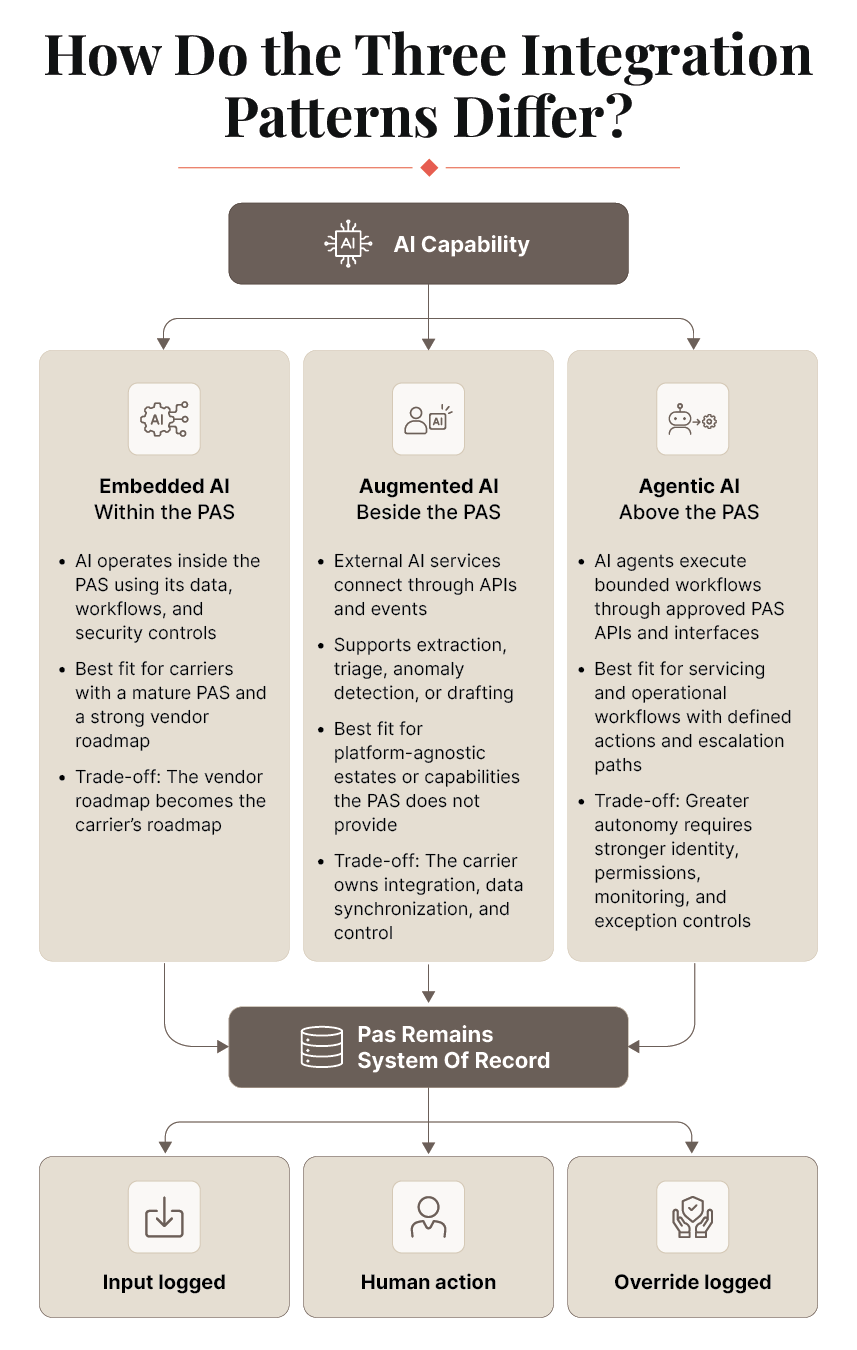
Embedded platform AI is strongest when AI capabilities are genuinely part of the PAS architecture itself, built into the platform’s data model and workflows. It can reduce integration complexity, but the carrier accepts greater dependency on the vendor’s product and model roadmap.
The augmentation layer gives insurers more architectural flexibility. An external service can extract submission data or triage endorsement requests while returning controlled outputs to the PAS. The pattern suits platform-agnostic estates, mid-tier carriers, and capabilities the PAS vendor does not ship. Its cost is integration engineering, plus the ongoing work of keeping the PAS authoritative. The trade-off is additional integration engineering and the need to maintain the PAS as the authoritative record.
The agent layer extends AI from individual tasks to bounded workflows. An agent may retrieve policy information, prepare a servicing response, or route an exception through approved interfaces. Production deployment requires explicit permissions, action boundaries, monitoring, and human escalation.
The governing rule remains constant across all three: the PAS stays authoritative, while every AI interaction has a traceable input, human control point, and override path. The architecture can change; the control model cannot.
“Modern platforms will become the base for far more intelligent AI-driven ecosystems, where AI is not just an add-on, but it is built into everything from design to operations. That’s how the modern platforms will evolve, and the customer experiences will become far more personalized and predictive.”
– Sanjeev Tripathi, Vice President, BFSI and Healthcare, Infosys
How Should Insurers Govern AI in Policy Administration?
AI governance in policy administration needs to operate at the transaction level. The practical rule is simple: AI outputs are signals, not decisions, and humans close the gate when an action affects coverage, money, rights, or the policy contract. Our Trustworthy AI framework reaches the same position: human judgment stays in place wherever AI can affect money, coverage, care, or rights. In policy administration, that covers eligibility, acceptance, changes that affect pricing, cancellations, and any action that alters what the policy promises.
The NAIC Model Bulletin[1], adopted in December 2023, expects insurers to maintain governance and risk-management controls around AI and to document information that regulators may request during an examination. The bulletin asks insurers to:
- Maintain a written AI governance program.
- Document how AI systems are used.
- Manage the risk of third-party models.
- Answer for the outcomes.
That information must be available to regulators during examinations. The bulletin applies only where a state adopts it. As of May 1, 2026[2], the NAIC’s implementation map lists 25 adopting jurisdictions, plus four states with their own insurance-specific AI rules or guidance. In January 2026, the NAIC also began a multistate pilot of an AI Systems Evaluation Tool that examiners can use to review insurer AI governance.
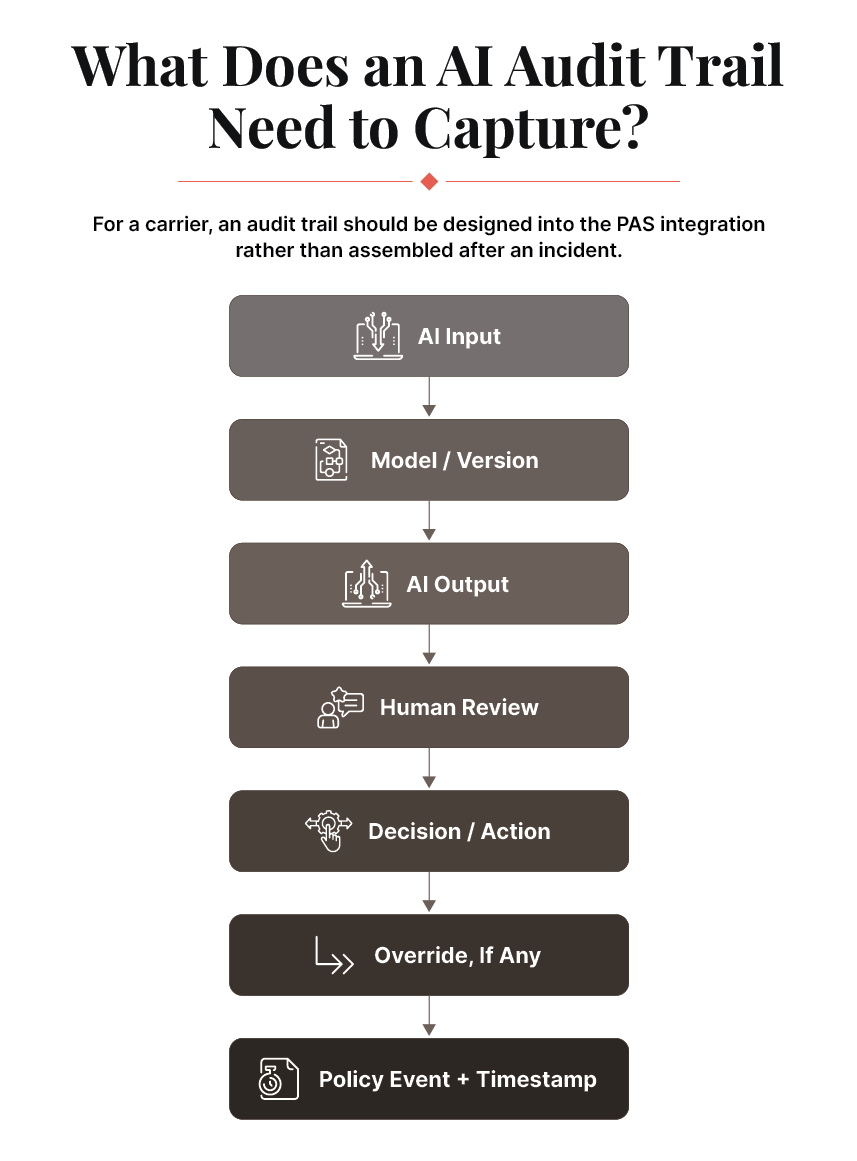
For a policy administration team, those expectations become a design requirement. This makes the policy event reconstructable: what information entered the AI workflow, what the system produced, who reviewed it, what action followed, and whether the output was overridden.
The human-in-the-loop must also be meaningful. A reviewer who can only approve an AI output without seeing its supporting evidence is not exercising effective control.
How Should Explainability Differ by AI Use Case?
Explainability should match the type of AI output. A predictive score should provide sufficient information to understand the factors influencing the result. A generated summary or response requires traceability to the source policy text, records, or documents used to produce it. The objective is not identical explanations for every model; it is enough evidence to support review, challenge, and reconstruction.
The NAIC also continues to develop tools to help regulators evaluate insurers’ AI governance, risk mitigation, high-risk models, and input data.
For insurers, the implication is clear: the audit trail is architecture, not paperwork. This is operational guidance, not legal advice; regulatory interpretation and legal determinations remain with the carrier’s counsel.
How Should Insurers Build Toward AI Autonomy?
AI maturity should be earned through measured performance, not declared through deployment. A carrier can move from low-risk assistance to bounded automation as evidence demonstrates that each stage operates reliably.
| Adoption Stage | Initial Use | Evidence to Measure |
|---|---|---|
| 1. Assist | Document intake and extraction | Accuracy against human-validated samples |
| 2. Prioritize | Renewal and endorsement triage | Outcomes, overrides, and queue efficiency |
| 3. Draft | Summaries, correspondence, impact notes | Approval rates and correction patterns |
| 4. Automate Within Bounds | Servicing workflows and scoped agent actions | Exception rates, escalation, and audit results |
| 5. Permanent Ceiling | Coverage decision | Human decision remains mandatory |
What Determines Whether AI Can Move to the Next Stage?
Each stage needs four controls before AI moves to the next one:
- A golden set: a fixed group of cases with verified answers, used to test the model.
- Sampled quality checks on live work.
- Override tracking, reviewed monthly.
- Defined criteria for escalating to a person.
The evidence should come from production workflows. An AI program’s maturity is measured by what it has earned the right to do, not by what it has switched on.
How Is the Agentic AI Era Reshaping Insurance Policy Administration?
What Does AI Not Fix in Policy Administration?
AI can expose process weaknesses faster than it can solve them. Four constraints determine whether an insurer can scale AI beyond a proof of concept.
1. Dirty PAS Data
AI doesn’t fix poor PAS data. Extraction, triage, and summarization are only as reliable as the policy, customer, and transaction data behind them. Deloitte’s[3] 2025 insurance research identified data security and privacy, data quality, and data integration among the leading barriers to scaling AI.
2. Legacy PAS Constraints
A PAS without usable APIs, event hooks, or accessible data limits every integration pattern. AI does not remove architectural debt. The carrier may need modernization before it can support real-time AI workflows across policy operations.
3. Deterministic Insurance Rules
Eligibility, rating logic, filing requirements, and other deterministic controls belong in the rules and policy architecture. A model is not a filing. AI can identify exceptions or support analysis, but it should not replace regulator-facing rules with probabilistic output.
4. Operating-Model Readiness
AI also doesn’t solve operating model readiness. Policy operations teams still need defined workflows, training, escalation paths, and accountability. The NAIC notes that insurers remain responsible for compliance, accuracy, fairness, and oversight when AI supports insurance activities.
These are not secondary implementation issues. They are prerequisites. A vendor that skips data quality, architecture, deterministic controls, and operating readiness during discovery has not solved the policy administration problem.
How Should Carriers Evaluate AI Capability in a PAS?
AI evaluation should move beyond feature checklists. A carrier should test where the capability sits, what evidence supports it, and what happens when the model is wrong.
| Evaluation Question | What It Reveals |
|---|---|
| Where does the AI live? | Embedded PAS capability, augmentation layer, or agent architecture |
| Can you reconstruct a policy event? | Quality of the audit trail and governance controls |
| How does a user override the output? | Actual human control, rather than nominal approval |
| How are models versioned and monitored? | Model governance and regulatory readiness |
| What evidence supports the capability? | Production performance versus demo performance |
| What depends on the vendor roadmap? | Long-term architectural and commercial dependency |
What Should a Vendor Demonstrate?
Ask the vendor to reconstruct one policy event from start to finish: show the source data, AI input, model output, human review, final action, and any override. This single exercise tests the audit trail, human-in-the-loop control, evidence quality, and operational transparency.
That scrutiny is increasingly relevant.
Platform selection itself remains a separate question: which PAS, vendor, and product tier best fit the carrier’s estate. The AI-powered insurance policy administration evaluation framework above should travel with that shortlist. Deeper underwriting decisioning and life insurance capabilities should be evaluated within their respective specialist workstreams.
Where Does Damco Fit in AI for Insurance Policy Administration?
Damco approaches AI in insurance policy administration from both the platform and implementation sides of the PAS estate.
InsureEdge embeds AI directly into its core data model and rules engine, supporting carriers, MGAs, and TPAs across policy administration workflows. This architecture keeps AI close to the policy data, business rules, and transactions it supports while preserving the policy administration system as the system of record.
For insurers operating other core platforms, Damco’s insurance technology practice can implement the integration patterns covered in this guide across the existing PAS estate. These include intelligent document intake and extraction, API-based augmentation layers, AI-assisted policy servicing, and bounded insurance AI agents. Governance instrumentation can be incorporated across these workflows to capture AI inputs, human review, overrides, and resulting policy events.
The same approach extends to legacy and heterogeneous estates. The objective is not to insert AI into every policy administration workflow. It is to determine which lifecycle stages have sufficient data quality, integration readiness, and control mechanisms to justify AI assistance or bounded automation.
money, coverage, care, or rights. In policy administration, that means humans retain authority over the coverage call. Damco’s published Trustworthy AI framework establishes the governing boundary: human judgment remains essential wherever AI can affect.
For carriers evaluating AI for insurance policy administration, the practical starting point is therefore the PAS estate itself: where AI should be embedded, where an augmentation layer makes more sense, and where agent workflows can operate safely within defined controls.
References:
- 1. NAIC
- 2. NAIC
- 3. Deloitte
Frequently Asked Questions
AI can support document intake and extraction, submission classification, endorsement triage, renewal prioritization, policy document drafting, servicing, and premium-audit anomaly detection. The level of autonomy should depend on the task's consequences. AI can assist or draft within controlled workflows, while human oversight remains for coverage-affecting decisions.
AI should provide signals and decision support rather than make consequential policy decisions independently. Eligibility, acceptance, coverage changes, cancellations, and other actions affecting the insurance contract require defined rules and human accountability. In the NAIC-era governance environment, insurers remain responsible for outcomes produced through AI-supported processes.
Three primary policy administration AI integration patterns exist: embedded AI within the PAS, an augmentation layer connected through APIs and events, and an agent layer operating through approved PAS interfaces. In every architecture, the PAS should remain the system of record, with AI inputs, actions, human review, and overrides captured in the audit trail.
The NAIC Model Bulletin on the Use of Artificial Intelligence Systems by Insurers establishes regulatory expectations around AI governance, risk management, documentation, testing, and accountability. For policy administration, these expectations translate into documented controls and the ability to reconstruct how AI contributed to consequential insurance activity. Requirements vary by jurisdiction, so the insurer's counsel still interprets the law.
Start with document intake, classification, and extraction, where outcomes can be tested against validated policy and submission data and decision authority remains outside the model. Expansion into triage, drafting, servicing, and bounded automation should follow measured evidence such as accuracy, exception rates, human overrides, and sampled quality assurance. AI autonomy should be earned through production performance, not assumed at deployment.


