

Executive Summary:
- Connect policy management with claims, billing, CRM, and underwriting to eliminate data silos
- Integrated systems improve efficiency, claims processing, billing accuracy, and customer experience
- API-first, cloud-based integration creates a scalable foundation for AI and automation
- A phased approach helps insurers modernize without disrupting ongoing operations
- Measure integration success through business outcomes, not just technical milestones
A customer purchases an auto insurance policy through your website. Weeks later, they update their address, pay their premium, and eventually file a claim after an accident. To the customer, it is one continuous relationship with the insurer. Behind the scenes, however, every interaction may involve a different system.
The policy administration platform stores coverage details. The CRM records customer interactions. The billing system manages premium collection. The claims platform verifies coverage and processes settlements. If these systems are disconnected, employees spend valuable time searching for information, customers repeat the same details across touchpoints, and critical decisions are delayed.
Most insurers have already invested heavily in modernizing individual applications. They have upgraded policy administration systems, implemented digital claims platforms, adopted cloud CRM solutions, and automated billing. Yet many still struggle to deliver seamless customer experiences or operate with complete business visibility.
The challenge is no longer replacing legacy systems. It is connecting them.
Insurance policy management integration is the next phase of digital transformation. Rather than treating policy administration, claims, billing, CRM, underwriting, and document management as separate functions, insurers are building connected operating models where information flows securely across the enterprise. This enables faster decisions, more efficient operations, and better customer experiences while creating the data foundation needed for AI and advanced analytics.
According to Deloitte’s Digital Insurance Maturity 2025 study, leading insurers are shifting from isolated digital initiatives to enterprise-wide transformation that connects front-, middle-, and back-office operations.[1] The focus is no longer on modernizing applications in isolation. It is on creating an integrated insurance ecosystem that can adapt quickly to changing customer expectations and market conditions.
Why Do Integrated Insurance Systems Matter?
“The effective integration of channels across marketing, sales, and service activities is critical to delivering a positive, brand-reinforcing experience at every touchpoint in the customer relationship.”
– Adrian Griggs, Board Member at Global Atlantic
Most insurers operate multiple core systems that evolved over time. When policy administration, claims, billing, CRM, and underwriting cannot share data, even routine processes become slower, more expensive, and prone to errors.
Integrated systems eliminate these disconnects, enabling faster operations, better customer experiences, and more informed business decisions.
1. Data Silos Limit Better Decisions
Disconnected systems create multiple versions of customer and policy information. Claims teams may work with outdated coverage details, underwriters may lack complete claims histories, and customer service representatives often switch between multiple applications before resolving a request.
The result is inconsistent decision-making, duplicate work, and avoidable delays.
More importantly, fragmented data limits executive visibility. Leadership teams struggle to understand portfolio performance, customer profitability, or operational bottlenecks when every department relies on different reports and different data sources.
2. Customer Experience Depends on Connected Operations
Insurers continue to invest in mobile apps, self-service portals, and AI-powered customer support. Yet digital experiences are only as effective as the systems supporting them.
Customers do not care which application stores their information. They simply expect every interaction to begin with complete context.
A policyholder reporting a claim should not have to confirm policy details that already exist elsewhere in the organization. Likewise, a service representative should not need to switch between four systems to answer a billing question.
Insurance CRM integration helps eliminate these disconnects by giving customer-facing teams access to policy, claims, billing, and interaction history within a unified workflow. The result is faster service, more personalized engagement, and greater customer confidence.
3. Operational Efficiency Becomes a Competitive Advantage
Efficiency is no longer measured by how quickly individual departments complete their work. It is measured by how seamlessly work moves across the organization.
When policy management system integration connects underwriting, billing, claims, and customer service, routine activities become automated instead of manual. Policy changes trigger premium recalculations automatically. Claims teams receive updated policy information instantly. Billing schedules adjust without human intervention.
The benefits extend beyond productivity. Connected workflows reduce servicing costs, improve renewal retention, shorten product launch cycles, and create the reliable enterprise data needed for AI-driven decision-making.
For insurers pursuing growth while managing rising operating costs, integration has become a strategic capability rather than simply an IT initiative.
How to Choose Insurance Policy Software That Supports Business Growth
Which Core Insurance Systems Should Be Connected?
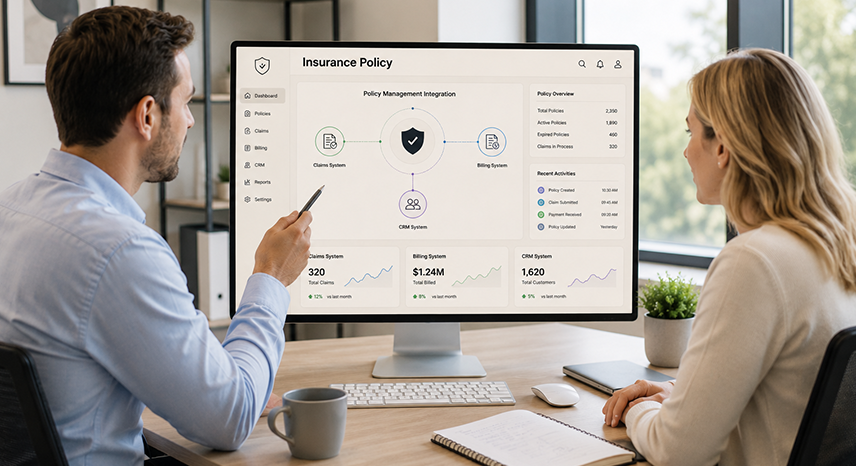
Insurance policy management integration connects the systems that support the entire insurance lifecycle. By enabling seamless data flow between policy administration, claims, billing, CRM, underwriting, document management, and third-party platforms, insurers can improve operational efficiency and deliver a more consistent customer experience.
Insurance policy management integration is not about connecting applications for the sake of technology. It is about enabling a single business process that spans the entire customer lifecycle.
Consider the journey of a commercial insurance customer.
A prospect first interacts with the insurer through a broker or digital channel. The CRM captures customer information and sales activity. Underwriting evaluates risk using both internal records and external data sources. Once approved, the policy administration system issues the policy, while the billing platform establishes payment schedules and the document management system generates policy documents. Months later, if the customer files a claim, adjusters should have immediate access to policy coverage, payment status, previous interactions, and supporting documentation without requesting information from multiple departments.
This connected journey is only possible when every core system communicates in real time.
I. Policy Management System
The policy management system serves as the operational backbone of the insurance business. It manages policy issuance, endorsements, renewals, cancellations, and coverage administration. Because almost every customer interaction depends on policy information, it should act as the central source of truth for connected workflows.
II. Claims Management System
Claims represent the most important moment in the customer relationship. Integrating claims and policy management enables adjusters to verify coverage instantly, access customer history, retrieve supporting documents, and accelerate settlement decisions. It also reduces claims leakage caused by incomplete or inconsistent information.
III. Billing and Payment Systems
Premium calculations, payment schedules, refunds, and collections should remain synchronized with policy changes. Insurance billing system integration helps eliminate reconciliation issues while improving cash flow visibility across the policy lifecycle.
IV. Customer Relationship Management (CRM)
Insurance CRM brings together customer conversations, service requests, sales opportunities, and engagement history. When integrated with policy administration, billing, and claims, it provides employees with a complete view of every customer relationship instead of isolated transactions.
V. Underwriting System
Underwriting platforms increasingly rely on real-time policy, claims, and payment data alongside third-party sources such as telematics, geospatial information, fraud databases, and identity verification services. Integrating the underwriting system with these core platforms, along with external data sources, enables underwriters to make faster, more informed decisions using real-time information.
VI. Document and External Data Integration
Document management and external data sources complement each other by bringing structured and unstructured information into connected insurance workflows. Policy documents, endorsements, invoices, and regulatory disclosures can be synchronized with external sources such as telematics, geospatial data, fraud databases, and identity verification services. This ensures teams have the right information at the right stage of the insurance lifecycle.
Together, these systems form a connected insurance ecosystem in which information flows seamlessly between departments, enabling faster decision-making and more consistent customer experiences.

What Are the Benefits of Insurance Policy Management Integration?
Connecting core insurance systems delivers value far beyond IT efficiency. It enables insurers to operate as one enterprise instead of a collection of disconnected departments.
1. Gain a 360-Degree Customer View
Every customer interaction adds valuable context. When CRM, policy administration, claims, and billing systems are integrated, agents and service teams can access a complete customer profile from a single interface. This reduces repetitive questions, improves first-contact resolution, and creates opportunities for personalized service and cross-selling.
2. Reduce Policy Servicing Costs
Routine activities such as endorsements, renewals, cancellations, and policy updates often involve multiple teams. Integration automates these workflows, reducing manual effort, and shortening turnaround times. The result is lower servicing costs and a better experience for policyholders.
3. Accelerate Claims Processing
Claims adjusters can instantly verify policy coverage, payment status, and customer history without switching between systems. This reduces processing delays, minimizes claims leakage, and helps insurers settle claims faster.
4. Improve Billing Accuracy and Cash Flow
Insurance billing system integration ensures premium calculations, payment schedules, and refunds stay synchronized with policy changes. This minimizes reconciliation issues while improving cash flow visibility and financial accuracy.
5. Strengthen Compliance and Business Insights
Integrated systems create consistent audit trails and improve regulatory reporting. At the same time, executives gain access to real-time dashboards that combine operational, financial, and customer data, enabling faster and more informed business decisions.
What Does a Modern Insurance Integration Architecture Look Like?
“If a core system did not have robust APIs, if they weren’t open, they weren’t able to bring in data from all types of third-party sources, then it really wasn’t going to be that effective of a core system.”
– Jay Sarzen, Director, Insurance Research at Conning
Modern insurance ecosystems require more than point-to-point integrations. Insurers need a scalable architecture that connects core systems, supports real-time data exchange, and can adapt as new technologies and business needs emerge.
I. API-First Integration
APIs enable policy administration, claims, billing, CRM, underwriting, and third-party applications to exchange data securely and consistently. An API-first approach creates reusable connections instead of one-off integrations, making it easier to add new applications, partners, and services without rebuilding the integration layer.
II. Cloud-Native Platforms
Cloud-native insurance platforms provide the scalability and flexibility needed to connect modern and legacy systems. They allow insurers to scale workloads as business volumes change, support faster deployment, and integrate new capabilities without making major changes to the underlying infrastructure.
III. Integration Platform as a Service
iPaaS provides a central layer for managing data flows across cloud, on-premises, and third-party applications. It can simplify integration management, improve visibility into data flows, and reduce the complexity of maintaining multiple point-to-point connections.
IV. Microservices Architecture
Microservices break large insurance applications into smaller, independently deployable services. Insurers can update or scale individual capabilities, such as billing or claims, without changing the entire application. This supports incremental modernization while reducing disruption to existing operations.
V. Real-Time Data Synchronization
Integration is only valuable when systems have access to current information. Real-time synchronization ensures that events such as policy endorsements, premium payments, and claim updates are reflected across connected systems, helping teams make faster decisions and deliver more consistent customer experiences.
Combined with real-time data synchronization, these new-age technologies ensure every department works with the latest information, whether it is a policy endorsement, premium payment, or claim status update.
What Are the Common Integration Challenges?
Most insurers understand the value of insurance software integration. The challenge lies in executing it without disrupting ongoing operations. Legacy technologies, inconsistent data, security risks, and organizational silos can slow integration initiatives and limit their long-term success.
1. Legacy Systems and Technical Debt
Legacy platforms often lack modern APIs, making integration more complex. Years of custom, point-to-point integrations can also create technical debt that is costly to maintain and difficult to scale.
2. Poor Data Quality and Governance
Duplicate customer records, inconsistent policy information, and disconnected data sources can undermine integration efforts. Strong data governance is essential to ensure accurate, reliable information across systems.
3. Security and Compliance Risks
Insurance integrations involve sensitive customer, financial, and policy data moving across multiple platforms. Insurers must protect this data through secure APIs, encryption, access controls, and monitoring while meeting regulatory and data privacy requirements. Security and compliance therefore need to be built into the integration architecture from the start, rather than addressed after implementation.
4. Limited Cross-Functional Alignment
Successful integration requires more than technology. IT, operations, underwriting, claims, and customer service teams must align on common processes, shared data standards, and ownership. Without that alignment, integration delivers only limited business value.
How to Choose Between Off-the-Shelf Insurance Software and a Technology Partner
What Are the Best Practices for Successful Integration?
Successful integration requires more than connecting applications. Leading insurers treat it as an enterprise-wide transformation that aligns technology investments with long-term business objectives.
I. Adopt an API-First Integration Strategy
Build an API-first architecture that supports scalability, partner connectivity, and future modernization instead of relying on one-off integrations that increase technical debt.
II. Establish a Unified Data Foundation
Standardize customer, policy, and claims data across systems to create a single source of truth. Strong data governance improves reporting, regulatory compliance, and AI readiness.
III. Modernize Around Business Priorities
Take a phased approach by prioritizing high-impact customer journeys, such as policy servicing or claims, before expanding integration across the enterprise. This reduces implementation risk while delivering measurable business value early.
IV. Measure Business Outcomes, Not Technical Milestones
Evaluate integration success through business KPIs such as lower servicing costs, faster claims settlement, higher customer retention, and quicker product launches, rather than simply counting the number of connected systems.

What Are the Future Trends Shaping Insurance Integration?
As insurers accelerate digital transformation, integration is becoming the foundation for the next generation of insurance operations.
AI-powered workflows will rely on connected enterprise data to automate underwriting, claims triage, fraud detection, and customer service. Without integrated systems, AI simply reinforces fragmented processes instead of improving them.
AI is also expected to accelerate core system modernization. According to McKinsey, agentic AI can improve productivity by 15% to 40% in platform configuration, 20% to 60% in data mapping and conversion, and 15% to 90% in testing and reconciliation, helping insurers modernize and integrate legacy systems faster.[2]
The industry is also moving toward event-driven architecture, where systems respond instantly to business events such as policy issuance, claim registration, or payment confirmation. This reduces delays and enables real-time customer experiences.
Another emerging trend is composable insurance, where insurers assemble business capabilities using modular services instead of monolithic applications. This approach makes it easier to launch new products, enter new markets, and integrate with partners.
At the same time, embedded insurance is expanding beyond traditional distribution channels. Whether insurance is offered through automotive platforms, travel portals, or digital marketplaces, seamless integration through APIs will be essential to support policy issuance, billing, and claims in real time.
Ultimately, insurers that invest in a connected, cloud-based insurance ecosystem today will be better positioned to adopt future technologies without another cycle of large-scale system replacement.
Conclusion
Most insurers have already modernized parts of their technology landscape. They have upgraded policy administration platforms, introduced digital claims systems, implemented CRM solutions, and migrated workloads to the cloud.
The next competitive advantage will not come from adding another application. It will come from connecting the ones they already have.
Insurance policy management integration transforms isolated systems into a unified operating model where policy, claims, billing, CRM, underwriting, and third-party platforms work together seamlessly. The result is lower operating costs, faster claims settlement, better customer experiences, stronger business insights, and the agility to embrace AI and future innovations.
For insurers planning their next phase of modernization, integration should be viewed as a business strategy rather than an IT initiative. Organizations that build a connected insurance ecosystem today will be better equipped to respond to changing customer expectations, regulatory demands, and competitive pressures tomorrow.
Whether you’re modernizing a legacy core platform or building a cloud-native insurance ecosystem, partnering with an experienced integration specialist can help accelerate transformation while minimizing operational disruption.
References:
- 1. Deloitte: Digital Insurance Maturity 2025
- 2. McKinsey: Can agentic AI finally modernize core technologies in insurance
Frequently Asked Questions
Insurance policy management integration is the process of connecting a policy administration system with claims, billing, CRM, underwriting, document management, and other business applications. It enables seamless data exchange, reduces manual processes, and improves operational efficiency across the insurance lifecycle.
Integration eliminates data silos and creates a unified view of customers, policies, and transactions. This helps insurers improve claims processing, streamline policy servicing, automate billing, and deliver more consistent customer experiences.
Insurance CRM integration enables agents and service teams to access policy details, claims history, billing information, and previous customer interactions from a single interface. This improves first-contact resolution, supports personalized service, and creates opportunities for cross-selling and retention.
A cloud insurance platform combined with insurance API integration enables real-time data sharing between core systems. It simplifies application connectivity, supports faster product launches, improves scalability, and provides the flexibility to integrate emerging technologies such as AI and embedded insurance.
A modern policy management platform should integrate with claims management, billing and payment systems, CRM, underwriting, document management, analytics platforms, and third-party services such as fraud detection, identity verification, telematics, and payment gateways. This creates a connected insurance ecosystem that supports end-to-end business operations.


