

Key Takeaways:
- Failure to select the right claims software stems from misaligned buyer types, lines of business, or architectures.
- Platforms should be evaluated using claims economics rather than feature checklists, because claims handling is the largest combined-ratio lever an insurer controls.
- Core-suite modules put claims on the same record as policy and billing. Standalone platforms trade that record unity for specialty-line configurability and a permanent integration to operate.
- Decide the architecture fork before shortlisting vendors. Buyers who skip it discover the mismatch months into implementation.
- AI belongs in the data model and workflow layer, sharing live data with claims. An adjuster still owns every judgment call.
- Enterprise deployments take 12 to 24 months while standalone platforms deploy in as little as 90 days.
- Compliance logging must be built from the start to prevent expensive retrofits.
Why do insurance claims software evaluations often end in disappointment?
The answer is almost always the same. Buyers enter the process without a clear framework. They treat fundamentally different platforms as interchangeable and discover the mismatch months into implementation.
Most selection failures come down to three predictable mistakes. First, buyer type mismatch. A carrier shortlists a platform built for third-party administrators (TPAs), only to discover that multi-client tenancy is doing work it never needed, and record unity is doing work it does.
Second, line coverage gaps. A platform built for Property and Casualty (P&C) claims cannot handle health adjudication or life and annuity workflows. Third, architecture misalignment. Many organizations buy standalone systems when their real problem was fragmentation that a core-suite module would have solved. The cost of getting this wrong is well-documented: recent research has found that large-scale core system transformations fail more than 70% [1] of the time, with nearly a quarter becoming full write-offs.

This comparison ranks platforms on claims economics rather than workflow feature checklists, because claims handling is the largest combined-ratio lever an insurer controls. Leakage, severity, and cycle economics decide whether a claims platform pays for itself. Intake screens do not.
Every entry below carries three labels: buyer type, line coverage, and architecture. Filter by yours, and the market shrinks to platforms built for your operation.
How Did We Rank the Best Insurance Claims Management Software?
Each platform in this list was reviewed against six criteria: claims lifecycle coverage, claims economics, artificial intelligence (AI) posture, audit-trail integrity and regulatory readiness, integration capabilities, and delivery track record. Our methodology used documentation and published case evidence for every capability claim.
“When the claim starts to take place, we believe a massive amount of this will be aided by AI. Where the human is going to be involved is where they’re providing emotional support to the customers in a highly traumatic situation.”
– Githesh Ramamurthy, Chairman and CEO, CCC Intelligent Solutions
1. Claims Lifecycle Coverage
Claims lifecycle coverage examines whether a platform handles the complete sequence, from First Notice of Loss (FNOL) through settlement and subrogation. It also checks whether it stays reliable when claim volume spikes, particularly during catastrophic events.
2. Claims Economics
This is the main lens, because claims handling is the biggest lever insurers have on their combined ratio. We checked three things:
- Leakage reduction: Does the platform have controls built into the workflow that hold payment to what the file supports, including subrogation and recovery capture, rather than reporting leakage after the fact?
- Severity management: Does the platform surface severity signals early enough to change the outcome, and how accurate are the resulting reserve estimates?
- Cycle-time improvement: How well does the platform route claims and capture clean data from the start?
3. AI Posture
AI posture distinguishes between claims-native intelligence embedded in the workflow layer and AI tools bolted on after deployment. The evaluation examined three specific questions: whether AI and workflow share the same data in real time, whether a human adjuster stays in the loop on complex files by design rather than by policy, and whether the platform publishes its straight-through processing rate. This last point matters more than it sounds: Capgemini’s 2026 industry survey found that 42% [2]of insurers aren’t measuring AI outcomes at all, leaving 60% stuck at the proof-of-concept stage. A platform that won’t publish its own numbers is asking you to buy into the same blind spot.
4. Audit-Trail Integrity and Regulatory Readiness
Audit-trail integrity and regulatory readiness means every action on every document creates a timestamped, cryptographically linked log entry. No one, not even a system administrator, can alter it after the fact. This is the level of proof regulators expect.
5. Integration Capabilities
This aspect covers how well a claims platform connects to policy administration, billing, payment systems, and external data providers. Does it require custom coding for each connection? Or does it come with a library of ready-made connectors?
6. Delivery Track Record
Delivery track record includes verified implementations, analyst coverage from firms like Gartner, and review-platform ratings with publication dates attached. We only considered platforms with verifiable track records.
Can Automation Address the Biggest Challenges in Claims Processing?
7. The Three-Label Classification System
Every platform entry in this comparison carries three classification labels.
- Buyer Type: Carrier, TPA/self-insured, or both. Carriers need claims on the same record as policy and billing, so a claim can be adjudicated and paid without leaving the core system. TPAs and self-insured organizations require multi-client structures, which keep each client’s claims, reserves, and reporting separated within a single instance. Platforms labeled “both” need to support a single-entity claims record for carriers and a multi-client partition model for TPAs within the same system, without forcing either buyer type to work around features built for the other.
Line Coverage: P&C, health, life and annuities, or multi-line. P&C platforms need estimating, subrogation, and catastrophe-response workflows built around auto and property losses. Health platforms need adjudication engines, medical coding support, and provider-network logic.
Life and annuities platforms need beneficiary verification, contestability review, and payout workflows suited to long-tail, low-frequency claims. Multi-line platforms need configurable claims logic that can run separate P&C, health, and life workflows side by side without collapsing them into one generic process.
- Architecture: Core-suite module or standalone. Core-suite modules combine claims, policy administration, and billing into one system, creating a unified record. Standalone platforms offer specialized claims depth but require strong integration with other systems to function properly.
Should You Choose a Core-Suite Claims Module or a Standalone Platform?
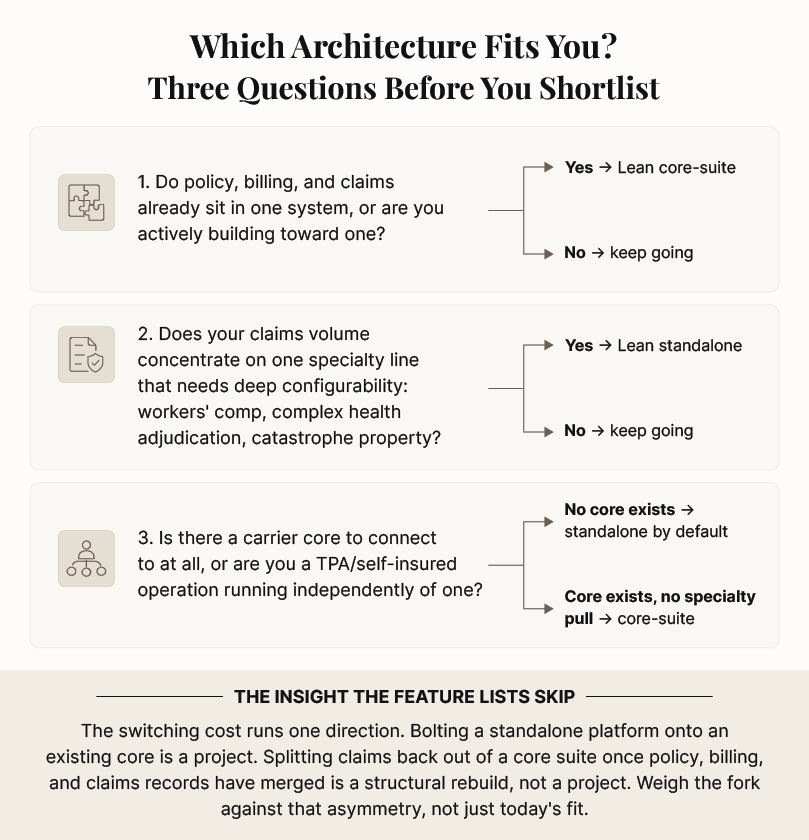
Core-suite modules put claims on the same record as policy and billing. Standalone platforms run alongside your existing core and trade that record unity for deeper specialty configurability. Decide this before you shortlist vendors, because the architecture decision eliminates more of the market than any feature comparison will. Most claims software lists start with vendors. This one starts here.
I. When a Core-Suite Claims Module Makes Sense
A core-suite claims module wins when:
- Record unity with policy and billing matters. Policy, billing, and claims sit in the same database, with no handoff where coverage details must move from underwriting into a separate claims system. Adjusters see endorsement history, premium status, and coverage changes without sync delays.
- One audit fabric and one upgrade schedule matter. Audit records stay inside one system from first notice of loss through closure, so regulatory reporting never crosses a system boundary. And when the vendor releases an update, policy and claims stay on the same version rather than drifting apart between upgrade cycles.
- The carrier has a single core system for policy, billing, and claims, or is in the process of building one. If a core modernization is already underway, a claims module inside that program usually costs less than a standalone platform plus its integration.
II. When Standalone Claims Software Makes Sense
Standalone claims software wins when:
- A specialty line needs configurability a general-purpose claims module cannot reach. Workers’ compensation is the standard example: state-by-state regulatory rules, jurisdictional benefit calculations, and medical management workflows that a suite module handles only through heavy customization. Filter the list below by the standalone architecture label to find platforms built for this depth.
- The existing core system is not getting replaced. An organization does not want to modernize their policy administration system, but their claims workflows need attention. In such a scenario, a standalone platform can connect to their setup and fix claims without touching the rest.
- There is no carrier core at all. TPAs and self-insured organizations need multi-client structures that can keep each client’s data separate. They require reports that show every client’s claims individually. Systems built for carriers are not designed for this.
III. The Integration You Keep
A standalone claims platform carries an integration you own for as long as you run the platform. Each connection to policy administration, billing, payment rails, and third-party data has a build cost at go-live and a maintenance cost after it. Vendor API changes on either side require regression testing. Data models drift, so reconciling the claims record against the policy record becomes a standing operational task rather than a one-time project.
Core-suite modules remove the policy-to-claims seam, though they do not remove integration work altogether: reinsurance, payments, fraud, and document management still connect. None of this argues against standalone claims software. It argues for pricing the integration into selection rather than discovering it in year two.
Choose your fork first. Then read the list below filtered by the architecture label on every entry, and the shortlist assembles itself.
What Are the Top Insurance Claims Management Platforms in 2026?
Ranked on claims economics and labeled so you can filter by buyer type, line coverage, and architecture, the platforms are: InsureEdge, Guidewire ClaimCenter, Duck Creek Claims, Sapiens ClaimsPro, Majesco Claims, Five Sigma, Snapsheet, Origami Risk, Riskonnect, and Salesforce FSC Claims. The right fit depends on your architecture, buyer type, and line of business.
1. InsureEdge Claims Management by Damco
- Claims lifecycle scope: Manages claims from first notice of loss (FNOL) through final settlement, with policy, billing, and reinsurance data on the same platforms. This eliminates the need for data handoffs between underwriting and claims.
- Labels: Buyer: Mid-market carriers and Managing General Agents (MGAs). Line: P&C and health. Architecture: Core-suite module.
AI posture and economics: AI sits in the data model and rules engine rather than alongside them, so fraud signals, document intake, and catastrophe-volume routing draw on live claim data.
On severity, early triage flags surface on the same record as policy history. On cycle economics, automated handling of low-complexity files concentrates adjuster capacity on claims where judgment changes the outcome. Adjusters own every coverage, reserve, and settlement decision.
- Delivery model: Backed by over 30 years of Damco insurance delivery experience. Includes mobile tools for adjusters and structured workflows for personal, commercial, and health lines.
- Best for: Mid-market carriers and MGAs that want claims data unified with policy and billing. This platform is not designed for TPAs or enterprise carriers committed to a best-of-breed claims strategy.
See InsureEdge Claims Management Software in Action
2. Guidewire ClaimCenter
- Claims lifecycle scope: Manages the full claims lifecycle from FNOL through investigation, reserving, payments, and closure using a rules-based engine.
- Labels: Buyer: Carrier. Line: P&C, all standard lines. Architecture: Core-suite module.
- AI posture & economics: AI capabilities are applied to severity forecasting and fraud detection, with the goal of improving accuracy and reducing manual tasks.
- Delivery model: Has the largest network of implementation partners in the industry; implementation timelines are best suited for carriers with enterprise-scale resources.
- Best for: Large P&C carriers that need an enterprise-grade system for managing claims across all standard lines. Not a fit for mid-market carriers without enterprise implementation capacity or a multi-year program budget.
3. Duck Creek Claims
- Claims lifecycle scope: Manages the complete process from FNOL, triage, and investigation through reserving and payment, integrating with Duck Creek’s policy and billing systems.
- Labels: Buyer: Carrier. Line: P&C. Architecture: Core-suite module.
- AI posture & economics: Uses AI for straight-through processing, where low-complexity claims can be automatically triaged, adjudicated, and paid. Deployed on a cloud-native architecture, the vendor is positioned for catastrophe volume.
- Delivery model: A continuous delivery model applies updates without requiring major carrier-side upgrade projects.
- Best for: Large and mid-to-large P&C carriers looking to move away from traditional system upgrades. Not a fit for organizations keeping a non-Duck Creek core in place long term.
4. Sapiens ClaimsPro
- Claims lifecycle scope: Manages the full claims cycle with built-in support for multi-jurisdictional regulations and complex claim handling.
- Labels: Buyer: Carrier. Line: P&C. Architecture: Core-suite module.
- AI posture & economics: Uses AI-driven workflows and automated claim assignments targeting cycle times, with routing rules applied at intake.
- Delivery model: Deployed across Europe, North America, and Asia-Pacific, with a configurable SaaS (Software as a Service) platform.
- Best for: International carriers and multi-market insurers wanting one vendor across jurisdictions, where regulatory variation drives cost. Not the shortest path for single-market carriers with simpler jurisdictional requirements.
5. Majesco Claims
- Claims lifecycle scope: Manages FNOL through closure, with AI tools embedded in adjuster’s workflows.
- Labels: Buyer: Carrier. Line: P&C. Architecture: Core-suite module.
- AI posture & economics: Majesco Copilot surfaces cross-system context and automates routine handling, with the vendor citing audit trail coverage across automated actions.
- Delivery model: Pre-configured templates for common claim types reduce implementation effort.
- Best for: Mid-market and regional P&C carriers wanting suite functionality on a mid-market budget. Not a fit for carriers needing health adjudication alongside P&C on one platform.
6. Five Sigma
- Claims lifecycle scope: Handles FNOL, triage, fraud detection, and documentation through an AI-native engine called Clive.
- Labels: Buyer: Carrier and MGA. Line: P&C, specialty. Architecture: Standalone.
- AI posture & economics: Built from the ground up with AI at its core, with cycle time and processing cost as the vendor’s stated targets.
- Delivery model: Deploys over an existing core on shorter timelines than enterprise suites.
- Best for: MGAs, specialist carriers, and mid-market insurers avoiding multi-year implementations, where cycle economics is the priority. Not a fit for carriers seeking record unity with policy and billing.
7. Snapsheet
- Claims lifecycle scope: Specializes in digital auto appraisals and virtual damage assessments, extending to broader auto and property claims handling.
- Labels: Buyer: Carrier. Line: P&C (auto and property). Architecture: Standalone.
- AI posture & economics: Uses no-code workflow configuration and smart assignment routing within a unified claim view, with review checkpoints on automated estimates. Adjuster time allocation is the stated economic lever.
- Delivery model: Implementations can be completed in as little as 12 weeks; integrates with an existing core system rather than replacing it.
- Best for: Carriers modernizing the policyholder claims experience without a core replacement, particularly in auto. Not a fit for multi-line carriers needing liability or workers’ compensation depth.
8. Origami Risk
- Claims lifecycle scope: Manages claims administration as part of a broader, single platform for policy, safety, compliance, and analytics.
- Labels: Buyer: TPA/self-insured. Line: Multi-line. Architecture: Module of a risk platform, standalone relative to a carrier core.
- AI posture & economics: Configurable cloud-native workflows built for integrated risk operations, supporting multi-entity program structures and shared services.
- Delivery model: Reaches mid-market organizations managing claims alongside enterprise risk programs.
- Best for: Self-insured corporates, captive insurers, risk pools, and the TPAs that serve them. Not built for carriers needing claims on the same record as policy and billing.
9. Riskonnect
- Claims lifecycle scope: Manages intake, investigation, adjudication, payments, and reporting across the full lifecycle.
- Labels: Buyer: TPA/self-insured. Line: Multi-line. Architecture: Module of a risk platform, standalone relative to a carrier core.
- AI posture & economics: AI-driven analytics for fraud detection and reserve optimization, with claims data connecting to broader risk, exposure, and safety modules.
- Delivery model: Designed for enterprise-oriented deployment.
- Best for: Large self-insured organizations and TPAs that want to centralize claims data alongside their enterprise risk information. Not a fit for organizations wanting a claims-only scope or a fast standalone deployment.
10. Salesforce FSC Claims
- Claims lifecycle scope: Manages digital FNOL intake, auto-adjudication, reserves, and payments using an insurance-specific data model.
- Labels: Buyer: Carrier. Line: Multi-line. Architecture: Standalone relative to an insurance core, native module within Financial Services Cloud.
- AI posture & economics: Einstein AI for claims summarization and fraud detection, and automation for routine service tasks and claims data joined to customer engagement history.
- Delivery model: Built on Salesforce’s Customer Relationship Management (CRM) infrastructure with pre-built insurance objects, reducing custom development time for organizations already on the platform.
- Best for: Carriers and agencies unifying claims with customer engagement on an existing Salesforce footprint. Not a fit for carriers without that footprint, where the platform cost is being justified by claims alone.
Each of these platforms earns its place on the list for a specific reason. None is the right choice for everyone. The next section covers pricing and implementation timelines, because those factors decide whether a platform delivers a strong Return on Investment (ROI) or becomes a long-term burden.
How Much Does Insurance Claims Management Software Cost, and How Long Does Implementation Take?
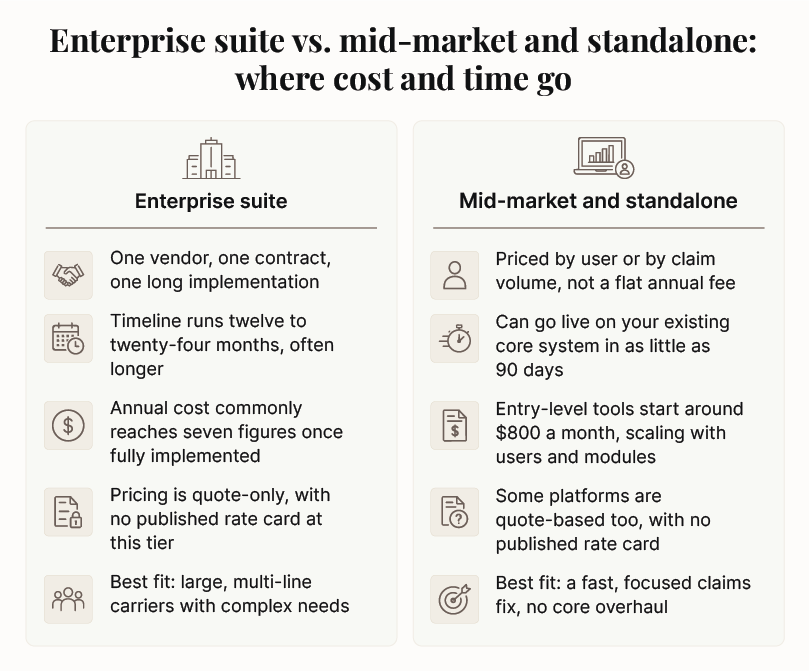
Enterprise suites run into seven figures annually and take 12 to 24 months (often 18 months or more) to implement, whereas mid-market platforms quote by user count or module and can go live in as little as 90 days.
I. What Drives Implementation Cost and Timeline
Four key factors determine implementation cost and time:
- Line complexity: Auto, property, liability, and workers’ compensation each add complexity layers, and supporting multiple lines costs more than a single-line deployment.
- Integration count: Each connection to policy administration, billing, payment systems, or a third-party data provider adds build and testing time.
- Data migration depth: The amount of claim history the project has to handle affects the complexity of the project.
- Configuration governance: How much of the workflow runs out-of-the-box versus gets built to match a specific compliance rule or adjuster process.
These four apply whether you are evaluating an enterprise suite or a standalone platform.
II. Enterprise Suite Pricing and Timelines
For large carrier deployments, enterprise platforms run into seven figures annually once fully implemented. Vendors at this tier generally don’t publish a rate card. Pricing is quote-only and scales with line-of-business count, user count, and integration scope. Implementation timelines range from 12 to 24 months depending on scope.
III. Mid-Market and Standalone Platform Costs
Pricing for mid-market and standalone platforms is usually determined by user count, module selection, or lines of business rather than a flat annual number. Published starting prices at this tier range from roughly $800 per month, scaling with users and modules. Some mid-market platforms don’t publish a rate card at all; pricing is quote-based and varies according to user count, lines of business, and configuration scope.
The trade-off for this flexible pricing is speed. Deployments on existing systems take around 90 days. This is markedly faster than the 12-to-24-month range common in enterprise suites. The reason is simple: these platforms plug into an existing core system rather than replacing it.
IV. Do Not Treat Compliance as an Afterthought
Compliance capability is another cost that varies widely depending on when you address it.
Adding audit-trail and explainability features to a system after it goes live can be expensive. It also produces weaker regulatory documentation than building those capabilities from the very beginning. Turning on full logging before a regulator asks costs a fraction of doing it once an audit is underway. The expense multiplies under pressure.
In short, audit-trail and compliance capability should be priced into your selection criteria up front. Do not treat it as something you can add to a live platform.
Here’s How Claims Management Software Helps Insurers Boost Profit Margins
How Do You Choose the Right Insurance Claims Management Software for Your Business?
The selection involves defining your buyer type, line of business, and architectural needs upfront to filter out incompatible platforms, and then converting core evaluation criteria into vendor demo questions. Below are the steps included in the process.
1. Start with Your Buyer Type
Carriers need claims on the same record as policy and billing, so that claims evidence ties back to policy inception without crossing system boundaries.
By contrast, TPAs and self-insured organizations need multi-client structures. A TPA managing claims for fifteen different organizations needs tenant separation, client-specific workflow rules, and reporting that can show each client’s data separately while aggregating across the book. Buyers who get this right can filter out incompatible solutions before they book a demo.
2. Define Your Line of Business Requirements
Property and casualty claims work very differently from health claims adjudication. P&C platforms rarely carry the adjudication depth, benefit rules, and coding accuracy that health claims require. Life and annuity claims turn on beneficiary verification tied into policy administration, which P&C platforms do not address.
The test is not the label a vendor uses. Ask for a named reference customer in your line, running the workflows you run. A configuration option is not line coverage.
3. Decide Your Architecture
Buyers building toward a unified core should weight suite modules first, and treat a standalone as a deliberate exception for a specialty line rather than a default. Buyers keeping their existing core should filter to standalone platforms, because a suite module carries a core commitment they are not making.
For Insurance Carriers Specifically
For insurance carriers, the best claims management software is the platform that holds claims on the same record as policy and billing, because coverage interpretation and payment authority both trace back to the policy. That narrows the field to core-suite modules before any feature comparison begins. From there, the six ranking criteria become your demo agenda, and the economics criteria in particular separate platforms that report on leakage from platforms that prevent it.
4. Turn Assessment Criteria into Your Demo Checklist
The evaluation criteria from our ranking methodology can be converted into questions that separate demonstrated results from marketing fluff. Here is a list of questions for your next vendor demo:
| Evaluation Area | Key Question to Ask | What a Weak Answer Looks Like |
|---|---|---|
| Claims lifecycle | Show me FNOL through settlement and subrogation on my claim types. | Demo runs on pre-built scenarios with no variation. |
| Claims economics | What is your average Straight-Through Processing (STP) rate across current customers? | Cannot provide STP metrics or cites only best-case clients. |
| AI posture | Does AI share live data with the workflow layer, and where does an adjuster stay in the loop by design? | AI output requires manual transfer into the claims system. |
| Integration | Show me a live connection to my policy admin system. | Requires custom build; no maintained connector library. |
| Security | Provide your SOC 2 (System and Organization Controls 2) Type II report with audit period and show me an immutable log including administrator actions. | Offers Type I only or a point-in-time assessment. |
| Support | Who is my named contact after go-live? | Routes to a shared queue; no named Service Level Agreement (SLA) commitments. |
| Total Cost of Ownership (TCO) | Provide a 36-month cost breakdown. | Quotes subscription only; excludes implementation and integration. |
| Adjuster adoption | Connect me with an adjuster at a reference customer. | Provides claims director references only. |
Conclusion
The process of choosing among the best claims management software solutions fails when buyers treat different platforms as interchangeable. It’s essential to define your buyer type, line of business, and architecture first, and then filter the market to shortlist platforms that match your needs. Use the evaluation criteria explained above to frame your demo agenda. In the end, the right fit saves your business time, money, and implementation hassle.
Not sure how to kickstart your assessment? Talk to Damco’s insurance team. Our experts will map your buyer type, line requirements, and architecture to the right solution.
References:
- [1]: https://www.carriermanagement.com/features/2026/03/04/285258.htm
- [2]: https://www.capgemini.com/news/press-releases/the-moment-of-ai-truth-for-property-casualty-insurance-trailblazers-see-21-higher-revenue-growth-while-broader-industry-lags/
Frequently Asked Questions
The answer depends on your buyer type, line coverage, and software architecture. Enterprise P&C carriers find success with unified core suites like Guidewire or Duck Creek. Mid-market carriers often prefer integrated systems like InsureEdge. Meanwhile, third-party administrators and self-insured organizations require standalone, multi-tenant platforms such as Origami Risk.
The best claims management software for insurance carriers is a system that unifies policy, billing, and claims data. Core-suite modules serve the needs of carriers well. They eliminate data handoffs between underwriting and claims, providing adjusters with instant access to coverage history while maintaining a single audit log for regulators.
It depends on your operational goal. Core suites suit carriers that want unified policy data, single audit trails, and minimal integration maintenance. Standalone systems are a good fit when you need deep configurability for complex lines like workers' compensation, manage multi-client structures, or want to upgrade claims workflows without modernizing your legacy core.
For large enterprise carriers, full core-suite implementations typically run into seven figures annually, with implementation timelines of 12 to 24 months, sometimes longer. Mid-market and standalone platforms use flexible usage or per-user pricing, with entry-level tools starting around $800 a month and scaling with users and modules. Some mid-market platforms are quote-based as well. The trade-off for this flexible pricing is speed: deployment can take as little as 90 days.
Effective AI is embedded into the workflow layer rather than bolted on. It ingests real-time telematics and document data to automate routine tasks, triage low-complexity cases, and flag fraud. Embedded AI assists human adjusters on complex cases, leaving settlement decisions firmly in expert hands.


