

Key Takeaways:
- AI is transforming investment research, portfolio management and operations.
- Human judgment remains central to fiduciary and investment decisions.
- Proprietary data and institutional expertise create competitive advantage.
- Agentic AI requires clear boundaries, oversight and validation.
- Strong governance, explainability and audit trails build trust.
The debate around AI in investment management has moved on. Whether asset managers should adopt artificial intelligence is no longer the interesting question. The more consequential question is how much authority they should give it.
Mercer’s 2026 AI in Asset Management Survey1, conducted among 131 managers in February and March 2026, found that 55% had integrated AI into at least one investment process. Another 27% were at the pilot or proof-of-concept stage. More tellingly, 91% planned to increase their AI use over the following 12 months. Adoption is accelerating, and the industry has largely crossed the experimentation threshold.
Yet, the technology has not assumed control of the decisions that move capital. Research, analysis, and operational workflows are absorbing AI at pace. Portfolio construction and trade execution remain firmly under human oversight.

That distinction deserves a closer examination. Is the industry simply waiting for better models, or has it recognized something fundamental about fiduciary responsibility?
The answer matters. Investment decisions carry obligations that extend beyond processing information or identifying patterns. They involve accountability, client objectives, risk tolerance, and judgments that must withstand scrutiny.
The decision stays human by design, and the advantage compounds around it.
This is the central argument for the next phase of artificial intelligence in investment management. Firms will differentiate themselves through faster research, more scalable operations, more relevant client engagement, and, above all, better-engineered governance.
This is an operating model argument, not investment guidance.
What Do the Latest Surveys Reveal About AI in Investment Management?
AI adoption across investment management is accelerating, but its integration is uneven. Firms are deploying it extensively across research, analysis, and operations while retaining human oversight of material investment decisions. The resulting two-speed adoption pattern reveals where the industry sees immediate value and where accountability remains paramount.
Consider two investment firms with access to comparable AI models. Both can summarise earnings calls, analyze regulatory filings, and process enormous datasets. Yet one has integrated these capabilities into its daily workflows, while the other still requires analysts to move information manually between disconnected systems.
Their difference is unlikely to be the sophistication of their models. It is the quality of their operating architecture.
The 2026 evidence points towards precisely this divergence. AI for asset management is progressing along two distinct tracks: broad adoption across supporting functions and more measured integration into investment decisions.
Is AI Adoption Becoming Mainstream?
KPMG’s Quarterly AI Pulse Survey2, based on responses collected between November and December 2025, reported an average planned AI investment of $101 million over the following 12 months among surveyed large firms.
The survey also found that 68% were piloting AI agents, while 24% had already deployed them.
KPMG’s Q1 2026 update indicated that planned investment had risen to $148 million, with 39% of asset management and private equity organizations actively scaling, deploying, or orchestrating enterprise AI agents.
This progression suggests that investment is moving from experimentation towards operational deployment.
Where Is AI Creating the Greatest Impact?
The functional impact is equally revealing.
Acuity Analytics’ Annual Survey of Asset Managers 20263, based on approximately 80 industry representatives, found that 64% reported significant AI impact in portfolio management. Regulatory compliance stood at 26%.
These figures reflect reported impact, not autonomous decision-making authority. That distinction is essential when interpreting adoption.
Wealth management tells a similar story. The September 2026 State of Wealth Management AI Adoption study4 surveyed 68 firms representing approximately $1.2 trillion in AUM.
Among participating firms using AI:
- 64% reported reduced manual and administrative work.
- 46% reported improved client communication.
The pattern is consistent across the evidence: AI is creating capacity before it assumes authority.
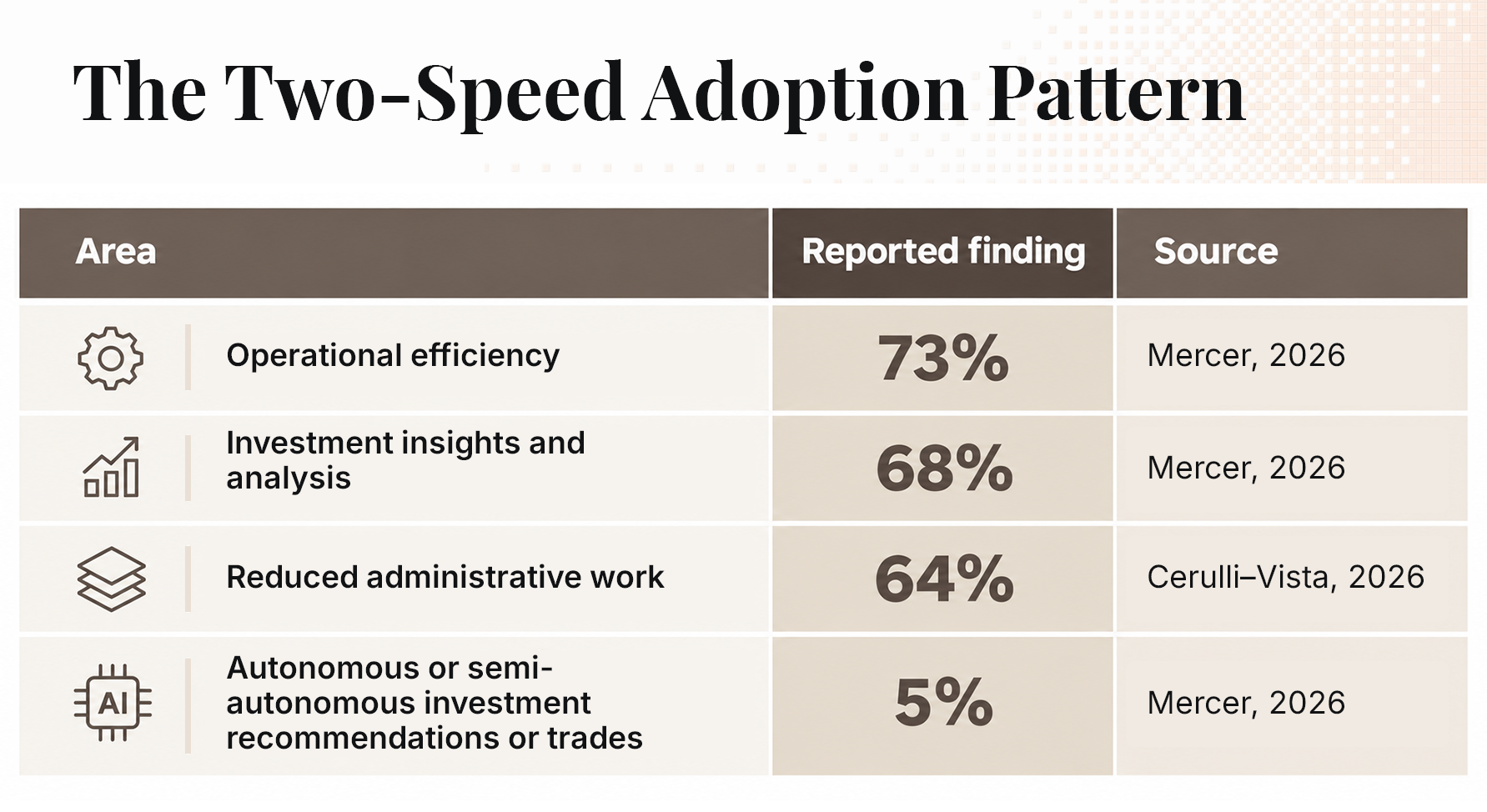
This can be described as AI operating across research and operations while remaining “on a short human leash” inside investment decisions. The observation captures the industry’s adoption divide.
A more constructive interpretation is that firms allocate autonomy according to the accountability attached to each task.
The question, therefore, is not why investment managers are holding back. It is whether they are designing the right boundaries.
Why Does the Investment Decision Stay Human by Design?
Investment models can process decades of historical information, identify correlations, and generate portfolio scenarios. They can even identify patterns that an analyst might overlook. However, fiduciary responsibility, explainability, and the economics of investment edge make a compelling case for keeping humans in control of material decisions.
Delegating Fiduciary Responsibility
In investment management, judgment is part of the product. AI can strengthen research and analysis, but investment professionals remain accountable.
JPMorgan Asset Management illustrates this distinction. Its Analyst Moneyball tool uses machine learning to identify potential analyst biases, while Trader Moneyball supports equity trading. Large language models assist internal operations but do not make portfolio investment decisions.
Vanguard follows a similar approach. Its quantitative investment practice uses machine learning models, while experienced professionals define their objectives, establish operating boundaries, validate implementation, and review portfolio actions.
As Cesar Orosco, head of Vanguard Quantitative Equity, put it in a November 2026 interview, human judgment matters: “At the beginning, the middle, and the end.”
AI can inform investment decisions and challenge assumptions. The responsibility for those decisions remains human.
Explainability Is an Obligation, Not an Optional Feature
An investment decision must be defensible. A client, board member, regulator, or investment committee may reasonably ask:
- Why was a particular exposure introduced?
- Which assumptions informed a recommendation?
- How was a specific risk identified?
- Which data influenced the model’s output?
- Who reviewed and approved the final decision?
A model that produces a sophisticated answer without a reconstructable rationale creates an accountability problem.
This is where explainability becomes an operating requirement, not an optional feature.
Firms need traceability across:
- Source data and its provenance.
- Model versions and configurations.
- Prompts and generated outputs.
- Assumptions and validation results.
- Human interventions and final approvals.
Can AI Create a Sustainable Investment Edge?
Another reason to keep judgment central: analytical capabilities are becoming more accessible.
When competing firms use similar foundation models, comparable datasets, and familiar analytical techniques, access to AI alone becomes less distinctive. A faster summary is useful, but its advantage may diminish as similar capabilities become commonplace.
The differentiators increasingly lie in:
- Proprietary data and institutional knowledge.
- Investment philosophy and research quality.
- Process discipline and governance.
- The ability to interpret evidence.
- Integration between analytical systems and investment workflows.
McKinsey’s July 2025 analysis5 estimated that AI, generative AI and agentic AI could affect 25% to 40% of an average asset manager’s cost base.
This is an estimate of potential economic impact, not a realized saving or investment-performance forecast.
The implication is significant. AI can change the economics of delivering investment services by improving capacity and reducing costs. The enduring advantage still depends on the quality of the firm’s judgment, data, and operating model.
Three forces, one conclusion: the human gate is where accountability lives.
How Do Conversational AI Chatbots Transform Customer Experience?
Where Does the Competitive Advantage of AI in Investment Management Actually Compound?
AI does not need to own the final investment decision to create value. Its advantage compounds across four areas: research compression, operational scale, wealth personalization, and portfolio intelligence. Each creates capacity, improves efficiency, or strengthens the quality of information available to professionals.
Better Investment Research
Research teams have always faced an asymmetry: the volume of information available to them grows faster than their capacity to examine it.
Consider an analyst reviewing a company’s quarterly results. Alongside the earnings release, hundreds of pages of regulatory filings, management commentary, analyst transcripts, industry reports, and alternative data may be available.
A meaningful detail could be buried in a footnote or emerge only when you compare several documents.
AI can compress this research cycle.
Natural language processing and generative AI can:
- Extract relevant information from regulatory filings.
- Summarize earnings calls and management commentary.
- Compare disclosures across reporting periods.
- Identify inconsistencies across documents.
- Classify signals and surface relevant relationships across datasets.
The analyst then spends more time examining the implications and less time hunting for information.
Investment research, distribution, and operations are areas where early industry examples indicate meaningful potential.
It also warns that technology spending can increase without corresponding productivity gains when firms accumulate fragmented applications and technical debt.
The distinction is between faster information retrieval and better research capacity. The latter requires clean data, connected systems, and workflows that put relevant evidence in front of the right professional.
Creating Scale Across Investment Operations
Investment firms operate through a dense network of processes: reconciliations, corporate actions, fund accounting, regulatory reporting, document processing, and exception management.
Much of this work is repetitive, document-intensive, and governed by well-defined rules. It is therefore a natural environment for automation.
AI can:
- Extract information from unstructured documents.
- Compare records and identify discrepancies.
- Prepare exceptions for human review.
- Automate recurring reporting activities.
- Coordinate tasks across enterprise systems.
Agents can manage connected activities and reduce manual hand-offs between operations teams.
Enterprise adoption requires changes to how organizations allocate capital, govern risk, make decisions, and organize work.
A Deloitte survey6 of more than 660 technology executives found that nearly 75% expected their operating models to change over the next 12 to 18 months.
The implication for asset managers is straightforward. Automating individual tasks has limited value if the surrounding workflow remains fragmented. The larger opportunity lies in connecting processes while retaining exception handling and accountability.
Making Wealth Management More Personal with Generative AI
Personalization has long been constrained by economics. Advisors can offer deeper engagement to clients with complex needs, but manually preparing every meeting, reviewing every communication, and tailoring every interaction becomes difficult as client books expand.
Generative AI in wealth management changes this equation.
It can prepare client briefs, summarize previous interactions, draft follow-up communications and consolidate relevant information from different systems.
Advisors can use this context to spend more time understanding client priorities and less time assembling records.
AI-led workflow redesign can improve efficiency and expand the scope for more customized services.
Its central distinction is between firms that add AI to existing processes and firms that rethink their operating models.
How Can AI Support Portfolio Management without Taking Control?
Portfolio construction sits closer to the fiduciary core, but it still contains substantial work that AI can support without assuming decision authority.
AI applications in portfolio management include:
- Scenario generation and sensitivity analysis.
- Exposure analysis across asset classes.
- Portfolio constraint checking.
- Risk identification and monitoring.
- Investment guideline comparisons.
- Analysis of relationships across market variables.
These capabilities can help portfolio managers examine a broader set of possibilities before making a judgment.
Machine learning in portfolio optimization can also help process complex relationships across asset classes, market variables, and portfolio constraints.
Acuity Analytics’ 2026 survey7 found significant AI impact in portfolio management at 64%, compared with 26% in regulatory compliance.
The result suggests that AI is already influencing analytical work close to the investment process. It does not establish that machines are independently directing portfolio decisions.
Vanguard’s quantitative equity model offers a practical illustration. Its models generate portfolio actions according to established investment principles and risk controls. Human professionals design, validate, and review the process.
The technology expands analytical capacity while preserving the investment philosophy that governs its use.
Where the Advantage Compounds
| Area | AI’s Contribution | Where Human Judgment Remains |
|---|---|---|
| Investment research | Document synthesis, signal identification and comparative analysis | Interpreting evidence and forming conviction |
| Middle-office operations | Reconciliation, exception detection and reporting | Resolving material exceptions and approving outcomes |
| Wealth management | Client summaries, communication drafts and meeting preparation | Understanding client priorities and delivering advice |
| Portfolio workflows | Scenario analysis, risk identification and constraint checking | Portfolio approval and investment accountability |
The common thread is capacity. Each application gives professionals more room to perform work that requires context, discretion, and accountability.
The advantage compounds when these capabilities operate together on reliable data and a coherent architecture.
How Should Investment Firms Approach Agentic AI?
Agentic AI introduces a more consequential question than whether a model can generate an investment insight. It can execute sequences of tasks, interact with enterprise systems, and complete workflows with limited human intervention. The challenge is deciding where that authority should begin and end.
For asset managers, the answer is increasingly yes. The more important question is where agents should operate independently and where human approval remains essential.
Agentic AI Adoption in 2026
KPMG’s Q1 2026 Quarterly AI Pulse Survey8 found that 39% of asset management and private equity organizations were actively scaling, deploying, or orchestrating AI agents. This was up from 24% in Q4 2025.
Its earlier survey also found that 68% of firms were piloting agents. The progression reflects growing confidence in deployment, alongside continuing investment in governance.
It is wise to describe firms layering generative AI agents onto existing workflows and training them as task specialists.
This is a pragmatic starting point: agents can operate within established processes before firms consider more extensive workflow redesign.
There’s a possible evolution from task-level automation towards agentic systems that coordinate multistep activities across advisor, client service and operational teams.
What Does Earned Autonomy Mean for Investment Firms?
The right operating principle is earned autonomy.
An agent should acquire greater authority as its reliability, performance, and controls are demonstrated. Its autonomy should reflect the task’s risk, the quality of available evidence, and the consequences of an incorrect action.
For example:
- Document Processing: An agent extracts information from capital call notices, compares it with internal records and prepares a reconciliation. A human reviews discrepancies before updating records.
- Investment Reporting: An agent consolidates portfolio information, prepares commentary, and routes the draft for compliance review.
- Client Servicing: An agent retrieves relevant account information, prepares a response, and escalates sensitive or complex queries.
- Portfolio Decisions: An agent may generate scenarios and identify risks, while accountable investment professionals retain decision authority.
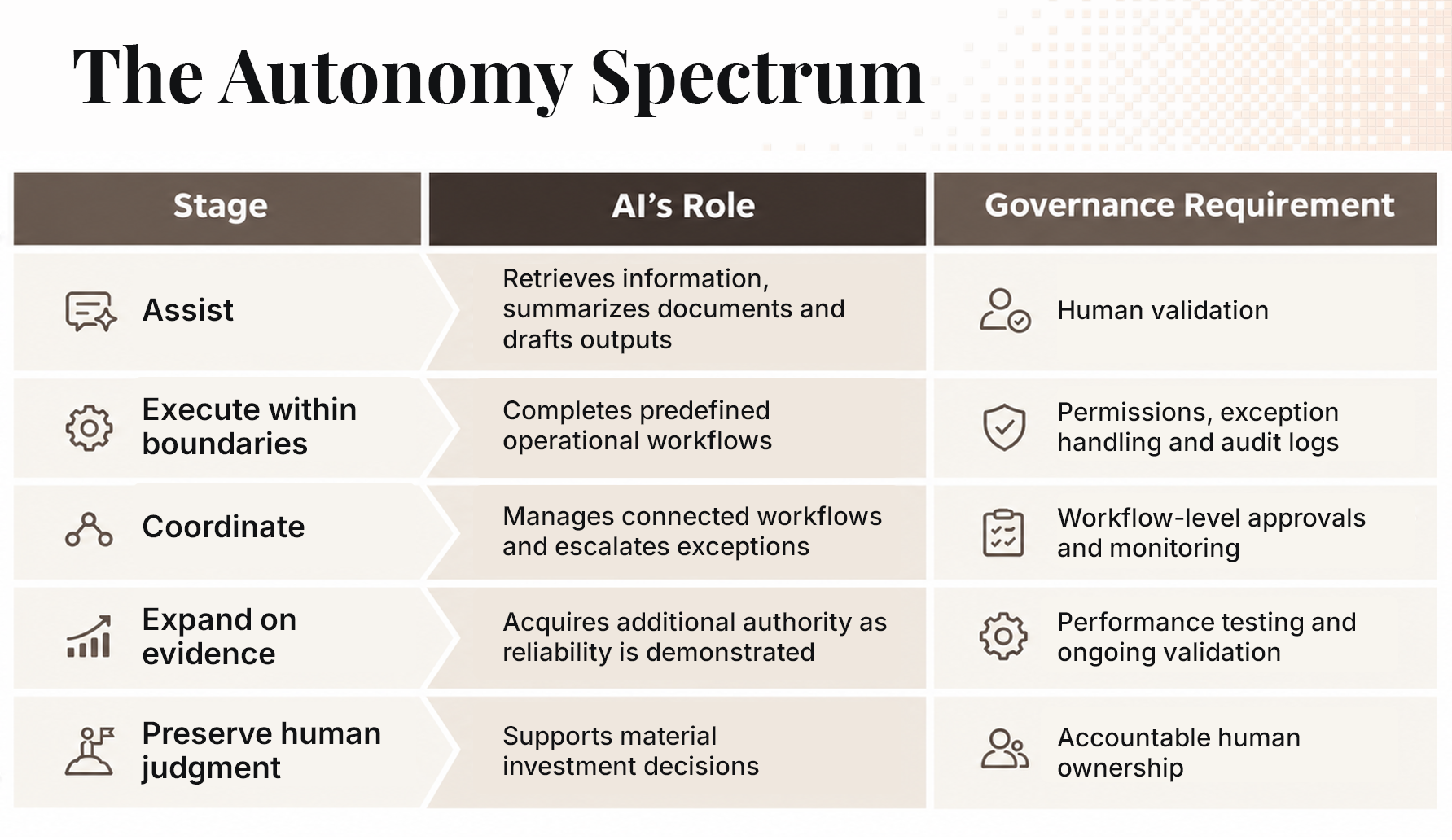
This is where agentic engineering becomes important. Firms need to design permissions, workflow orchestration, escalation logic, monitoring and recovery mechanisms alongside the agents themselves.
To access the engineering depth behind this approach, read How to Build an AI Agent.
An agent in production inside defined boundaries represents genuine progress. An agent described without its boundaries is marketing.
How Are AI Claims Changing Under Regulatory Scrutiny?
Investment firms have another reason to be precise about their AI capabilities: regulators and institutional investors increasingly expect technology claims to withstand scrutiny. The gap between what a firm says its AI can do and what its workflows actually demonstrate can create disclosure and reputational risks.
What Does the SEC’s Enforcement Record Tell Investment Firms?
The US Securities and Exchange Commission has already established an enforcement precedent.
On March 18, 20249, the SEC announced settled charges against investment advisers Delphia (USA) Inc. and Global Predictions Inc. for making false and misleading statements about their purported AI use.
The firms agreed to pay $400,000 in combined civil penalties.
The significance extends beyond those individual cases. A firm’s statements about its AI capabilities must accurately reflect what its technology actually does.
There is a material difference between:
- Using a language model to summarize research.
- Employing machine learning to identify portfolio signals.
- Deploying an autonomous agent to execute a workflow.
Describing all three as equivalent AI capabilities creates an inaccurate picture of the firm’s operating model.
The SEC’s March 2024 actions demonstrate that overstating AI capabilities can have securities-law consequences. The relevant lesson for leadership is to ensure public disclosures, investor presentations, and internal governance records align with actual deployment.
How Can Boards and Allocators Distinguish Substance from Salespersonship?
This is also becoming an allocator due-diligence question.
Mercer’s 2026 AI in Asset Management research10 cautions investors against accepting broad AI claims without examining how the technology is implemented. Its findings show that 69% of respondents identified data quality and access as the principal barrier to further AI adoption.
The survey also found that 57% had between one and five dedicated AI specialists supporting development, implementation, or oversight.
The implication is that a sophisticated AI narrative may conceal a relatively modest operational capability.
A useful location test can help distinguish substance from salespersonship.
Boards and allocators can use a practical set of questions to assess whether an organization’s AI capabilities match its claims.
| Board or Allocator Question | What the Answer Should Establish |
|---|---|
| Where does AI operate? | The specific investment or operational workflows in which it is deployed. |
| What does it actually do? | Whether it retrieves, analyses, recommends, drafts or executes. |
| What limits its authority? | Permissions, approval gates and escalation conditions. |
| How is performance validated? | Testing methodology, error rates and ongoing monitoring. |
| Can its actions be reconstructed? | Data provenance, model versions, decision logs and human approvals. |
The distinction matters because the AI governance framework is no longer simply an internal technology concern. It affects disclosures, fiduciary oversight, investor confidence and institutional credibility.
Governance used to be the cost of using AI. Now it’s proof that a firm is using it responsibly.
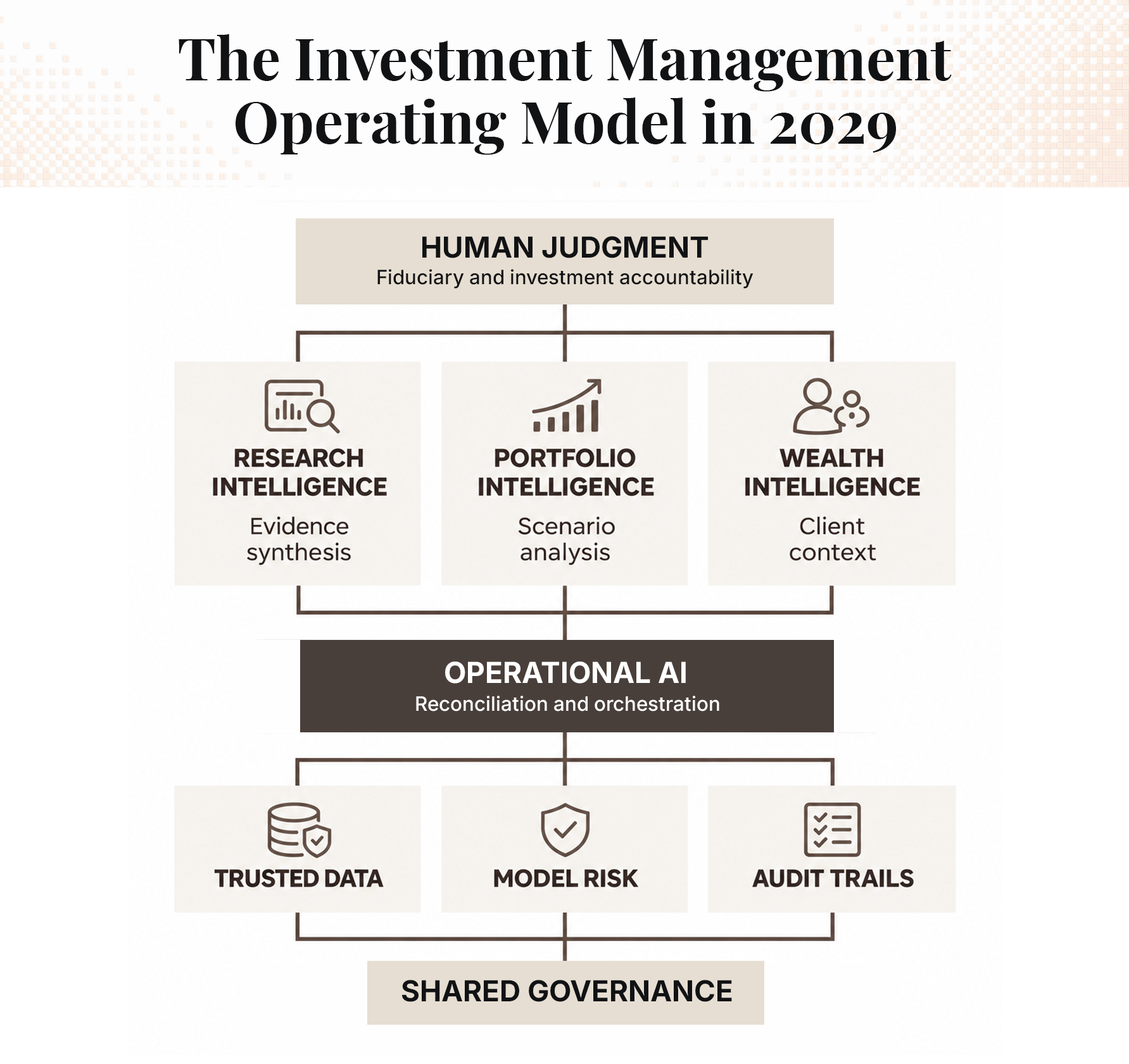
A well-governed architecture can answer these questions by design. It defines where models operate, which decisions require human approval, and how the organization reconstructs an AI-assisted outcome.
That is a more durable proposition than claiming to be an AI-first investment manager without being able to demonstrate what the phrase means.
How Should Investment Firms Engineer Earned Autonomy Over the Next Three Years?
The next three years will test whether investment firms can convert AI expenditure into a coherent operating advantage. The differentiator will be the ability to embed AI in reliable workflows, establish evidence-based autonomy, and retain clear accountability for material decisions.
What Should Change in the Investment Management Operating Model?
Governance must be designed at the functional level. Research synthesis, client communication, compliance monitoring, and portfolio construction have different risk profiles. They cannot operate under one undifferentiated set of permissions.
Each requires gates proportionate to its purpose and potential consequences.
Evidence thresholds must also become explicit. A workflow should demonstrate acceptable accuracy, reliability, resilience, and exception-handling performance before its autonomy expands.
Production monitoring should examine:
- Override frequency and recurring errors.
- Data drift and model performance.
- Failures across connected systems.
- Escalation and exception-handling effectiveness.
- Compliance with defined approval requirements.
Passing a demonstration is not the same as establishing operational reliability.
Auditability needs similar attention. An organization should be able to reconstruct which information an AI system accessed, which model generated an output, what actions followed, and where a professional intervened.
This evidence should be available to internal risk teams, compliance functions and relevant oversight bodies.
How to Secure Enterprise AI Systems: Development, Deployment, and Governance
How Will AI Change the Investment Management Workforce?
The workforce will evolve alongside the technology.
- Investment analysts will spend less time locating information and more time assessing its implications.
- Operations teams will shift towards exception management and process oversight.
- Wealth advisors will have more capacity for conversations that require an understanding of individual circumstances.
- Risk and compliance professionals will focus more closely on model behavior, auditability and governance.
- Technology teams will need stronger capabilities across data engineering, model validation and agent orchestration.
These changes also affect talent strategy.
KPMG’s Q1 2026 survey found that 89% of asset management and private equity leaders identified employee skill gaps as a barrier to demonstrating AI ROI.
The challenge is therefore as much organizational as technical. Firms need people who understand investment workflows, data, model risk and the engineering required to connect them.
The broader consulting evidence reinforces this direction. Firms may need to rethink operating models around agentic capabilities as baseline analytical tools become more accessible.
All in all, technology investment alone does not create operating leverage. The surrounding organization must change.
“The key is embedding governance into the technology itself, not treating it as a separate review step.”
– Mani Iyer, Chief AI and Technology Officer, Vanguard
This is also the position we have articulated through our Trustworthy AI doctrine: humans own judgment where money is decided, and autonomy is earned on evidence.
For financial services firms, translating that principle into production requires more than model selection. It requires engineering the gates, evidence mechanisms, integrations, and audit architecture that make AI dependable within real business workflows.
The competitive question for investment management leadership is therefore changing. It is no longer simply how much AI a firm can deploy. It is how much autonomy its systems have earned, where that autonomy creates measurable value, and whether the organization can demonstrate the controls behind it.
The firms that answer these questions well will have something more durable than an impressive AI portfolio. They will have an operating model in which technology expands capacity while human professionals retain the judgment that makes AI for investment management accountable.
The decision stays human by design. The advantage compounds around it.
References:
- [1]: Mercer
- [2]: KPMG
- [3]: Acuity Analytics
- [4]: Cerulli
- [5]: McKinsey
- [6]: Deloitte
- [7]: Acuity Analytics
- [8]: KPMG
- [9]: SEC
- [10]: Mercer
Frequently Asked Questions
AI supports investment research, portfolio analysis, risk monitoring, operational efficiency, and client servicing. Mercer's 2026 Artificial Intelligence in Asset Management Survey found that 55% of managers had integrated AI into at least one investment process, while 73% used it for operational efficiency. AI adoption is broadening, although autonomous investment decision-making remains limited.
AI is more likely to change portfolio managers' responsibilities than eliminate the need for their judgment. It can analyze information, identify patterns, generate scenarios, and support portfolio construction. However, investment professionals remain accountable for interpreting evidence, assessing suitability and approving material decisions. Vanguard's November 2026 investment research perspective illustrates this model, with human professionals designing, validating, and reviewing machine learning-driven investment processes.
Firms should prioritize research synthesis, document processing, reconciliations, reporting, and other well-defined operational workflows. These applications offer opportunities to improve capacity while keeping decisions within established control boundaries. Agentic workflows can expand as their reliability, auditability, and exception-handling capabilities are demonstrated. Material investment decisions should retain accountable human ownership.


