

Key Takeaways:
- Start with decision rights by defining which decisions humans own, what AI can signal, flag, draft, or execute within limits, and what evidence justifies greater autonomy.
- Build a complete AI inventory covering internally developed systems, embedded AI, employee tools, third-party models, and AI agents.
- Assign clear accountability by naming owners, defining approval authority, outlining governance council responsibilities, and establishing escalation paths for every AI use case.
- Govern the entire AI lifecycle through controls for design, development, deployment, monitoring, and retirement.
- Maintain an auditable trail of evidence covering approvals, testing, monitoring, incidents, remediation, and periodic reviews.
- Map governance to the appropriate standards and obligations, distinguishing voluntary frameworks, certifiable management systems, binding laws, and sector-specific rules.
As organizations move AI from pilots into business operations, governance must keep pace with deployment. For CIOs, CTOs, chief data officers, and risk leaders, the challenge is to expand AI use while maintaining accountability, managing risk, and keeping consequential decisions under appropriate human control.
The scale of adoption makes this urgent. Stanford HAI’s 2026 AI Index Report1, drawing on 2025 survey data, reports that 88% of surveyed organizations used AI in at least one business function, up from 78% in 2024. Yet adoption alone does not establish that organizations have adequate controls.

An effective enterprise AI governance framework must answer four questions:
- Which decisions can an AI system influence or make?
- Who remains accountable for its use?
- What safeguards apply throughout its lifecycle?
- What evidence supports its continued operation?
This guide explains how to build a governance structure that addresses these questions, maps relevant standards and legal obligations, and applies consistent principles across enterprise AI environments.
What an Enterprise AI Governance Framework Actually Governs
An AI governance framework defines who controls AI decisions, what systems may do, how risks are managed, and what evidence demonstrates accountability. An artificial intelligence governance framework must connect decision-making authority with organizational responsibilities, technical safeguards, and ongoing oversight.
A practical framework begins with a decision-rights register that establishes which decisions remain with humans, what AI systems may do, and what evidence is required before their authority expands.
Four supporting layers make these decision rights operational:
- 1. Inventory and Risk Classification: Identify the AI systems in use and assess their potential impact.
- 2. Operating Model and Accountability: Assign owners, approval authority, and escalation routes.
- 3. Lifecycle Controls: Apply safeguards from design and development through deployment, monitoring, and retirement.
- 4. Evidence Trail: Maintain records of decisions, approvals, testing, incidents, and reviews.
A standards map connects these layers to voluntary frameworks, certifiable management systems, binding laws, and sector-specific rules.
The approach is platform-neutral. Salesforce, Microsoft Power Platform, insurance systems, and AI agents require additional controls suited to their environments, but the underlying governance principles remain consistent.
How Should You Define AI Decision Rights Before Deployment?
A decision-rights register defines what an AI system may do, which decisions require human judgment, and what evidence would justify expanding its authority.
The four levels of AI decision rights
| AI Role | Permitted Activity | Example |
|---|---|---|
| Signal | Surface relevant information. | Identify a change in customer behavior. |
| Flag | Highlight an exception for review. | Flag a potentially fraudulent transaction. |
| Draft | Prepare an output for human approval. | Draft a response to a customer complaint. |
| Act within limits | Execute bounded, reversible, logged actions. | Route a support request to an approved queue. |
These levels represent increasing authority, not an automatic progression. Human decision-making remains essential wherever money, coverage, care, or rights are at stake. AI can surface evidence and prepare recommendations, but a named person retains responsibility for consequential judgment.
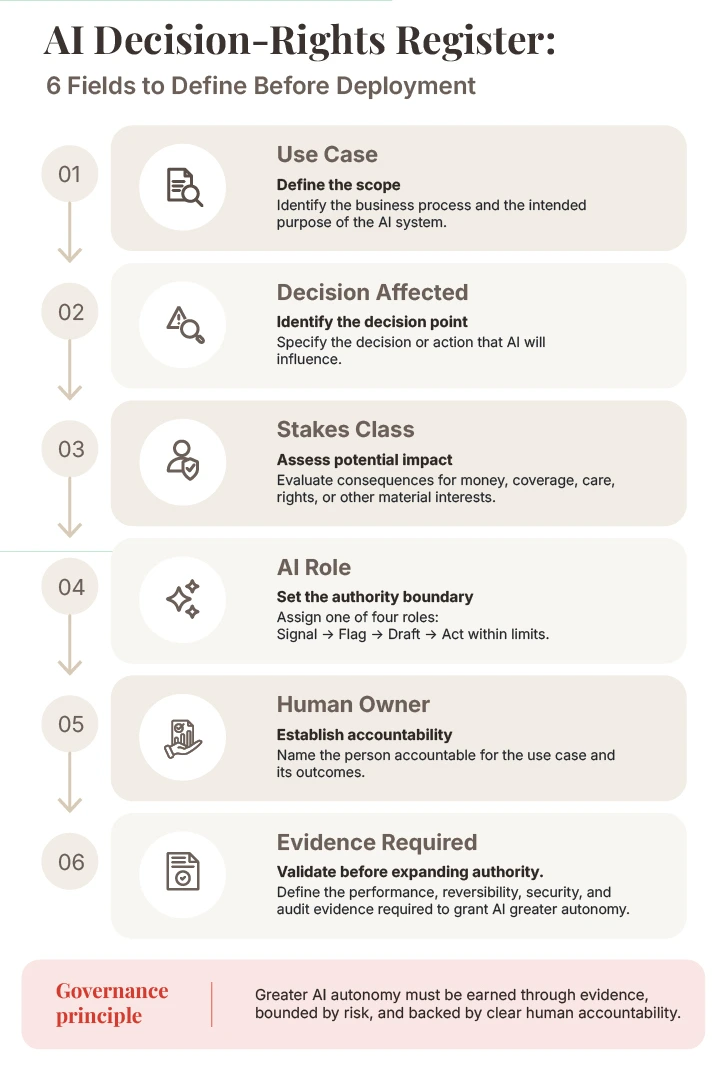
Consider a customer service agent. It may classify tickets, flag sensitive complaints, and draft responses. It might also update ticket categories automatically when the action is reversible and logged. That permission does not automatically extend to issuing refunds, denying claims, or making contractual commitments.
Expand Autonomy Only When Evidence Supports It
An AI system should gain additional permissions only after demonstrating reliable performance, appropriate security, reversibility, and satisfactory audit results. A vendor release or successful demonstration alone does not justify greater authority.
Agentic systems also introduce risks such as prompt injection and unauthorized API access. The register establishes which actions an agent may take, while technical controls enforce those boundaries.
Enterprises can start by documenting a small set of existing AI use cases and identifying unclear ownership, excessive permissions, and decisions that need stronger oversight. Damco can discuss how to structure an initial register around these use cases and their risk priorities.
“Every organization is going to be spending millions, if not billions, of dollars on AI governance just as they’re spending it now on data protection and privacy. They need to be educated about how to think about it and spend those dollars wisely.”
– Kevin Werbach, Vice Dean, The Wharton School.
How Do You Operationalize Enterprise AI Governance?
Operationalizing AI governance requires more than defining policies; it means embedding clear responsibilities and risk-based controls into everyday operations. Three foundational layers help organizations identify AI systems, establish accountability, and enforce safeguards throughout the AI lifecycle.
Layer 1: Inventory and Risk Classification
An organization cannot govern AI systems it has not identified. An AI inventory should cover internally developed applications, purchased software with embedded AI, employee use of general-purpose AI tools, third-party models, and AI agents.
Classify each use case across three dimensions.
- Business Stakes: Does the system affect financial decisions, insurance coverage, healthcare, employment, access to services, or legal rights?
- Regulatory Exposure: Which laws, contractual obligations, and sector rules may apply?
- Autonomy: Does the system surface information, flag exceptions, draft outputs, or execute actions?
These dimensions help determine the controls each use case requires. Risk classification should reflect the system’s purpose and potential consequences, not just its department or technical sophistication.
Address Shadow AI
Employees may adopt unapproved AI tools to complete legitimate tasks. Prohibiting these tools without addressing the underlying need can limit the organization’s visibility.
Provide practical approved alternatives, clear data-handling rules, and a straightforward process for requesting new tools. Integrate inventory updates into procurement, security reviews, and application onboarding.
The inventory must remain current as systems, integrations, and permissions change.
What Are the Key Gaps Hindering Enterprise AI Adoption, and How Can Organizations Address Them?
Layer 2: The Operating Model: Owners, Councils, and Escalation
Every AI use case needs a named owner, an approval path, and an escalation process. Without these, policies can exist on paper while accountability remains unclear.
Assign responsibilities across the organization:
- Business Owner: Accountable for the use case and business decisions affected by AI.
- Technology Owner: Responsible for implementation, configuration, performance, and maintenance.
- Risk, Legal, and Compliance Teams: Assess relevant risks and obligations.
- Security and Privacy Teams: Review access, data handling, and security controls.
- AI Governance Council: Approves, rejects, or escalates use cases within its delegated authority.
- Internal Audit: Independently evaluates governance processes and controls.
The governance council must have authority to say no. Its charter should define which projects it can approve, block, or return for additional evidence. Material changes to a system’s purpose, permissions, or affected decisions should trigger review.
Integrate AI governance into existing risk, security, privacy, and architecture forums where practical. Provide role-based training so employees understand the controls relevant to their responsibilities.
Layer 3: Lifecycle Controls From Design to Retirement
AI governance must cover the full lifecycle. A system approved during development may become unsuitable when its data, integrations, or use changes.
I. Design
Document the system’s purpose, stakes, data requirements, permitted AI role, and accountable owner. Identify foreseeable misuse, applicable obligations, and conditions requiring renewed approval.
II. Develop
Test accuracy, robustness, bias, data quality, and security. For generative AI and agents, examine prompt injection, sensitive-data exposure, unauthorized tool access, and unintended actions. Document test results and unresolved risks.
III. Deploy
Require approval against the decision-rights register. Enforce access controls, data protection rules, human approval gates, logging, and execution limits.
Runtime enforcement is important because policies must hold during actual system use. Gateways, access controls, and monitoring can restrict model requests or data flows. However, these controls cannot replace business accountability, lifecycle reviews, or human decision rights. Runtime enforcement is one layer of controls, not the framework itself.
IV. Monitor
Track performance, drift, usage, cost, incidents, and compliance with approved permissions. Define thresholds for investigation, restriction, or suspension. Review material changes to models, data sources, and integrations.
V. Retire
Revoke credentials, disable integrations, meet data retention requirements, preserve necessary records, and document closure.
Each lifecycle stage should have a clear owner, approval requirement, and record of the controls applied.
Layer 4: The Evidence Trail
An AI audit trail should make governance decisions and control performance verifiable. It is architecture, not paperwork: the evidence must be generated and maintained as systems operate.
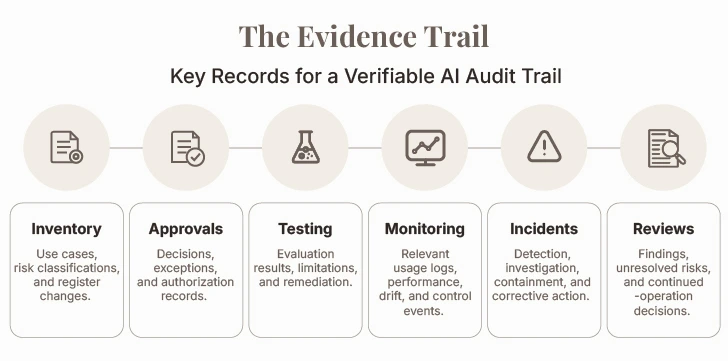
Retention and access rules should reflect legal obligations, contractual requirements, and data sensitivity.
When an incident occurs, investigate both the immediate failure and the governance conditions that permitted it. Update the register, permissions, tests, or deployment controls where necessary.
Liminal’s enterprise governance guidance recommends quarterly policy reviews rather than relying only on annual updates. A quarterly cadence can serve as a starting point, with additional reviews for high-risk systems and material changes.
The evidence trail also determines whether to expand autonomy. Successful testing and monitoring may support additional permissions. Missing records, unresolved incidents, or weak controls should hold the system at its current level.
“If you see any agent or model’s output as a black box, it’s very difficult to explain to the regulators or auditors.”
– Naresh Dulam, Senior Vice President of Software Engineering.
How Do AI Governance Frameworks, Standards, and Laws Differ?
Enterprises must distinguish voluntary frameworks, certifiable management systems, binding laws, and sector-specific rules. They serve different purposes and are not interchangeable.
| Reference | Classification | Purpose and Status |
|---|---|---|
| NIST AI Risk Management Framework2 | Voluntary framework | Structures AI risk management around four functions: Govern, Map, Measure, and Manage. |
| NIST Generative AI Profile3 | Voluntary guidance | Addresses risks associated with generative AI. Published in July 2024. |
| OECD AI Principles4 | International policy principles | Covers trustworthy AI, human rights, transparency, privacy, and safety. Updated in May 2024. |
| ISO/IEC 42001:20235 | Certifiable management system standard | Specifies requirements for establishing, maintaining, and continually improving an AI management system. Certification is not universally mandatory. |
| EU AI Act6 | Binding law | Establishes legal obligations for covered AI systems and actors, with phased application. |
| NAIC AI Guidance7 | Sector-specific regulatory guidance | Addresses insurer AI governance and compliance with applicable insurance requirements. Legal effect depends on state adoption and implementation. |
How Should Enterprises Choose a Starting Point?
NIST AI RMF provides a flexible structure for managing risk. ISO/IEC 42001 can help formalize management processes and accountability. The EU AI Act creates enforceable obligations for covered systems and organizations. Sector rules may add further requirements.
The EU AI Act entered into force on August 1, 2024. Check its application dates and phased provisions against the current consolidated text and the European Commission’s official implementation timeline. Do not rely on older summaries where amendments may affect an obligation’s timing.
US enterprises should similarly check applicable federal and state measures, distinguishing enacted requirements from proposals.
For insurers, the NAIC Model Bulletin on the Use of Artificial Intelligence Systems by Insurers was adopted in December 2023. Its effect depends on the relevant state’s adoption and implementation. See the guide to AI use cases in insurance policy administration for sector-specific considerations.
These references can work together. A decision-rights register and the four governance layers provide a common structure you can map to applicable frameworks and obligations.
How Are Conversational AI Chatbots Transforming Customer Engagement and Business Operations?
What Are the AI Governance Best Practices?
Effective AI governance starts with clear decision rights, risk-based controls, accountable ownership, and lifecycle oversight. Enterprises should enforce runtime permissions, maintain auditable evidence, align controls with applicable standards and laws, and expand AI autonomy only when supported by evidence.
Apply these practices in order:
- 1. Define decision rights before drafting policies.
- 2. Inventory the AI estate, including embedded AI, third-party systems, and agents.
- 3. Classify risk by business stakes, regulatory exposure, and autonomy.
- 4. Assign owners and give governance councils explicit approval authority.
- 5. Apply lifecycle controls from design through retirement.
- 6. Enforce permissions at runtime using appropriate access, data, and execution controls.
- 7. Maintain an evidence trail covering approvals, tests, monitoring, and incidents.
- 8. Map applicable standards and laws by class and current status.
- 9. Review systems regularly and after material changes.
- 10 Expand autonomy on evidence, not by default.
Recent research reinforces why these practices matter. In EY’s September 2026 survey9 of 202 senior AI executives at large US companies, 98% reported formal AI governance policies, yet 47% said their organizations had previously bypassed governance processes for urgent deployments. EY also found that 49% of respondents whose organizations used agentic AI had not updated their governance frameworks to address agent-specific risks. These findings point to an implementation gap between written policy and operational practice.
Extend the Framework to Your Platform and Sector
The enterprise framework provides common principles. Implementation requires platform-specific controls.
- Salesforce: Address Einstein governance, the Trust Layer, and shared responsibility.
- Microsoft Power Platform: Address governed low-code adoption, connectors, permissions, and data access. For guidance on governing AI agents built with Power Platform, see our dedicated Power Platform AI agents governance guide.
- Insurance: Connect enterprise governance to insurance requirements and policy administration processes.
- AI Agent Development: Establish clear governance for AI agent development by defining tool access, instruction handling, execution boundaries, and the controls required to expand autonomy safely.
These resources should complement the enterprise framework rather than duplicate it.
A Published Framework in Practice: Damco’s Trustworthy AI Commitments
A published framework lets customers and stakeholders review an organization’s stated approach to AI governance.
Damco’s Trustworthy AI describes its approach to AI strategy, architecture, deployment, governance, and responsible AI considerations, including reliability and safety, privacy and security, fairness, and transparency.
This provides a reference for discussing how governance principles connect to architecture and implementation. Enterprises must still define their own decision rights, assign accountable owners, select appropriate lifecycle controls, and maintain evidence for their systems.
A published responsible AI framework can inform vendor evaluation, but it does not replace an organization’s own risk assessment or legal review.
For teams planning new AI applications or extending existing systems, Damco’s AI development services can be a starting point for discussing how to build AI systems under a defined governance approach. The conversation can focus on current use cases, human decision ownership, required controls, and evidence needs. The appropriate scope depends on the organization’s systems and requirements.
References:
Frequently Asked Questions
An AI governance framework defines decision rights, assigns accountability, manages risk, and maintains evidence throughout the AI lifecycle. It establishes what AI systems may do, which decisions require human judgment, and which controls apply to each use case. A practical framework starts with a decision-rights register, then moves to inventory and risk classification, an operating model, lifecycle controls, and an evidence trail. It also maps relevant voluntary frameworks, management standards, laws, and sector-specific rules.
The key components of enterprise AI governance are a decision-rights register and four layers: inventory and risk classification, operating model, lifecycle controls, and evidence trail. The register defines permitted AI roles, affected decisions, stakes, accountable owners, and evidence needed to expand autonomy. The supporting layers establish which systems are governed, who approves them, how controls operate, and what records demonstrate effective oversight.
The appropriate AI governance standards depend on regulatory exposure, business activities, customer requirements, and risk-management needs. NIST AI RMF provides voluntary guidance, ISO/IEC 42001 specifies a certifiable management system, and the EU AI Act establishes binding obligations for covered systems and actors. Sector-specific rules may add further requirements. Enterprises should map applicable references to their governance controls and verify current legal status against official sources.
The standard itself does not universally require ISO/IEC 42001 certification. ISO/IEC 42001:2023 specifies requirements for establishing, implementing, maintaining, and improving an AI management system. Certification may support customer assurance or procurement requirements, but whether it is necessary depends on applicable laws, contracts, and market conditions. Organizations should verify the specific requirement before treating certification as mandatory.
Govern AI agents by defining permitted actions, restricting access, testing behavior, monitoring execution, and requiring evidence before expanding autonomy. Record each agent's purpose, affected decisions, stakes, owner, and permitted role in the decision-rights register. Use bounded permissions, human approval for consequential decisions, and logging for actions. Test for prompt injection, unauthorized API access, and other relevant risks. Expand permissions only when performance, security, reversibility, and audit results justify the change.


