

Key Takeaways:
- HL7 and FHIR serve different needs, with FHIR offering a more modern, API-based approach to healthcare data exchange.
- HL7 remains widely used for connecting legacy healthcare systems and exchanging clinical data.
- FHIR supports modern digital healthcare through RESTful APIs and modular data resources.
- Organizations may need both standards to modernize interoperability without disrupting existing systems.
- Successful interoperability requires more than standards, including strong integration, data governance, security, and system architecture.
If you are searching for HL7 vs FHIR, you will quickly find conflicting answers. Some guides describe FHIR as the replacement for HL7. Others explain why hospitals still rely on HL7. The confusion is understandable because the question itself mixes two related things.
FHIR is actually a standard developed by HL7 International. The more useful comparison is therefore HL7 v2 vs FHIR: an established messaging standard versus a newer, API-focused approach to exchanging healthcare data.
That distinction matters when you are connecting an EHR, building a healthcare application, modernizing integrations, or preparing for interoperability requirements. The need for that interoperability is already widespread: 76% of US hospitals reported engaging in all four measured interoperability activities in 2025: sending, receiving, finding, and integrating electronic health information.1 This guide explains what each standard does, which projects fit each one, and how healthcare organizations can use both together.
The discussion also has a practical deadline. New interoperability requirements are making FHIR-based APIs increasingly important, particularly for payers. For organizations planning their next integration project, the question is no longer simply what works today. It is what needs to work next.
With experience across healthcare technology and insurance operations, Damco approaches the question from both sides of that equation: the systems organizations already have and the interoperability capabilities they need to build.

What Is HL7, and What Standards Does It Include?
“HL7” does not refer to a single standard. It is a family of standards developed by HL7 International for exchanging healthcare information.
The best-known member is HL7 v2. It has been used for decades to move events such as admissions, discharges, orders, and lab results between healthcare systems. A typical v2 message consists of pipe-delimited segments and fields and is commonly exchanged through interface engines using protocols such as MLLP.
HL7 v3 took a more formal approach to healthcare information modeling. It was an ambitious attempt to bring greater consistency to healthcare messaging, but it did not achieve the widespread adoption of v2.
CDA, or Clinical Document Architecture, addresses a different need. Rather than sending individual events, CDA structures clinical documents such as patient summaries and transition-of-care records.
The HL7 Family at a Glance
| Standard | Primary Role | Typical Use |
|---|---|---|
| HL7 v2 | Event-Based Messaging | Admissions, Orders, Results, EHR Integrations |
| HL7 v3 | Structured Messaging and Information Modeling | Limited Adoption Compared With v2 |
| CDA | Clinical Document Exchange | Patient Summaries, Referrals, Transitions of Care |
This distinction matters because HL7 v2 is sometimes described too broadly or inaccurately. HL7 v2 is not an XML-only standard. Its familiar pipe-delimited message format is one reason it remains deeply embedded in hospital and laboratory integrations.
That longevity also explains why FHIR did not simply make HL7 v2 disappear. Healthcare organizations have decades of systems, interfaces, and workflows built around these standards.
And that brings us to FHIR: another HL7 standard, designed around a very different way of making healthcare data available.
How AI in Healthcare Is Transforming Patient Care and Clinical Operations
What Is FHIR and Who Made It?
Here is the correction that makes the HL7 vs FHIR debate easier to understand: FHIR is not a competing standard created outside the HL7 family. HL7 International developed FHIR. The useful comparison is therefore HL7 v2 versus FHIR.
FHIR takes a different approach to exchanging healthcare data. Instead of sending fixed event messages, it organizes information into modular resources such as Patient, Encounter, and Observation. These resources can be accessed through web-based APIs, typically using REST with JSON or XML.
The ecosystem goes further. FHIR R4 remains the key baseline for many current implementations, while R5 is the newer published release. US Core profiles define how FHIR is applied to common US healthcare use cases. SMART on FHIR provides a framework for securely launching applications against FHIR-enabled systems, while Bulk FHIR supports large-scale data exchange for predictive analytics and population health.
“Most people think about FHIR as a technical specification, but I look at it first of all as a community.”
– Grahame Grieve, Principal at Health Intersections Pty Ltd.
The design goal is straightforward: make healthcare data easier to access and use through technologies familiar to modern application developers.
How Does HL7 v2 Compare with FHIR?
HL7 v2 is best suited to established, event-driven system integrations, while FHIR is designed for modern APIs, applications, and data access.
The practical choice depends on the project: many healthcare organizations need both, with FHIR providing a modern API layer on top of existing HL7 v2 infrastructure.
The easiest way to understand FHIR vs HL7 is to stop asking which standard is better and look at what each one is built to do.
| Dimension | HL7 v2 | FHIR |
|---|---|---|
| Data Format | Pipe-Delimited Messages | JSON/XML Resources |
| Transport | Often MLLP | HTTPS/REST APIs |
| Data Access | Pushes Event Messages | Supports Search and Retrieval |
| Implementation | Highly Interface-Specific | Profiles Provide Greater Consistency |
| Developer Experience | Requires Healthcare Integration Expertise | Uses Familiar Web Technologies |
| Best Fit | Established System-to-System Messaging | APIs, Apps and Modern Data Exchange |
FHIR addresses several limitations of traditional v2 messaging, especially around API access and application development. But that does not make v2 obsolete.
Hospitals already have thousands of working v2 interfaces. They handle critical, high-volume events every day. Replacing that infrastructure simply because FHIR is newer would rarely make business sense.
So the practical answer is a division of labor: FHIR wins the API layer; HL7 v2 keeps much of the plumbing running underneath it.
Which Standard Is Best for Which Project?
There is no universal winner. The right standard depends on what you are building, what already exists, and what the project must support.
| Project | Best Fit | Why |
|---|---|---|
| EHR or Lab Integration | HL7 v2 + FHIR Where Available | Existing systems often speak v2; use FHIR APIs where the EHR supports them. |
| Patient-Facing App | FHIR | SMART on FHIR provides a practical route to connect applications with certified EHRs. |
| Payer Compliance | FHIR | CMS interoperability requirements make FHIR APIs central to these programs. |
| Population Analytics | Bulk FHIR | Designed for moving larger datasets rather than individual transactions. |
| Medical Devices / Legacy Systems | HL7 v2 | Established equipment and ancillary systems often depend on existing interfaces. |
| New Health-Tech Product | FHIR + v2 Ingestion | Build FHIR-native, but expect to ingest v2 data from the existing ecosystem. |
The decision also affects talent, timelines, and implementation effort. Route the project first. Then decide what skills and architecture it actually requires.
How Do HL7 and FHIR Work Together?
For most healthcare organizations, coexistence is not a compromise. It is the architecture. FHIR was never designed in isolation. As former HL7 International CEO Charles Jaffe noted, “The development and adoption of FHIR was advanced by a remarkable and committed international community.”
That is becoming clearer as FHIR moves from isolated implementations into broader national use. In 2026, 81% of countries surveyed reported using FHIR for at least a few national use cases, while 20% said it was already their main or near-main standard.2
The challenge is that FHIR is entering an ecosystem that already works. The goal, therefore, is rarely to discard existing connections. Instead, it gives newer applications a better way to access the data those connections already move.
The simplest way to picture it is as a translation layer between two worlds:
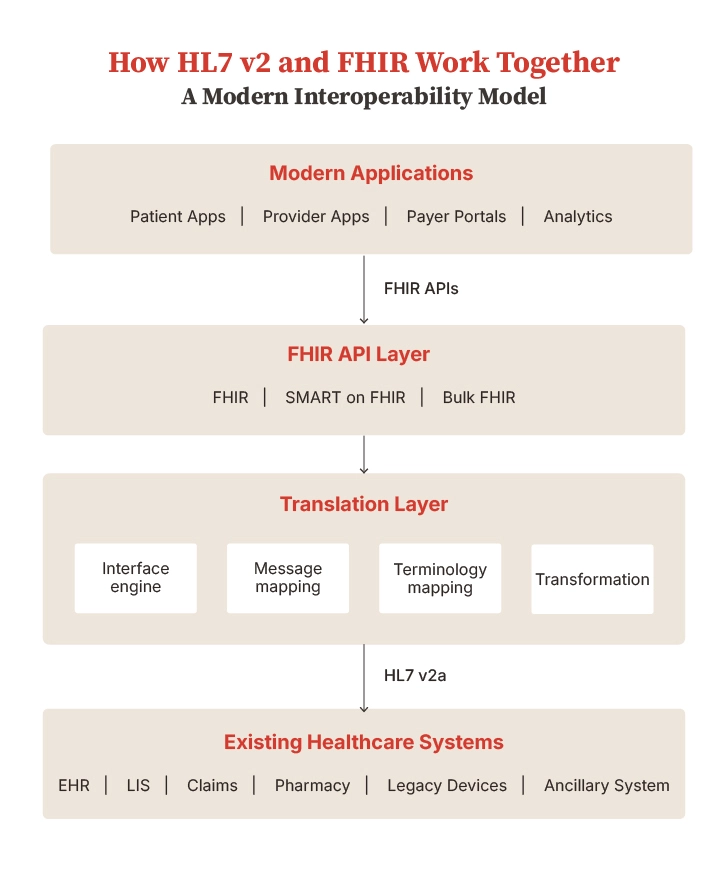
An interface engine can act as the translation hub between established HL7 v2 systems and newer FHIR applications. For example, a hospital admission sent as an ADT message can be mapped into FHIR `Patient` and `Encounter` resources.
The critical deliverable is the mapping specification: a clear definition of how fields, concepts, and terminology move from one model to another. Transportation is rarely the difficult part. Semantic mapping is. Different code systems, terminology bindings, and local conventions can make a seemingly simple exchange surprisingly intricate.
Another useful pattern is the FHIR facade. Instead of replacing legacy systems, an organization can place a modern FHIR API in front of them. New applications see a clean FHIR interface while the underlying v2 plumbing continues doing its job.
Bidirectional exchange requires another layer of discipline: conflict rules. If two systems change the same patient data, the architecture must determine which update prevails.
The practical goal, then, is not to choose one standard and discard the other. It is to make the two interoperate deliberately, rather than letting years of interfaces become an accidental architecture.
How Healthcare Digital Marketing Drives Sustainable Patient Growth
What Do the Latest FHIR Regulations Mean for Healthcare Organizations?
Healthcare interoperability is also scaling up. In June 2026, HHS reported that more than 1 billion health records had been exchanged through TEFCA, up from roughly 10 million in less than a year.3 The growth illustrates how quickly electronic health information exchange is expanding beyond individual interfaces and organizations.
“Healthcare is entering a new phase where interoperability is no longer optional; it’s foundational.”
– Rachel Dunscombe, CEO, HL7 International.
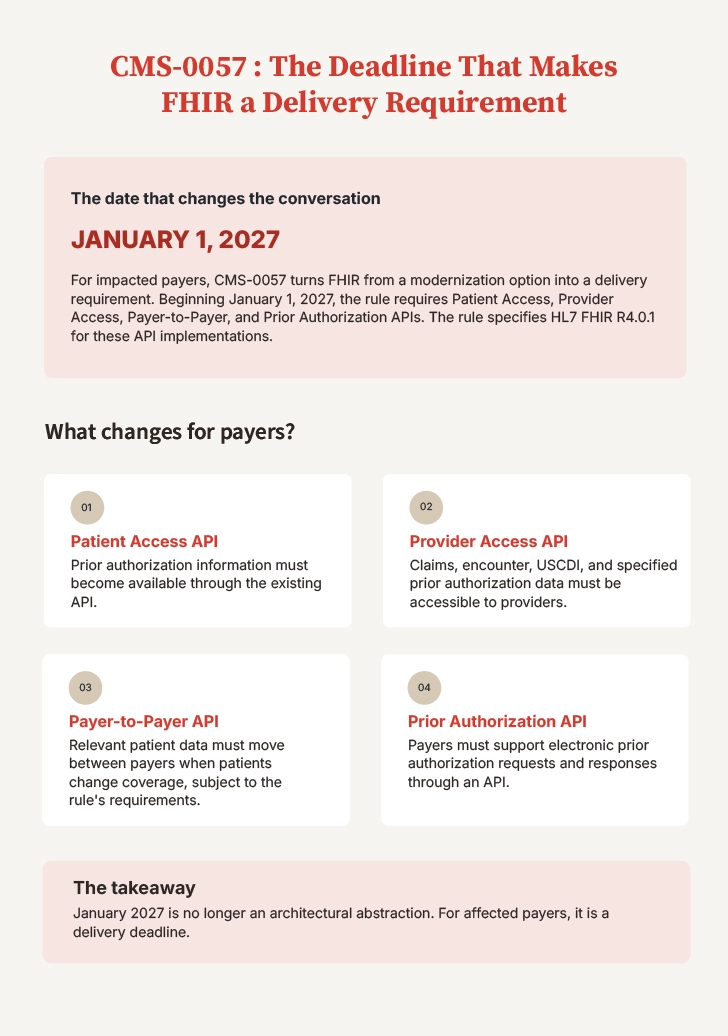
For payers, that broader shift now comes with a more immediate obligation. CMS-0057-F establishes API requirements for impacted payers, with major requirements taking effect January 1, 2027. FHIR is central to those requirements.
What Does HL7 and FHIR Integration Actually Involve?
Knowing which standard to use is only the starting point. Implementation looks different for each. That is not a minor concern. KLAS found that only 38% of organizations said their recent EHR implementation hit the mark, while 40% of healthcare leaders reported significant misses.4 For interoperability projects, the lesson is straightforward: the standard is only part of the work. Mapping, testing, governance, workflow alignment, and ongoing support determine whether the integration works in practice.
HL7 Integration
Inventory → Interface analysis → Mapping → Engine configuration → Testing → Maintenance
HL7 v2 projects are usually scoped per interface. The work includes understanding existing messages, mapping fields to the receiving system’s expectations, and testing against its local quirks.
FHIR Integration
API assessment → API build → Profile conformance → Application integration → Testing
FHIR work is typically scoped per API and profile. Engagements may involve EHR endpoints, SMART on FHIR applications, US Core conformance, or CMS implementation guides for regulatory programs.
The artifact that matters
Mapping Specification
This is where the real work becomes visible. A mapping specification defines how data moves between systems and flags where concepts, fields, and terminology don’t align cleanly.
The transport is often the straightforward part. Semantic mapping is where the intricacy lies.
That is the practical work behind healthcare data interoperability services: connecting established systems to newer APIs and applications without losing the meaning of the data along the way.
Where Damco Fits
Interoperability projects rarely begin with a blank sheet. A payer may need to modernize its APIs while keeping years of claims and policy systems running. A provider may need to expose FHIR data without dismantling the HL7 interfaces that still carry critical events.
That is where Damco fits.
Damco combines healthcare software development with healthcare IT consulting to work across both sides of the interoperability equation. Its teams can handle HL7 interface engineering, FHIR API programs, application integration, and the translation layer connecting legacy systems with newer applications.
The insurance perspective is particularly relevant for payer programs. Experience across healthcare claims and payer workflows provides context for projects where interoperability is tied to prior authorization, member data, provider access, and regulatory requirements. The same engineering foundation also supports healthcare app development where FHIR APIs become the bridge between applications and clinical systems.
The objective is practical: understand the existing interface landscape, determine where FHIR belongs, define the mappings, and build an architecture that can evolve without disrupting the systems already doing essential work.
For organizations facing a new interoperability requirement, the first step is often assessing what already exists, what needs to change, and what the compliance calendar leaves time to build.
References:
- 1. https://healthit.gov/data/quickstats/electronic-health-information-exchange-hospitals/
- 2. https://fire.ly/2026-state-of-fhir-report/
- 3. https://www.hhs.gov/press-room/onc-strengthens-tefca-one-billion-health-records-exchanged.html
- 4. https://klasresearch.com/archcollaborative/report/ehr-implementations-2025/628
Frequently Asked Questions
HL7 is the standards organization and the name commonly used for its family of interoperability standards. FHIR is one of those standards. In practice, the comparison usually means HL7 v2 vs FHIR: v2 uses event-based messaging, while FHIR uses resources and web-based APIs.
EHR integration services often use both standards to connect clinical systems and applications.
No. FHIR is itself an HL7 standard. FHIR is increasingly used for APIs and modern applications, while HL7 v2 continues to support a large installed base of healthcare interfaces.
With reference to HL7 vs FHIR, neither is universally better. The project determines the fit. Existing EHR and laboratory integrations may rely on HL7 v2, while new healthcare IT solutions, payer APIs, and modern data-access requirements increasingly call for FHIR.
Yes. In fact, this is a common enterprise architecture. An interface engine or translation layer can map HL7 v2 messages into FHIR resources, while a FHIR facade can expose modern APIs without replacing underlying legacy systems.
For impacted payers under CMS-0057-F, major API requirements generally begin January 1, 2027, including the Prior Authorization, Provider Access, and Payer-to-Payer APIs. The exact requirements vary by API and payer type, so implementation planning should be based on the applicable CMS provisions. FHIR-based interoperability also supports modern Rcm solutions by enabling efficient data exchange between payer and healthcare systems.


