EHR/EMR Integration Services
Want to exchange data securely across your healthcare ecosystem? Our EHR/EMR integration solutions connect EHRs with clinical, telehealth, laboratory, imaging, billing, and patient-facing systems, enabling seamless interoperability, real-time data exchange, and coordinated patient care.
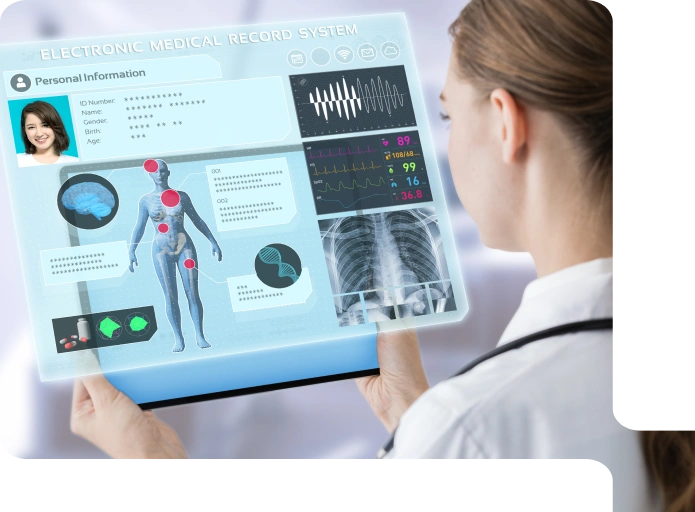
EHR/EMR Integration Solutions That Keep Care Teams, Systems, and Data in Sync
When EMR and EHR systems are poorly integrated, teams spend valuable time looking for records, reconciling duplicates, and filling in data gaps. Referrals become slower. Prior authorizations and billing rework increase. Telemedicine EMR integration becomes inconsistent across locations and tools.
Damco’s EHR/EMR integration solutions are centered around providing the correct information to the right workflow through reliable data integration, transparent interface management, and scalable integration patterns. We operate across APIs and interface engines, conform to your security and compliance requirements, and provide EMR/EHR integration to facilitate clinical, operational, and analytics use cases.

EHR Integration Services Built Around Care Workflows
We focus on how data needs to move across your teams, sites, and systems. Our EMR/EHR integration services support that flow without adding complexity.
HL7 and FHIR Integration
Design and deploy HL7 interfaces and FHIR APIs that keep EMR data integration uniform, correct, and easier to support over time.
Laboratory and Radiology Connectivity
Seamlessly connect all laboratory and imaging systems to your EHR to ensure orders, results, and reports return efficiently and without manual steps or missed updates.
Pharmacy and ePrescribing Integration
Embed ePrescribing, medication history, and safety alerts into daily EHR workflows to give clinicians the confidence to prescribe with fewer handoffs.
HIE Integration and Care Summary Exchange
Provide secure connectivity to HIE networks, including consent handling with Continuity of Care Documents, so the patient histories can travel with the patient.
Payer & Eligibility Integration
Automate checks for eligibility, prior authorization triggers, and claim status responses tied to events in EHRs to reduce rework and avoidable delays.
Third-party App and Device Integration
Connect telemedicine platforms, patient applications, and devices using SMART on FHIR and secure APIs so that data lands in the right workflow.
EHR/EMR Integration Solutions We Deliver
Connect your EHR or EMR with the healthcare systems your organization relies on. Our EHR/EMR integration solutions enable secure data exchange, real-time interoperability, and streamlined clinical and administrative workflows.
-
 Clinical Data Exchange Foundations
Set up HL7 and FHIR-based integrations that keep the EHR connected even as platforms evolve.
Clinical Data Exchange Foundations
Set up HL7 and FHIR-based integrations that keep the EHR connected even as platforms evolve. -
Lab and Imaging (PACS) Connections
Automate the routing of lab orders and imaging results to the chart so that teams receive reports quicker, with fewer follow-ups.
-
Telehealth and Patient Engagement Tools
Incorporate telemedicine EMR integration to keep visits, forms, messages, and notes linked to the patient record.
-
Practice Management and Billing Sync
Link the scheduling, charges, and claim events to lessen reworks and delays in getting payments settled.
-
Quality Reporting and Analytics
Develop dependable data sources for reporting and dashboards that enable leaders to track their metrics without the need for manual consolidation.
-
Custom APIs for Digital Health Vendors
Develop secure APIs that new tools can easily connect to, without interrupting core workflows or causing integration debt.


Reduce Integration Risk Before It Hits the Front Line.
Business Benefits of Our EHR/EMR Integration Solutions
When systems connect well, teams spend less time chasing information and more time moving care forward. These are the outcomes most leaders look for from EMR/EHR integration.
Less Manual Work Across Teams
Reduce duplicate entry, follow-ups, and handoffs by keeping data in the right workflow.
Faster Clinical Decisions
Make labs, images, medication, and notes available where clinicians work, not buried across systems.
Cleaner Revenue Operations
Automate eligibility, authorization, and claim event synching to avoid rework and preventable reimbursement delays.
More Consistent Patient Access and Virtual Care
Improve telemedicine integration with an EMR for scheduling, documentation, and follow-up.
Improved Reporting and Analytics
Improve measure tracking and dashboards by integrating more comprehensive and reliable EMR data.
Integration You Can Scale and Support
Standardize integrations across sites so new systems and vendors do not create new breakpoints.

Healthcare Outcomes Delivered by Our EHR/EMR Integration Company
Real examples of how global healthcare organizations partnered with Damco to improve reliability, efficiency, and control across patient-facing and back-office work.
Preserving Historic Data
Supported a national regulator of health and adult social care in the preservation of historical records, using stringent validation controls to protect accuracy and continuity.
Learn More
AS/400 Patient Record Modernization
Helped a healthcare organization modernize a patient record system based on AS/400 to improve usability, throughput, and operational efficiency.
Learn More
Extracting Patient Data Automatically
Automation of high-volume patient data extraction for a records management company provided efficiency gains, consistency, and audit readiness.
Learn More
Scale Care Delivery with Stable EHR Integrations.
EHR Integration Across Your Healthcare Ecosystem
EMR/EHR integration should enable the entire continuum of care, not just health records. We connect your EHR data to applications your teams use for access, care delivery, and operations.
Patient Portals
 Patient Portals
 Telemedicine Platforms
 Telemedicine Platforms
 Scheduling And Practice Management Systems
 Scheduling And Practice Management Systems
Billing And Revenue Cycle Tools
 Billing And Revenue Cycle Tools
Payer Connectivity for Eligibility and Prior Authorizations
 Payer Connectivity for Eligibility and Prior Authorizations
Laboratory Information Systems (LIS)
 Laboratory Information Systems (LIS)
Radiology And Imaging Systems (RIS/PACS)
 Radiology And Imaging Systems (RIS/PACS)
Pharmacy And ePrescribing Systems
 Pharmacy And ePrescribing Systems
Remote Patient Monitoring and Device Platforms
 Remote Patient Monitoring and Device Platforms
Analytics, Reporting, And BI Tools
 Analytics, Reporting, And BI Tools
Our EMR/EHR Integration Process
A clear, repeatable approach that reduces surprises and keeps clinical workflows protected. Each phase is designed for delivery, validation, and long-term support.
- 1 Discovery We verify workflows, identifying data sources, integration points, operational constraints, security, and compliance for clinical, operational, and security teams.
- 2 Integration Assessment & Plan We clarify the scope, priority, methods of integration (HL7/FHIR/API), timelines for rollout, and supporting the implementation.
- 3 Solution Design We establish the mapping of data to the interface, establish error handling processes, audit requirements, etc., to create a robust and maintainable design.
- 4 Build, Test, and Validate We develop the integrated system and perform functional testing to verify that integration functions correctly and perform regression and data validation testing prior to going live with the system.
- 5 Go Live & Support Monitoring We monitor data flows, resolve exceptions in real-time, and maintain integration as systems, vendors, and requirements evolve.
Why Choose Damco as Your EHR/EMR Integration Company
You need integrations that hold up in production, not just in a test environment. To keep data flowing consistently, Damco brings in engineering discipline, always- on support model, and healthcare context from day one.
We understand EHR ecosystems and clinical workflows, so the integrations fit how care is truly delivered.
We build on top of HL7, FHIR, and secure APIs so that EMR data integrations remain maintainable across changing platforms and priorities.
For HIPAA-aligned delivery, access controls, audit trails, and secure data handling are designed in from day one.
The design, implementation, testing, monitoring, and ongoing support are all done by one team, so ownership remains clear.
Latest Insights
Perspectives, trends, and insights shaping real decisions across the healthcare IT landscape.

Blog
Driving Patient-Centricity: The Role of Data Processing in Healthcare Industry
Learn how organized, accurate data supports smarter decisions, better care, and streamlined operations.

Blog
Data Mining in Healthcare: The Ultimate Guide to Improving Patient Outcomes
See how data mining reveals insights, patterns, and opportunities to improve care and outcomes.

Blog
Revenue Cycle Management in Healthcare: Reducing Denials and Accelerating Payments in 2026
Key Takeaways: Most RCM failures happen where disconnected healthcare systems hand off data. Revenue cycle management in healthcare works as...
Frequently Asked Questions
EHR/EMR integration services connect your EHR or EMR with healthcare systems such as labs, telehealth, billing, and patient portals to enable secure, real-time data exchange.
EHR/EMR integration solutions can connect laboratories, PACS, pharmacy systems, telehealth platforms, patient portals, HIEs, practice management, and billing systems.
Our EHR/EMR integration solutions support HL7, FHIR, DICOM, X12, and secure REST/SOAP APIs to enable seamless healthcare interoperability.
Yes. We integrate legacy applications with modern EHR platforms using APIs, HL7 interfaces, FHIR, and middleware while minimizing workflow disruption
An experienced EHR/EMR integration company delivers secure, standards-based integrations that improve interoperability, scalability, and long-term system performance.