

Executive Summary:
- The problem: Several top-ranked “best health insurance software” lists misattribute the industry’s leading core platform and mislabel a care-management system as a claims administrator.
- The correction: Health insurance software is five layers around one core. Core administration is the system of record; engagement, care management, payment integrity, and interoperability sit around it.
- The core vendors: TriZetto Facets and QNXT (Cognizant), HealthRules Payer (HealthEdge), InsureEdge (Damco), Oracle Health Insurance, and Plexis, each built for a different plan segment, not ranked against each other.
- The real decision: Most plans don’t pick one winning vendor. They buy the core, build the edges (portals, integrations, member experience), and extend legacy systems with modern APIs.
- The clock: CMS-0057-F requires four production FHIR APIs live by January 1, 2027, and industry surveys show payer readiness is still uneven going into that deadline.
- The first move: Confirm which layer you’re actually shopping in before you shortlist a single vendor. Composition, not selection, is the 2026 default.
Choosing health insurance software is rarely a one-quarter decision. The core platform a health plan selects will shape how it enrolls members, pays claims, and responds to regulators for the next decade.
Yet most searches for the best health insurance software return flat top-10 lists that rank CRMs, care-management tools, and claims engines side by side, as if they were interchangeable. A shortlist built that way sends leaders into vendor meetings asking the wrong questions.
This guide takes a different route. It maps the market by layer, places each platform in the segment it actually serves, and shows how health plans are building their stacks in 2026.

Look closer at the current top results, and the confidence on that shelf is misplaced. Some lists rank a population-health and utilization-management platform as if it were a core system that handles premium billing and claims adjudication.
These are category errors, and a buyer who trusts them walks into vendor conversations with a map that’s wrong at the center. Before the platform map, a quick reality check on why this decision is landing on C-suite desks right now.
What’s Driving Health Plan Technology Budgets in 2026?
Cost containment has remained the number-one challenge for health plan executives for the second consecutive year, according to HealthEdge’s 2026 Healthcare Payer Survey.1 The survey also found that 85% of health plan executives said regulatory pressures were significantly impacting margins.
A 2026 Black Book Research 2 study of 8,194 verified managed care and health plan respondents found that 86% prioritized prior-authorization and utilization-management modernization, while 82% cited interoperability, FHIR/API readiness and usable data exchange as essential to payer operations.
In plain terms: the same three layers this guide walks through, i.e., core, compliance-facing interoperability, and utilization management, are where 2026 technology spend is concentrating. That’s not a coincidence; it’s the market catching up to the compliance clock and cost pressure at the same time.
What Software Do Health Insurance Companies Actually Run?
Software for health insurance companies spans a layered stack. At the center: the core administration platform, sometimes shorthanded CAPS, for core administrative processing solutions, the system of record for enrollment, premium billing, claims adjudication, and member and provider data.
Everything else in the category integrates with that core. It doesn’t replace it, which is exactly where the flat “top 10” lists go wrong.
Here are the five layers, what each does, and who typically buys it:
| Layer | What It Does | Representative Leaders | Who Buys It |
|---|---|---|---|
| Core Administration | System of record: enrollment, premium billing, claims adjudication, member management, provider network management | TriZetto Facets, TriZetto QNXT, HealthRules Payer, InsureEdge, Oracle Health Insurance | COO/CIO, multi-year platform decision |
| Engagement & Broker/Member CRM | Member 360 view, service and self-service layer over the core | Salesforce Health Cloud | Marketing, member experience, broker relations |
| Care & Utilization Management | Population health, care coordination, UM workflows | ZeOmega Jiva | Medical management / clinical operations |
| Payment Integrity | Claims accuracy, overpayment recovery, cost containment | Cotiviti | Finance, program integrity |
| Interoperability & EDI | FHIR APIs, EDI transaction sets, clearinghouse connectivity | Edifecs (Cotiviti), regional clearinghouses | IT/interoperability, compliance |
But why does this split matter so much? Because each layer is bought by a different sponsor, on a different budget cycle, against different criteria.
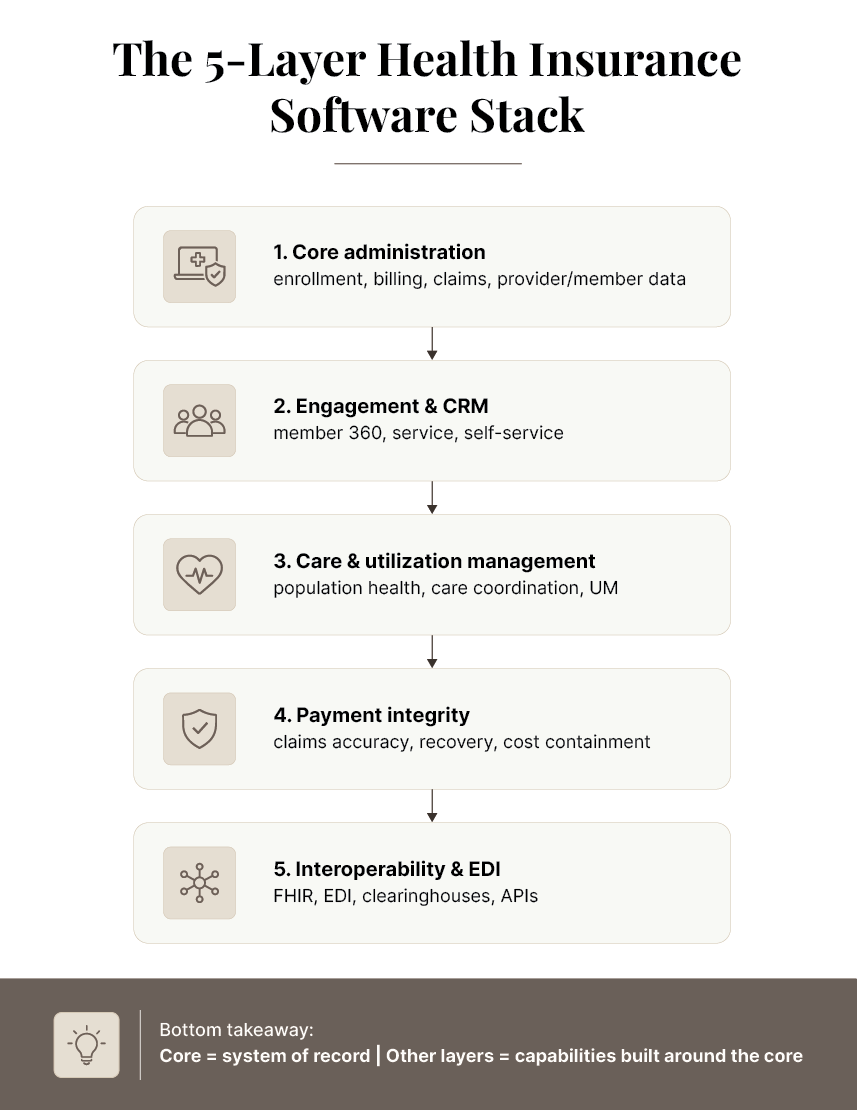
PwC notes that while core systems remain the backbone of insurers’ IT and business operations, complementary technologies are increasingly being used to enhance them.3
Blending all five into one ranked top-10 is where the category confusion starts. Route yourself to your layer first. For nearly every plan, the core comes first; everything else configures or integrates around the decision made there.
How Was Every Vendor in This Guide Verified?
Every entry in this guide is checked against vendor documentation and analyst category definitions, with ownership attribution as a standing review gate. Labels are applied in identical order across every entry, no rankings blend across layers, and no cost figures are printed without a public source.
- Every entry is checked against vendor documentation and analyst category definitions at the time of writing. The category’s flagship platforms have changed hands more than once.
- Every entry carries the same three labels, in the same order, namely: best-fit buyer, segment, and layer so that readers can scan the labels alone and know whether a platform belongs in their consideration set.
- No blended rankings across layers. A CRM is never ranked against a core administration platform. They solve different problems, for different buyers, on different budget cycles.
- The placement disclosure stays consistent. InsureEdge, a modern TPA software, appears in the core-administration tier, in the segment it actually serves.
- Cost is described at category level only. Licensing models, implementation multiples, per-member and transaction-based pricing patterns.
One more discipline sits underneath all five: semi-annual re-verification, with a mandatory ownership pass every cycle.
Which Core Administration Platforms Actually Run the Book of Business?
The core administration vendors that matter most are Cognizant’s TriZetto Facets and QNXT, HealthEdge’s HealthRules Payer, Damco’s InsureEdge, and Oracle Health Insurance, because every other layer in the stack integrates with whichever core a plan runs.
Each serves a distinct segment, and none is a drop-in substitute for another; where swapping cores is a migration decision.
1. TriZetto Facets (Cognizant)
Best Fit: Large enterprise health plans.
Segment: National and regional carriers.
Layer: Core administration.
Facets is the configurability-and-scale entry, integrating consumer data, claims administration, and revenue management in one system. The trade-off is the one every deeply configurable enterprise core carries: implementation and change-management complexity that smaller plans rarely need to take on.
2. TriZetto QNXT (Cognizant)
Best Fit: Mid-market and government-program plans.
Segment: Medicaid, Medicare Advantage, multi-line-of-business payers.
Layer: Core administration.
QNXT handles end-to-end claims processing across multiple lines of business, with a workflow engine and open-access integration framework built for plans that need government-program flexibility without Facets’ full enterprise footprint.
3. HealthRules Payer (HealthEdge)
Best Fit: Plans prioritizing modern architecture.
Segment: Mid-size to large payers modernizing off legacy cores.
Layer: Core administration.
The cloud-native, rules-driven entry on this list, built around configuration speed and product-launch agility rather than the decades-long footprint of the TriZetto platforms. The honest trade: a shorter installed-base track record at the largest national scale.
4. InsureEdge (Damco)
Best Fit: Health payers, TPAs, and managed care organizations at mid-market and TPA scale.
Segment: Mid-market payers, third-party administrators.
Layer: Core administration.
InsureEdge pairs core administration with the option of combined platform-plus-operations delivery. Its limitation: it’s built for the mid-market and TPA segment, not as an enterprise Facets or QNXT replacement.
5. Oracle Health Insurance
Best Fit: Enterprise plans already standardized on Oracle’s broader stack.
Segment: Large payers with ERP-adjacent buying processes.
Layer: Core administration.
Oracle’s entry suits plans where the core-platform decision runs through an existing enterprise-software relationship, such as finance, ERP, and cloud infrastructure already on Oracle, more than a from-scratch payer-technology evaluation.
6. PLEXIS Healthcare Systems (Quantum Choice)
Best Fit: Smaller TPAs and niche payers.
Segment: Below the scale where Facets, QNXT, or HealthRules Payer make economic sense.
Layer: Core administration.
PLEXIS rounds out the roster as verified TPA software and health plan administration technology. Its Quantum Choice platform covers claims adjudication, enrollment, and premium billing for organizations below the scale where enterprise licensing and implementation costs pencil out.
What Are the Solution Layers Around the Core?
Beyond the core, health insurance solutions splits into five layers: engagement (Salesforce Health Cloud), care and utilization management (ZeOmega Jiva), payment integrity (Cotiviti), and interoperability/EDI (Edifecs, now under Cotiviti). Each is bought by a different stakeholder on a different cycle.
Knowing which layer you’re buying in is what prevents the category confusion a flat ranking creates.
I. Engagement and CRM
Salesforce Health Cloud sits here as a member-360 and service layer over a core. It doesn’t adjudicate claims or run premium billing. Marketing, member experience, and broker-relations teams typically own this buying decision, running on top of whatever core is already in place.
II. Care and Utilization Management
ZeOmega Jiva belongs in population health and utilization management. Jiva coordinates care and manages utilization. It doesn’t process premium billing or adjudicate claims, despite appearing in that role.
III. Payment Integrity
Cotiviti anchors the accuracy-and-recovery tier: claims accuracy, overpayment identification, and cost-containment analytics that finance and program-integrity teams buy independently of the core administration decision.
IV. Interoperability and EDI
Edifecs anchors this tier alongside regional clearinghouse networks, handling FHIR APIs and EDI transaction sets.
The interoperability tier and the payment-integrity tier above now sit under common ownership, even though they remain distinct buying decisions and distinct product lines. Before making any move, understand healthcare interoperability standards-level depth on FHIR and HL7, including CMS-0057-F readiness.
V. Government-Program Administration
Gainwell represents the specialized case: Medicaid-tier administration and services for state and government-program payers; a buying motion distinct from the commercial and Medicare Advantage segments the platforms above primarily serve.
Each entry above is a representative leader in its layer, not a first-place finisher in a ranking that was never really being run.
Should a Health Plan Buy, Build, or Extend Its Platform?
Most health plans don’t pick a single winning vendor; they compose a stack. The 2026 default is: buy the core (its regulatory and adjudication depth isn’t worth rebuilding), build the edges (portals, integrations, differentiating workflows), and extend legacy cores with modern APIs rather than ripping them out.
“Health plans should not have to rebuild their data and technology foundation for every new mandate.”
– Susheel Ladwa, CEO, Onyx
Here’s the decision the ranking lists never reach, because it isn’t actually a ranking: most plans don’t choose one product:
i. Buy the Core
A configured platform’s regulatory depth, adjudication engines, and compliance maintenance are rebuild-proof economics for almost every plan. Facets, QNXT, HealthRules Payer, and InsureEdge all represent years of accumulated regulatory logic a custom build would spend years re-earning. The named exception: insurtechs whose model doesn’t fit any packaged core’s benefit structure, where a from-scratch build is the more honest answer than forcing a fit.
ii. Build the Edges
The member portal, mobile experience, broker and employer-facing tools, the integration fabric connecting the core to everything else, and the differentiating workflows a plan competes on. This is where packaged vendor portals routinely disappoint, and where plans spend real engineering budget regardless of which core they run.
iii. Extend the Legacy
For plans on a working but aging core, modernization means wrapping it with modern APIs and experience layers, not ripping it out on a slogan.
The build-versus-buy line doesn’t run around the stack. It runs through the middle of it.
A plan can simultaneously buy its core, build its portals, and extend its legacy claims workflow with a FHIR layer, and most plans getting this right in 2026 are doing exactly that.
What building the edges involves, and what it costs to scope, is the next question.
Planning to Modernize Your Health Insurance Stack?
What Do Health Insurance Software Development Services Involve?
Health insurance software development services cover five scopeable engagements: portal builds against the core’s APIs, EDI/FHIR integration programs (including CMS-0057-F compliance APIs due January 2027), core configuration-vs-customization work, insurtech product engineering, and per-integration estimation discipline.
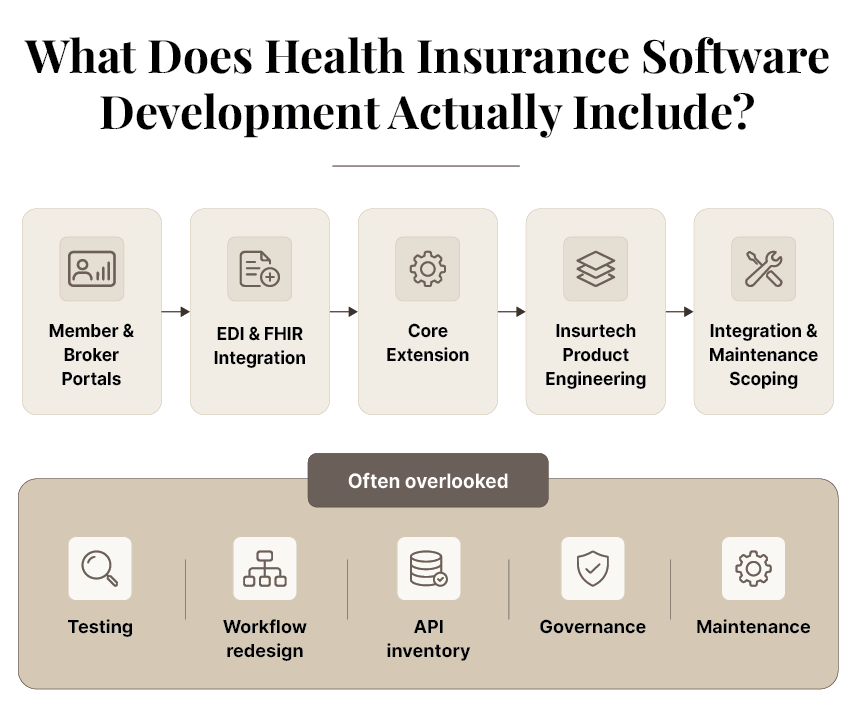
Health insurance software development isn’t a vague line item. It breaks into five concrete, scopeable engagements.
-
Member and Broker Portal Builds
Built against the core platform’s APIs, held to the experience standards members now expect from consumer software generally.
-
Integration Programs
EDI transaction sets, FHIR APIs, clearinghouse and vendor connections, including the CMS-0057-F compliance API build-out.
-
Core Extension Work
The distinction here is what belongs in the platform’s native configuration versus what becomes a separately maintained codebase. Get this wrong, and a “quick customization” turns into a maintenance liability three years later; a shortcut that looks free at launch and bills itself back with interest at the next upgrade cycle.
-
Insurtech Product Engineering
The full-custom case, entered with eyes open about the compliance scope a health plan carries regardless of whether its core is packaged or bespoke. A model that doesn’t fit any packaged benefit structure still has to clear HIPAA and state filing requirements.
-
Scoping Discipline
Per-portal and per-integration estimation rather than lump-sum guessing, an API-inventory-first approach before any build starts, and a maintenance reality that’s easy to underweight: built edges are owned, not finished, once launched.
The Compliance Clock Behind the Integration Work
The CMS-0057-F deadline is fixed: impacted payers, including Medicare Advantage, Medicaid and CHIP managed care, and qualified health plans on federal exchanges must have Patient Access, Provider Access, Payer-to-Payer, and Prior Authorization FHIR APIs live by January 1, 2027.4 Operational prior-authorization requirements, including decision-turnaround rules and public metric reporting, are already in force since early 2026.
Readiness is improving, but unevenly. A payer survey by WEDI5 found only 10% of payers reporting they hadn’t yet started prior-authorization API work down sharply from 43% just months earlier. But more than a third of surveyed payers reported being 25% complete or less on their Patient Access API build-out in the same period. Early motion doesn’t yet mean the harder integration work is done.
The vetting question that separates development vendors here: a partner who has operated inside payer compliance prices this work differently than a generalist, because they can see costs a generalist can’t yet see.
Is Your Payer Technology Stack Ready for the January 2027 CMS-0057-F API Requirements?
How Should a Health Plan Choose, and Where Does Damco Fit?
Choosing a health insurance platform comes down to six checks: auto-adjudication rate on your own claim mix, the configuration-versus-customization boundary, segment fit over feature count, category-level total cost, a software-versus-services-versus-both decision, and CMS-0057-F readiness as a 2026 selection criterion.
Six checks, in the order a real evaluation should run:
InsureEdge is a core administration platform for the mid-market payer, TPA, and managed-care segment, not an enterprise Facets or QNXT competitor.
Around that core, Damco’s health insurance software development services build the edges: portals, EDI and FHIR integration, CMS-0057-F compliance work. Its claims operations capability adds capacity for plans that need people as well as code.
For the platform-versus-portfolio question this guide raises, the practical next step is a conversation: where does your current stack stand against the January 2027 clock, from a vendor that builds, extends, and operates rather than only sells a license?
What’s Next?
The best health insurance software isn’t one product; it’s the right core for your segment, with well-built edges around it. Buy the core that fits your book of business, build the portals and integrations your members and brokers actually use, and extend what still works with modern APIs. With the January 2027 CMS-0057-F deadline approaching, the time to map your stack against that clock is now, not after the deadline.
External Links:
- 1. HealthEdge Payer Planning Survey
- 2. Black Book Research, State of Payer Digital Technology 2026
- 3. PwC
- 4. CMS Interoperability and Prior Authorization Final Rule
- 5. Workgroup for Electronic Data Interchange
Frequently Asked Questions
Health insurance companies typically use a layered software stack, with a core administration platform for enrollment, premium billing, and claims adjudication, supported by CRM, care management, payment integrity, and interoperability solutions.
For core administration, i.e., the system-of-record layer, the verified leaders are Cognizant's TriZetto Facets (large enterprise) and QNXT (mid-market/government programs), HealthEdge's HealthRules Payer (modern, rules-driven), Damco's InsureEdge (mid-market/TPA), and Oracle Health Insurance (enterprise, ERP-adjacent). "Best" depends entirely on segment fit, not a single ranking.
A core administration platform is a system of record for a health plan that manages enrollment, premium billing, claims adjudication, and member and provider data. Every other layer of payer platform, including CRM, care management, payment integrity, and interoperability, integrates with the core rather than replacing its function.
For the core, buy: adjudication engines and regulatory depth are rebuild-proof economics for almost every plan. For the edges, including portals, integrations, and differentiating workflows, health insurance software development is where plans compete. Legacy cores that still work are usually extended with modern APIs rather than replaced outright.
No reliable public per-plan figures exist for enterprise or mid-market core platforms; treat any specific number circulating online as unsourced. What's real: licensing typically runs on enterprise-tier or per-member/transaction models, with implementation, integration, and portal work as separate, often underestimated, budget lines.
CMS-0057-F is the CMS Interoperability and Prior Authorization Final Rule. It requires impacted payers to have four FHIR APIs live by January 1, 2027: Patient Access, Provider Access, Payer-to-Payer, and Prior Authorization. Impacted payers include Medicare Advantage organizations, state Medicaid and CHIP programs, Medicaid and CHIP managed care plans, and qualified health plan issuers on the federal exchanges. The rule's operational prior-authorization requirements, such as decision timeframes and public metric reporting, already apply from 2026.
TPA software is the core administration system used by third-party administrators, which manage self-funded health plans on behalf of employers. It covers eligibility and enrollment, claims adjudication, provider network pricing, funding and billing, and reporting to employer clients. TPA platforms are sized for smaller books of business than enterprise payer cores. Options built for this segment include InsureEdge and PLEXIS Quantum Choice.


