

Executive Summary:
- AI agents for insurance agencies arrive from every direction. This includes the agency management system, the rater, the phone system, and a long tail of startups. Most advice on AI for insurance agents either ranks tools or repeats that humans keep the coverage decision, without specifying where.
- AI agents can prepare much of an agency’s routine work so licensed staff spend more of their day on advice and relationships.
- Generic AI agents draft, check, and flag inconsistencies in insurance processes. The licensed agent advises, binds, changes coverage, and holds the client conversation.
- If your agency management system already does it, use that before you build anything.
- Pick one high-volume, low-risk workflow. Then check your carrier agreements, put an acceptable-use policy in writing, and pilot with every output reviewed.
AI agents for an insurance agency can handle multi-step tasks: capturing intake, pre-filling raters, checking submissions, and preparing renewals. They should not advise, bind, or own the client relationship. Those stay with the licensed agent, who carries the errors and omissions (E&O) exposure.

If you run an independent or captive agency, a brokerage, or a small managing general agency, you have probably been pitched AI this quarter. Few of those pitches explain where software stops and your license starts.
A word on terms, because this industry uses “agent” twice. This guide is about AI agents, i.e., software that carries out multi-step tasks within set limits, working for insurance agents, i.e., the licensed people who advise clients and place coverage.
The timing matters because the agency management system (AMS) vendors have moved. On September 23, 2026, Vertafore introduced “The Agentic Agency,” its plan to put AI across agency sales, servicing, accounting, and intelligence. It launched the plan alongside four Velocity AI agents for document research, product guidance, commercial policy intake, and policy checking.1 Six days later, Applied Systems launched Epic Conductor, an AI platform built into Applied Epic to handle multi-step work across the policy lifecycle.2
When the system of record starts doing work on its own, the question changes. It is no longer whether to use AI. It is which work, inside which system, and under whose judgment.
In the Big “I” Agents Council for Technology’s (ACT) 2026 Tech Trends Report3, independent agents ranked data privacy or compliance risks as their top concern about AI, ahead of inaccurate outputs.
This guide is about getting it right. The idea underneath it is short: AI agents can prepare the work; the licensed agent gives the advice. AI meant for carriers is covered in our guide to AI in insurance policy administration.
“AI is entering agencies at a time when many are already struggling with disconnected systems and limited automation. That complexity makes it harder to move from experimentation to meaningful impact. What we hear consistently is that agents aren’t worried about the price of AI; they’re worried about the cost of getting it wrong.”
– Kasey Connors, Executive Director, Agents Council for Technology (ACT)
Where Does AI for Insurance Agencies Fit in the Daily Workflow?
AI agents fit into an insurance agency’s workflow wherever the work is preparation and stop where the work becomes judgment, including assessing needs, recommending and binding coverage, changing coverage, and advocating on claims.
The table below maps eight agency workflows. For each workflow, it shows what an AI agent can draft, check, or route, what the licensed agent must own, and the risk to watch.
Table 1: AI agent tasks vs. licensed agent responsibilities, by agency workflow
| Workflow | What an AI agent can do | What the licensed agent owns | Risk to watch |
|---|---|---|---|
| Intake and lead qualification | Capture prospect details from web forms, calls, and email; pre-fill the AMS record; flag missing items such as prior carrier, loss history, or driver details | The needs assessment: what the client must protect and which lines to discuss | Misheard or incomplete details flowing into quotes unchecked |
| Quoting and rating | Pre-fill raters from intake data; run comparative rating; set outputs side by side with differences in limits, deductibles, and exclusions highlighted | The recommendation, and the explanation of why one option fits | Some carrier agreements may restrict automated quoting4 |
| Carrier submissions | Check submissions for completeness before they go out; assemble ACORD forms (the industry’s standard application forms) and supporting documents; suggest markets by appetite | Market selection, and the narrative that presents a difficult risk | Portal terms of use; client data reaching a market it should not reach |
| Servicing: certificates, endorsements, cancellations | Draft and process routine certificate requests from live policy data; prepare endorsement paperwork; log and route cancellation requests | Anything that changes coverage, non-standard certificate wording, and every cancellation conversation | A certificate that implies coverage the policy does not give |
| Renewals | Assemble renewal summaries; flag changes in exposure, premium, or terms; draft remarketing packages | The renewal conversation, and the advice to stay or move | Missed exposure changes; quiet coverage reductions at renewal |
| Claims support | Take first notice of loss, collect documents, and send status updates | Advocacy, coverage questions, and any dispute with the carrier | Implying coverage before the carrier has decided |
| Marketing and client communication | Draft newsletters, follow-ups, cross-sell prompts, and review requests | Compliance review before sending, and any content that describes coverage | Unapproved coverage statements; undisclosed automation |
| Agency operations | Process documents, clean data, reconcile carrier statements, and build reports | Exceptions, financial sign-off, and carrier escalations | Errors in trust accounting; bad data fed back into the AMS |
Looking at it closely, three patterns run through the table:
- The AI column is all verbs of preparation. Capture, pre-fill, check, draft, route, flag. Each produces something a person can inspect before it reaches a client or a carrier.
- The licensed agent’s column is all verbs of judgment. Assess, recommend, explain, bind, advocate. Each carries professional responsibility.
- The risk column clusters at the agency’s edges. Most of the risk sits where an AI agent touches something outside the building: a carrier portal, a client inbox, a certificate holder. Inside the agency, a mistake costs rework; the exception is trust accounting, where the agency holds premium as a fiduciary. Outside, it can cost coverage, a carrier relationship, or an E&O claim.
The edges are also where the friction is. As per Applied Systems’ 2026 connectivity survey5, 74% of respondents state that re-keying risk data into multiple carrier portals is the most cited pain point. The direction matches what agencies report: the slowest work runs between systems, not inside one.
Agency management systems are increasingly adding AI to submission intake and policy checking. These capabilities can flag missing information, compare policy documents with agency management system records, and recommend corrections for staff review. The operational principle is straightforward: software identifies gaps and proposes fixes; a person validates the result and approves any change.
A row is not a mandate. Some agencies will keep intake human because clients expect it. The map is a menu, sorted by who must stay in charge.
Identify the Right AI Opportunities for Your Insurance Agency
What Decisions Should Stay with a Licensed Insurance Agent When Using AI?
A licensed insurance agent should keep coverage advice, explanations of exclusions, binding and declining, any change to coverage, claims and dispute conversations, and final review of client-facing coverage content. The agent holds the license, the E&O exposure, and the client relationship.
Nearly every serious piece on AI for insurance agents now says humans keep the coverage decision. The practical distinction is not whether AI can assist with agency work, but where its authority must stop. It can read, draft, flag, and track routine tasks; licensed professionals should retain coverage decisions and intervene when expertise, judgment, or client relationships are at stake. The principle is settled. The line is not, so here it is, item by item.
What stays with the licensed agent:
- 1. Coverage Advice and Recommendations: Which policy, which limits, and which carrier
- 2. Explaining Exclusions and Gaps: What the policy does not cover and what that means for this client
- 3. Binding and Declining: Committing a carrier or telling a client a risk cannot be placed
- 4. Factors Impacting a Client’s Coverage: Endorsements that alter terms, limit changes, and cancellations
- 5. Claims and Dispute Conversations: Advocacy with the carrier and any discussion of whether a loss is covered
- 6. Final Review of Coverage: Proposals, renewal letters, marketing copy, and non-standard certificate wording
Why line falls there? The agent is licensed, and selling, soliciting, and negotiating insurance are licensed activities. The agent carries E&O exposure, so a wrong recommendation lands first on the agency, not the software vendor. And the agent holds the client relationship, which is the asset an agency is actually built on.
Damco’s Trustworthy AI is simple. AI agents draft, check, and flag; people decide where coverage, money, or rights are at stake. Where an AI agent’s output would change what a client is covered for, what they pay, or what they are owed, a licensed person signs off.
Earned autonomy sets the pace. An AI agent should be trusted with more only after it has proved itself on less. A certificate agent that has processed routine requests cleanly for months may earn the right to issue standard certificates from pre-approved templates without line-by-line review. It does not earn the right to approve non-standard wording. Autonomy widens inside the preparation column; it never crosses into the judgment column.
Agencies that want to formalize who decides what can use a decision-rights register covered in enterprise AI governance guide.
How Should an Agency Choose AI Tools for Insurance Agents: AMS-Native, Best-of-Breed, or Custom?
Agencies should choose AI tools for insurance agents by starting with what their agency management system ships, adding best-of-breed tools for single jobs, and building custom AI agents only where a workflow crosses systems. No independent benchmark ranks these tools.
The map tells you what work to hand over. It does not tell you what to buy. There are three paths, and most agencies will use more than one.
Path 1: AI agents built into your agency management system. Major AMS platforms are adding AI capabilities for tasks such as policy intake, policy checking, reconciliation, and document search. Availability and functionality vary by platform, product tier, and rollout stage, so confirm what is generally available before making a purchase decision.
- When it fits: The workflow lives mostly inside the AMS, such as policy intake, policy checking, reconciliation, or document search.
- What to watch: You get what the vendor ships, on the vendor’s timetable. Check which features are generally available and which are early-adopter only.
Path 2: Best-of-breed tools for a single job. Certificate management, intake forms, phone answering, web chat, email triage. Each does one thing and connects to the AMS.
- When it fits: One high-volume job where your AMS is weak and a specialist tool is clearly stronger.
- What to watch: Integration depth. A tool that cannot write back to the AMS creates a second system of record and a reconciliation job. Its access to your AMS also rests on terms between its vendor and your AMS vendor, not on your contract, so ask what those terms are.
Path 3: Custom AI agents that work across systems. Agents built for your agency that move between the AMS, carrier portals, the CRM, email, and document storage.
- When it fits: The workflow crosses systems and no product covers the whole path. Commercial submissions across several markets, renewal remarketing, and multi-system servicing are typical candidates.
- What to watch: Build and maintenance cost, carrier portal terms, and ownership of the agent’s logic.
The Rule: Buy the core, build the edges. Use what your AMS already ships. Add a tool where a single job needs it. Build custom only where your workflow genuinely differs. That stops an agency from rebuilding what it already pays for.
Questions to ask any vendor:
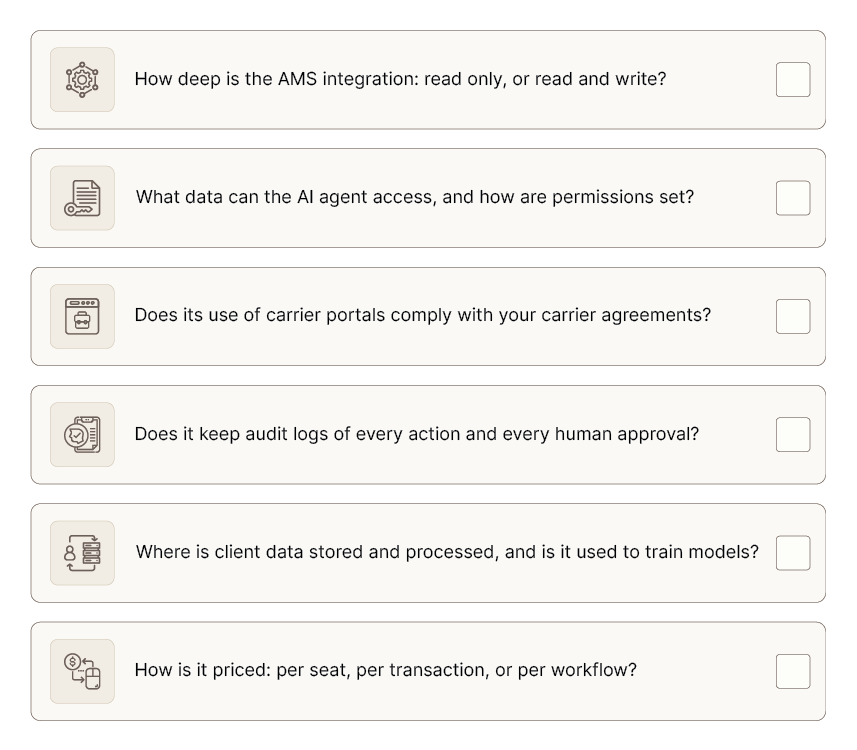
Be wary of rankings. A list written by a vendor that ranks itself is marketing, however many stars it carries. Your own pilot is the only benchmark that counts. AI features inside an agency CRM belong to a separate decision, covered in our guide to CRM for insurance agents, brokers, and carriers.
What Should an Insurance Agency Check Before an AI Agent Goes Live?
Before an AI agent goes live, an insurance agency should confirm its carrier agreements allow automation, consult its E&O carrier, keep advice with licensed staff, and secure client data. It should also write an acceptable-use policy and plan disclosure, retention, and vendor checks.
Most agencies are not ready on paper. In the Big “I” ACT 2026 Tech Trends Report, 24% of agencies named data privacy or compliance risks as their top AI concern, and 55% had no written AI use policy. The survey was a national email survey of independent agency members; the release page does not publish the sample size.8
The agency risk checklist:
- Carrier Agreements: Confirm whether each agreement permits automated quoting, portal access by software, and use of carrier data. Check your carrier agreements before an AI agent touches a carrier portal.
- E&O Coverage: Ask your E&O carrier, in writing, how AI use affects your coverage and what controls it expects.
- Licensing: Make sure no AI agent gives coverage advice or does anything that requires a license. Scripts and chat flows should route coverage questions to a licensed person.
- Data Privacy and Security: Map where client data goes. Many states have adopted versions of the NAIC Insurance Data Security Model Law.9 The model law applies to licensees, which include agencies. It exempts licensees with fewer than ten employees, including independent contractors, from some requirements, but not from notifying the regulator after a cybersecurity event. Check your state’s version and carrier data requirements before sharing client data with any AI vendor.
- Acceptable-Use Policy: Write it before rollout, including approved tools, prohibited uses, what data may be entered, and who reviews output.
- Client Disclosure: Decide how clients will know when they are dealing with an automated system.
- Record Retention: Keep AI-assisted work and the human approvals on it under the same retention rules as the rest of the client file.
- Vendor Due Diligence: Security posture, data ownership, model training on your data, and exit terms that return your data in usable form.
A note on regulation. The NAIC Model Bulletin on the use of AI systems by insurers, adopted in December 2023, applies to insurers, not agencies. By the NAIC’s count, 29 jurisdictions had adopted it as of October 8, 2026.9 Its relevance to agencies is indirect: the bulletin asks insurers to govern AI they rely on from third parties, so carriers may extend those expectations to distribution partners through agreements and audits.
How Should an Insurance Agency Roll Out AI Agents?
An insurance agency should roll out AI agents one workflow at a time. It should pilot a high-volume, low-risk task, measure results against its own baseline, review every output, train staff to check results, and widen scope only on evidence.
A disciplined rollout follows six practical steps. Use the sequence below as the implementation plan.
How Should an Insurance Agency Roll Out AI Agents Successfully?
The six-step rollout plan:
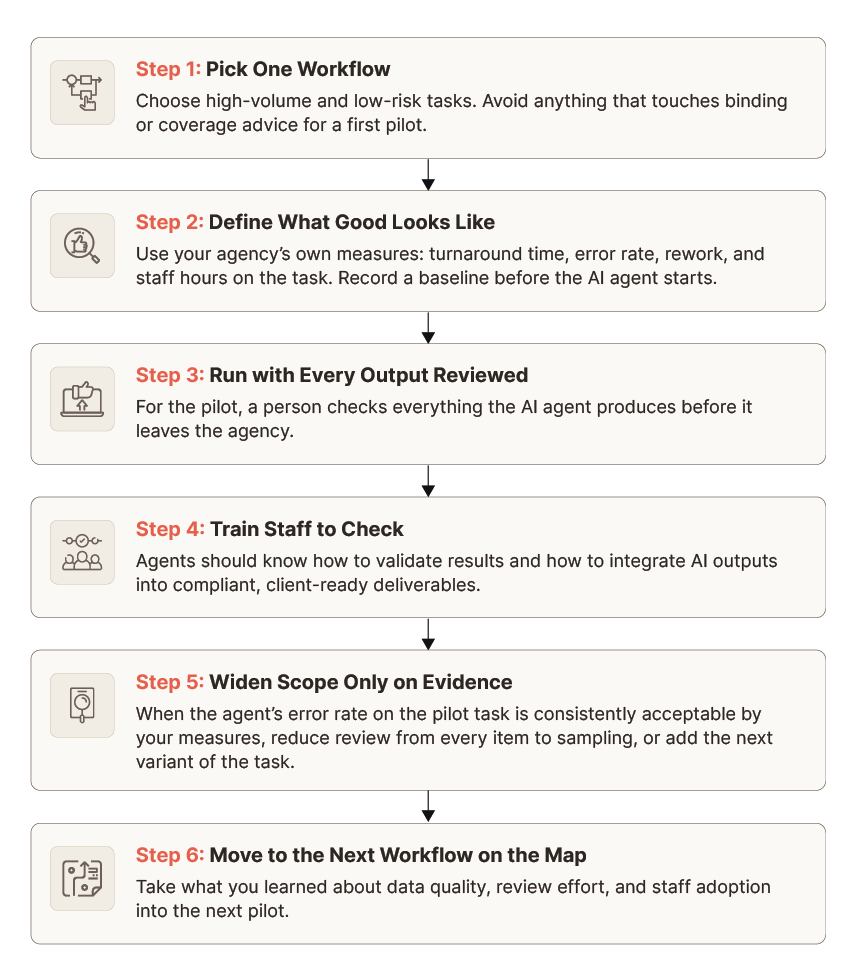
Each step should be written down. The documentation from a careful pilot doubles as evidence for your E&O carrier and answers any carrier’s questions about how you use AI. Start with one workflow, prove it, then expand.
How Will AI Agents Change Work for Insurance Agency Staff and Clients?
AI agents shift insurance agency roles from processing toward reviewing and advising, so account managers spend more time on client conversations. Clients should always be able to reach a licensed person and should know when they are dealing with an automated system.
The vendors are explicit about the staffing story they are selling.
“An individual’s insurance expertise and their ability to build relationships with customers, carriers, and wholesalers is still the biggest differentiator. What’s different now is that AI allows you to scale that skill.”
– Nikhil Kansal, Co-Founder & CTO, Cara
Clients should always be able to reach a licensed person. Every chat flow and AI phone assistant needs a clear route to one, and clients should know when they are talking to an automated system.
Hiring changes too. Agencies will need staff who can check AI work quickly and explain coverage clearly, two skills that now matter more than speed at data entry.
Deploy Custom AI Agents Across Insurance Workflows without Loosing Human Control
How Does Damco Build AI Agents for Agencies and Brokerages?
Damco builds AI agents for agencies and brokerages by starting from the workflow map and using what the agency management system already provides. It builds custom agents only where workflows cross systems and keeps the licensed agent’s decisions explicit.
Damco works with insurers and brokers on AI agents for insurance.
- Map First: We start with readiness assessments and workflow mapping against the table above, so that every AI agent has a defined job and a defined boundary.
- Use the AMS Before Building: Where your agency management system already does the job, we say so. Custom work is reserved for workflows that cross the AMS, carrier portals, CRM, and email.
- Keep the Line Explicit: Every agent we build drafts, checks, and flags. Approval points for coverage, money, and client rights are designed in, not bolted on.
- Support the Checklist: Audit logs of agent actions and human approvals, documentation for E&O and carrier conversations, and ongoing monitoring and tuning after go-live.
The agents we build are not designed to replace your producers or account managers. They are designed to give them back the hours that routine work takes.
References:
- 1. Vertafore release
- 2. Applied Systems
- 3. Big “I” Agents Council for Technology’s (ACT) 2026 Tech Trends Report
- 4. Liberty Mutual Agent for the Future
- 5. Applied Systems’ 2026 connectivity survey
- 6. Vertafore release
- 7. WisdomStream
- 8. Big “I”
- 9. NAIC adoption map
Frequently Asked Questions
Insurance agents can use AI to prepare routine work while keeping advice and decisions for themselves. Practical uses of AI for insurance agents include capturing intake, pre-filling raters, checking submissions for completeness, processing routine certificates and endorsements, preparing renewal summaries, and taking first notice of loss.
Agency operations such as document processing and statement reconciliation are also strong candidates. Coverage recommendations, binding, coverage changes, and claims advocacy should stay with the licensed agent. The safest approach is to map each workflow, start with one high-volume, low-risk task, and review every output until the results justify more autonomy.
No, AI is not replacing insurance agents; it is taking on routine work so licensed people can focus on advice and relationships. AI agents can draft, check, and route, but coverage advice, binding, and the client relationship require a licensed person who carries E&O responsibility.
The major agency management system vendors frame their own AI the same way, as taking on manual work so agency professionals can apply their expertise. Clients should always be able to reach a licensed person. What will change is the job, which shifts from processing toward reviewing and advising.
An AI tool helps with one step, while an AI agent carries out a multi-step task within set limits. A tool might summarize a policy or draft an email when asked. An agent might read an incoming certificate request, check it against live policy data, draft the certificate, route anything unusual to a person, and log what it did. Because agents act across steps and sometimes across systems, they need clearer boundaries, permissions, and audit logs than tools do. Most agencies will use both, and the workflow map decides which fits each job.
AI agents can prepare quotes, but binding and coverage advice should stay with the licensed agent. An AI agent can pre-fill raters from intake data, run comparative rating, and lay out options with differences highlighted.
Choosing the right option for the client, explaining it, and committing a carrier are licensed, judgment-based acts that carry E&O exposure. Carrier agreements matter here too: Liberty Mutual’s Agent for the Future warns that AI quoting may conflict with some carrier agreements. Check every agreement before an AI agent touches a carrier portal or rater on your behalf.
Before using AI, an agency should check its carrier agreements, its E&O coverage, its licensing boundaries, and its handling of client data, and it should write an acceptable-use policy. Confirm that carrier agreements permit automated quoting and portal access. Ask the E&O carrier how AI use affects coverage.
Make sure no AI agent gives advice that requires a license. Map where client data goes, and vet each vendor’s security, data ownership, and exit terms. Plan how clients will be told about automated interactions, and keep AI-assisted work under normal record retention rules.


