

Key Takeaways:
- AI is shifting data collection from a manual operational process to an intelligent, scalable business capability.
- The biggest barriers to enterprise AI are often data quality, accessibility, governance, and collection scalability, not model performance.
- Organizations that validate and govern data at the point of collection reduce downstream costs and improve AI outcomes.
- Real-time collection architectures are becoming essential for use cases such as fraud detection, customer experience management, and operational monitoring.
- Compliance, security, and human oversight must remain embedded in AI-powered collection frameworks.
- The future advantage will belong to enterprises that build scalable, AI-enabled data pipelines rather than relying on fragmented collection processes.
What if collecting business data didn’t mean sacrificing accuracy for speed, or drowning in costs to get both?
Enterprise data requirements are expanding faster than traditional collection methods can support. There’s a literal explosion of data. Formats are diverse, decision urgency requires real-time insights, data accuracy takes a backseat at scale, and compliance obligations become stricter. Yet many organizations still rely on fragmented workflows and manual processes that were never designed for today’s environment.

This creates a significant operational challenge, as the value of analytics, automation, and AI depend entirely on the quality, availability, and timeliness of the input data. When data collection becomes a bottleneck, reporting, forecasting, machine learning, customer experience optimization, and other data-related initiatives suffer.
AI data collection, therefore, emerges as the solution. AI improves accuracy, accelerates collection process, automate validation, scale across multiple sources, and enforces governance requirements from the moment data enters the pipeline. This shift reflects a broader trend, where AI/ML innovations are increasingly built on data collection foundations rather than treating collection as a separate upstream task.
Let’s explore how AI is transforming modern data collection by addressing traditional challenges, making the process more agile and efficient. Additionally, discover data collection strategies, enabling technologies, success metrics, compliance requirements, and security best practices.
Data collection, thus, supports growth, agility, and competitive advantage. As per a McKinsey survey, respondents report use-case-level cost and revenue benefits, and 64% say that AI is enabling their innovation.[1] By adding AI to data collection pipeline, organizations can reduce time, cost, and effort required to gather data while improving the quality of information available.
What Does Modern Data Collection Actually Look Like?
Data collection has evolved dramatically over the past decade. Traditionally, it was done manually, and there’s a full spectrum of data collection methods, ranging from surveys and observations to focus groups and interviews. Providers primarily focused on acquiring and organizing data from disparate sources before handing it off for further use.
Today, enterprise data ecosystems look entirely different. Your customer data might sit in a CRM system, sales figures in an ERP platform, and customer sentiment on social media. Other than that, website behavior resides in analytics tools while supporting tickets to sit in helpdesk software. Some data arrives in neat, structured databases, while other information comes as unstructured text, images, or videos.
While manual methods were sufficient when data volumes were relatively manageable, they struggled to keep pace with today’s complexity, which is exactly why AI and ML are changing data capture practices across the enterprise. Now, data is collected through web scraping, API integrations, IoT sensors, mobile applications, document digitization platforms, and automated survey systems. That said, the real challenge isn’t just collecting this data, but validating, standardizing, governing, and operationalizing at a scale that supports enterprise decision-making.
“There’s no question we are in an AI and data revolution, which means that we’re in a customer revolution and a business revolution. But it’s not as simple as taking all of your data and training a model with it. There’s data security, there’s access permissions, there’s sharing models that we have to honor. These are important concepts, new risks, new challenges, and new concerns that we have to figure out together.”
– Clara Shih, Advisor & Founder, Meta Business AI
What Are the Biggest Data Collection Challenges?
Though it sounds easy, data collection, particularly with a multitude of sources and methods available, is an uphill task. Not to forget the evolving compliance surrounding data security and privacy. There are various other issues:
1. Incomplete, Inconsistent, and Multi-Format Data
Ensuring consistency across data collected is one of the biggest issues in modern data collection. There are different formats, naming conventions, structures, and standards. Missing fields, duplicate entries, inconsistent classifications, and incompatible file types further create downstream challenges.
Additionally, your suppliers might send invoices as PDFs, your sales team works in Excel, and your website generates JSON files. Manually standardizing these formats takes time and resources while creating room for potential human error.
When poor-quality data enters the pipeline, analytics become unreliable, reporting becomes inconsistent, and AI models produce inaccurate outputs. The cost extends far beyond collection itself, affecting every subsequent business process that depends on trustworthy information.
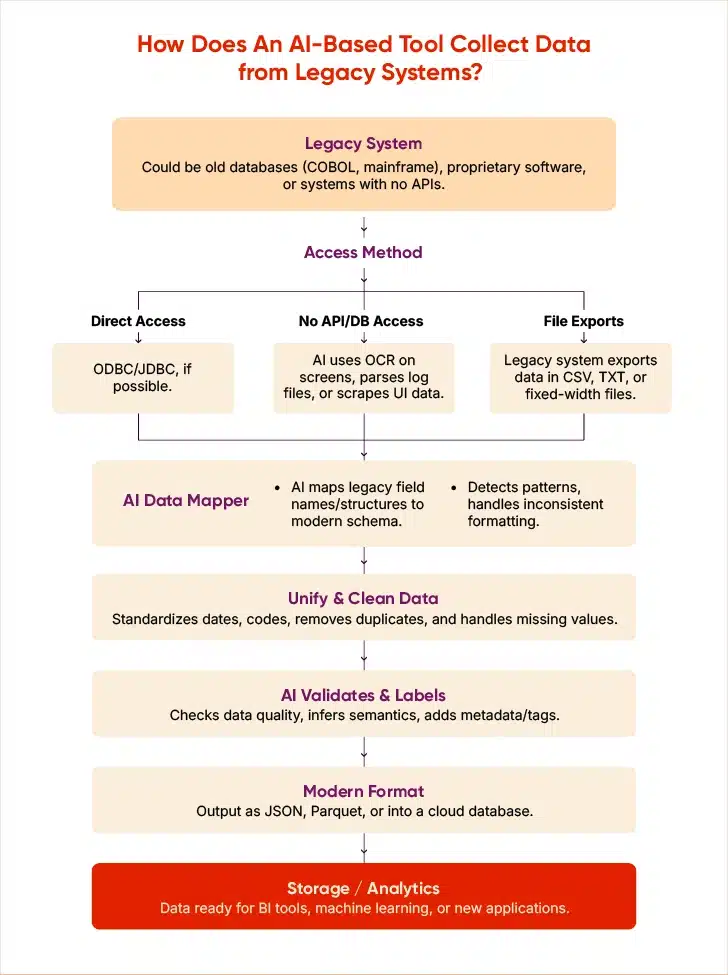
2. Collecting Data from Legacy Systems Without Breaking Existing Infrastructure
Many organizations still rely on legacy ERP systems, proprietary databases, mainframes or applications that lack APIs and modern interoperability standards. As a result, data extraction and sharing become difficult and expensive.
Replacing these systems outright is often impractical due to operational risk, cost, and business continuity concerns. As organizations pursue analytics and AI initiatives, they face the challenge of integrating valuable historical and operational data without disrupting existing infrastructure. Traditional approaches require extensive custom development and maintenance, slowing innovation and increasing technical debt.
3. Ensuring Quality at the Point of Collection
According to the latest IBM research, 43% of Chief Operations Officers identify data quality as their most significant data priority.[2]
Historically, organizations gather large volumes of data first and then invest in cleaning it. This entire process is costly, time-consuming, and often ineffective. By the time quality issues are discovered, the source context is already lost. What’s worse are the analytics and decisions based on inaccurate information. Thus, the ability to validate, verify, and standardize information at the point of ingestion has become a critical requirement for scalable data operations.
Improve Data Accuracy and Minimize Manual Errors Through AI-Powered Data Collection Services
4. Privacy, Security, and Ethical Risks in Automated Data Collection
As data collection becomes increasingly automated, organizations face heightened scrutiny regarding privacy, ethics, and governance.
Data protection regulations expand globally, strictly governing how organizations collect, store, process, and use personal information. At the same time, AI-driven tools raise concerns regarding algorithmic bias, transparency, accountability, and responsible data usage.
That said, automation alone is not enough for ethical data collection. Human oversight remains essential for validating AI-generated decisions, addressing ethical concerns, and maintaining transparency. Without proper governance, automated collection systems can amplify risks just as easily as they improve efficiency, making it critical to follow established data collection best practices for ensuring ethics and privacy.
“With great power comes great responsibility, and that responsibility comes in the form of security and privacy. This battle between data protection and business objectives is not new — most of us are very used to balancing speed and cool new technology with safety.”
— Suzie Compton , Senior Director, Product Management, Salesforce
How Does AI Solve These Data Collection Challenges?
AI addresses the root causes of inefficiency, inconsistency, and scalability limitations during data collection. It enables intelligent collection ecosystems that continuously improve over time.
I. Identifying and Eliminating Manual Bottlenecks
Traditional data collection workflows often involve numerous manual steps, creating bottlenecks that slow operations and limit scalability.
Professional data collection companies analyze existing workflows to identify repetitive activities that can be automated. They then use ML, NLP, and IPA to streamline data movement across multiple sources while reducing manual intervention.
For example, AI can automatically classify incoming documents, extract relevant information, validate records against predefined criteria, and route data to appropriate systems without human involvement. This workflow intelligence improves operational efficiency.
Organizations can easily collect higher data volumes, reduce turnaround times, and respond more quickly to changing business requirements.
II. Accuracy and Consistency at Machine Scale
Data quality plays an important role in business performance, wherein manual collection processes inevitably introduce inconsistencies caused by human error. AI eliminates these issues by enforcing validation rules consistently across every record entering the system.
ML models detect anomalies, identify duplicates, standardize formats, validate entries, and flag incomplete information in real time. NLP systems extract structured information from unstructured content while maintaining consistency across datasets.
In short, AI improves quality right at the point of data collection. This shift produces significant benefits. Analytics become more reliable. Reporting accuracy improves. Machine learning models perform better because they are trained on cleaner, more representative datasets.
Most importantly, organizations gain greater confidence in the information supporting strategic decisions.
III. Scalability Without Proportional Cost Increases
Traditionally, scaling data collection required scaling headcount. But today, AI-powered collection systems help expand data operations without increasing labor requirements at the same rate. Automated pipelines can process growing volumes of structured and unstructured information while maintaining consistent performance levels.
These systems operate continuously and can accommodate fluctuations in data volume without much operational disruption. Whether organizations are collecting information from thousands of customer interactions, millions of IoT devices, or large-scale web sources, automated systems provide the flexibility required for growth.
The economic impact includes reduced labor-intensive processing costs, improved operational efficiency, and accelerated time-to-value from collected data. Instead of investing primarily in manual processing capacity, resources can be redirected toward analytics, innovation, and business strategy.
IV. Real-Time Data Analysis and Actionable Insights
Traditional batch-based approaches remain valuable for historical analysis, regulatory reporting, and large-scale data processing. However, many modern business scenarios require immediate visibility into events as they occur. For example, fraud detection, inventory management, customer service interactions, IoT monitoring, and operational risk management.
AI enables real-time collection, validation, and analysis by processing incoming data streams continuously. But the debate doesn’t end here. It is very important to understand whether to collect data in batches or in real time.
Real Time vs Batch Data Collection: When to Use Each
| Aspect | Real Time Data Collection | Batch Data Collection |
|---|---|---|
|
When to Use |
When you need instant insights and immediate action |
When timely response isn’t important |
|
Key Use Cases |
Fraud detection in banking |
Monthly financial statements |
|
Ecommerce inventory tracking |
Historical trend analysis |
|
|
Customer service chatbots |
Market research reports |
|
|
IoT sensor monitoring |
Regulatory compliance reporting |
|
|
Live dashboard metrics |
Large-scale data processing |
|
|
Data Flow |
Continuous stream processing |
Scheduled bulk transfers |
|
Processing Speed |
Milliseconds to seconds |
Hours to days |
|
System Requirements |
Stream processing frameworks, low-latency infrastructure |
Scheduled jobs, robust storage, processing clusters |
|
AI/ML Role |
Real-time decision making, immediate anomaly detection, instant pattern recognition |
Model training, batch predictions, trend analysis, data enrichment |
Understanding these data collection strategies helps you design a system that matches your actual business needs rather than adopting a one-size-fits-all approach.
V. Tailored Data Collection Strategies for Different Business Contexts
Traditional automation systems typically rely on fixed rules and predefined workflows. While effective for predictable tasks, these systems often struggle to adapt to changing data collection requirements.
But AI introduces a more intelligent approach. It analyzes historical performance, user behavior, operational conditions, and collection outcomes to refine collection strategies. Thus, organizations can customize data collection approaches based on industry requirements, business goals, and operational environments.
For example, a healthcare provider may prioritize regulatory compliance and patient privacy, while a retail organization focuses on customer behavior and inventory visibility. Predictive analytics further enhances these capabilities by identifying emerging trends and anticipating future requirements.
What Are the Tools and Techniques Powering AI-Driven Data Collection?
AI-powered data collection depends on a combination of integration technologies, machine learning techniques, automation frameworks, and governance mechanisms. The following approaches are shaping how enterprises build scalable and reliable collection pipelines.
1. APIs and Web Scraping Bots: Automating Structured and Unstructured Data Ingestion
APIs and web scraping serve complementary roles in modern data collection:
- APIs provide structured, permissioned access to data. They enable applications to exchange information in standardized formats, making them ideal for CRM integrations, ERP synchronization, payment systems, logistics platforms, and cloud applications. APIs support reliable, scalable ingestion with clear authentication and governance controls.
- Web scraping bots extract data from websites and unstructured sources. They are especially useful when APIs are unavailable, incomplete, or too limited for business needs. Scraping systems can gather pricing information, market intelligence, product catalogs, financial disclosures, news content, and competitive data at scale.
Modern enterprises often use both together. For example, an ecommerce analytics platform might pull internal sales data through APIs while scraping competitor pricing and inventory data from public websites in real time. And, beyond traditional web scraping, AI agents are revolutionizing web data collection.
2. Synthetic Data Generation: Filling Gaps Where Real Data Is Scarce or Restricted
In many cases, real-world data is incomplete, imbalanced, privacy-sensitive, or difficult to obtain at scale. Synthetic data generation addresses this by creating artificial datasets that mimic the statistical properties of real data without exposing actual sensitive information.
A common example is fraud detection in financial services. Because fraudulent transactions represent only a small fraction of overall transaction volumes, organizations often lack sufficient examples to train AI models effectively. Synthetic data helps simulate a wide range of fraud scenarios, enabling models to learn from diverse patterns without relying exclusively on historical incidents.
Similarly, synthetic datasets helps test new systems, validate analytics workflows, or train AI models when regulatory requirements limit access to production data. Techniques such as statistical modeling, simulation frameworks, and advanced generative models like Generative Adversarial Networks (GANs) help create these datasets.
However, synthetic data is not a complete replacement for real-world information. If the generated data does not accurately reflect operational reality, models trained on it may perform poorly in production.
3. Self-Supervised Learning and Feedback Loops: Improving Collection Quality Over Time
Traditional supervised machine learning depends heavily on manually labeled datasets, which are expensive and time-consuming to create. Self-supervised learning reduces that dependency by allowing models to learn patterns directly from unlabeled data.
In data collection systems, this enables AI models to improve continuously as they process more information. For example, a document extraction system can learn to recognize invoice fields, contract clauses, or product attributes by identifying patterns across large volumes of unlabeled documents. Over time, feedback loops refine the model based on corrections, validation outcomes, and user interactions.
The result is a collection pipeline that becomes more accurate and adaptable without requiring constant manual retraining. This is especially valuable in environments where data formats evolve frequently, such as supplier onboarding, financial operations, or customer communications.
4. Human-in-the-Loop Systems: Where Human Judgment Stays Essential
Not every decision can be delegated to AI. This becomes even crucial as enterprise data environments often contain ambiguous records, evolving business rules, compliance-sensitive information, and edge cases that fall outside a model’s training data.
Relying solely on automation often leads to classification of errors, compliance violations, or inaccurate insights that are difficult to detect at scale. Thankfully, Human-in-the-Loop (HITL) systems addresses this. Here, AI handles routine collection and validation tasks, while human reviewers intervene only when the system encounters uncertainty or high-risk scenarios.
For example, a healthcare organization processing patient records may use AI to extract and classify information automatically, while routing low-confidence cases or compliance-sensitive records to trained specialists for review. Similarly, financial institutions often require human validation when AI flags unusual transactions that could have regulatory implications.
This hybrid model offers two major advantages:
- Higher accuracy and reliability: Human reviewers catch edge cases that automated systems may misinterpret.
- Continuous learning: Human corrections feed back into the AI system, improving future performance.
The goal is to reserve human expertise for decisions where it creates the most value.
5. MLOps Frameworks: Operationalizing AI Data Collection at Enterprise Scale
As AI-powered collection systems grow, managing them manually becomes impractical. MLOps frameworks provide the operational backbone for deploying, monitoring, and maintaining machine learning-driven data pipelines.
In a data collection context, MLOps frameworks support:
- Automated pipeline orchestration
- Version control for models and datasets
- Continuous monitoring of model performance
- Scheduled or event-driven retraining
- Alerting when data quality or accuracy degrades
For example, an enterprise collecting customer support data across multiple channels may use an MLOps platform to monitor extraction accuracy, retrain models when new ticket formats appear, and ensure updates are deployed consistently across environments.
Without MLOps, AI data collection initiatives often become fragile prototypes that are difficult to scale or maintain. With it, organizations can treat AI-driven collection as a stable operational capability rather than a one-off experiment.
At the same time, shifting from manual workflows to AI-driven data collection is not a single technology deployment. It is an operational transition that works best when approached incrementally.
A practical enterprise roadmap typically includes:
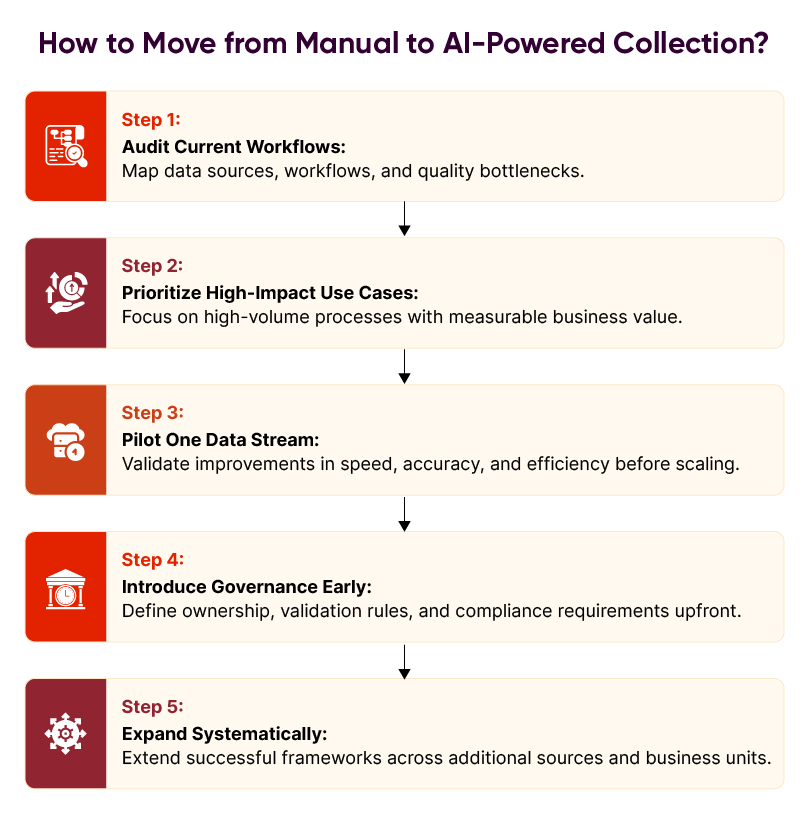
So, this is how you move from manual to automated data collection. And once the data is collected, what is the next step? To track if you are going in the right direction. The next section lists down the metrics to measure for successful data collection.
Scale Data Collection Economically as Your Business Demands Grow
What Metrics Should You Track to Measure Data Collection Success?
Beyond broad efficiency gains, it’s important to track specific operational metrics that tell you if your data collection efforts are working. Here’s what successful organizations monitor:
| Metric | What It Measures | Business Impact |
|---|---|---|
|
Collection Completeness |
Percentage of records with all required fields populated. |
Improves the reliability of analytics and reporting. |
|
Data Freshness |
How latest and up-to-date the collected data is. |
Supports timely decision-making and real-time operations. |
|
Source Coverage |
Whether all intended data sources are being collected successfully. |
Reduces blind spots in business intelligence. |
|
Collection Latency |
Time between an event occurring and the data becoming available. |
Enables faster operational response. |
|
Error Rate |
Frequency of invalid, duplicate, or inconsistent records. |
Reduces downstream cleansing costs and model inaccuracies. |
|
Cost per Record |
Total collection cost divided by usable records gathered. |
Demonstrates ROI and operational efficiency. |
These metrics give you concrete numbers to track improvement over time and demonstrate ROI to stakeholders. And, with these measurement frameworks in place, you can continuously refine your data collection processes rather than hoping they work well.
Cannot Decide Between In-House & Outsourced Data Collection?
How Do You Ensure Compliance with Automated Data Collection?
As you automate more data collection processes, compliance and privacy considerations become even more critical. The good news is that AI helps maintain compliance more effectively than manual processes.
A. What regulations apply to your data collection?
Different industries and geographies impose different requirements on data collection practices. Common frameworks include:
- Healthcare organizations must comply with HIPAA regulations in the United States.
- Any company collecting data from European users’ needs to follow GDPR requirements.
- California’s CCPA adds another layer for businesses operating in that state.
- Financial services have their own regulatory frameworks.
- Organizations deploying AI-powered data collection systems in the European Union must comply with the EU AI Act.
Businesses using AI to collect and process personal data may be subject to additional transparency, accountability, and governance requirements under emerging AI regulations. The challenge with manual data collection is ensuring every team member follows every rule, every time. Human errors or lack of awareness can lead to compliance violations that carry serious consequences.
B. How does AI help maintain compliance?
AI-powered data collection systems can be programmed with compliance rules built-in from the start. Examples include:
- Verifying that consent has been obtained before collecting personal data.
- Limiting collection to approved data fields (data minimization).
- Applying geographic restrictions for data residency requirements.
- Detect unusual collection patterns that may indicate policy violations.
This reduces reliance on manual oversight and helps organizations apply governance policies consistently across high-volume data operations.
C. Why are audit trails important in automated pipelines?
Automated data collection tools must be able to demonstrate what was gathered, when it was gathered, from where, under what permissions, and how it was processed, from where, under what permissions, and how it was processed.
Comprehensive audit trails are essential for:
- Regulatory reviews and compliance audits
- Internal governance and risk management
- Investigating data incidents or anomalies
- Responding to customer or employee data access requests
Without detailed logging, enterprises may struggle to prove compliance even if their practices are technically sound.
How to Address Data Security Concerns During Data Collection?
Data security concerns are valid. After all, you’re entrusting sensitive business information to automated systems. However, modern AI-powered data collection actually offers security advantages over manual processes.
1. Built-In Security Protocols
Reputable data collection platforms implement encryption both when data is moving between systems and when it’s stored. Access controls ensure that only authorized personnel can view or modify collected data. Activity logs track who accessed what data and when, creating accountability.
2. Reducing Human-Related Security Risks
Many data breaches happen because of human mistakes. For instance, someone emails sensitive data to the wrong person, leaves a laptop unsecured, or falls for a phishing attack. Automated collection systems eliminate many of these vulnerabilities by reducing the number of people who need to handle sensitive data directly.
3. Choosing the Right Partner
Getting this choice wrong carries real costs, and a wrong data collection company can hurt your bottom line far beyond the initial contract value. When selecting AI data collection companies, ask specific questions about their security practices. Key questions include:
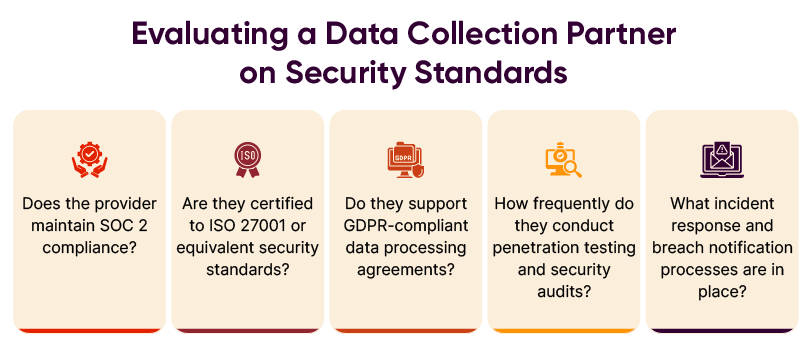
A quality provider will have clear, detailed answers to these questions and will be transparent about their security measures. Security shouldn’t be a barrier to adoption. It should be a key evaluation criterion when choosing your automation partner.
Why AI Is the Key to Overcoming Automated Data Collection Failures
Way Forward
AI data collection is no longer a niche capability reserved for highly specialized organizations. It is becoming the operational baseline for enterprises that need scalable analytics, reliable automation, and faster decision-making.
Though fragmented systems, inconsistent data, compliance pressure, and security concerns can slow adoption. AI-driven data collection systems are the ultimate hack, as these improve accuracy at ingestion, scale without proportional labor growth, support real-time insights, and embed governance directly into the pipeline.
In fact, McKinsey’s 2025 survey found that 39% of respondents gain measurable EBIT impact from their AI investments at the enterprise level.[3] and the organizations realizing these benefits are not simply collecting more data. They are building data operations that are intelligent, measurable, compliant, and resilient.
References:


