
Client: Emergency Department, Hospital Center
Industry: Healthcare
Country: United States
The Challenge:
As the community size grew, partly due to the pandemic, bottlenecks started to surface in the hospital center Emergency Department (ED). Manual, time-consuming registration and triage assessments led to staff fatigue and burnout, delayed care delivery, and contributed to rising Leave Without Being Seen (LWBS) cases.
Client Need:
Real-time visibility into clinical and operational workflows that can help streamline patient flow, enhance staff allocation, and facilitate proactive decision-making across the ED.
Services Used:
HIPAA-compliant, cloud-based real-time visibility model
Key Outcomes:
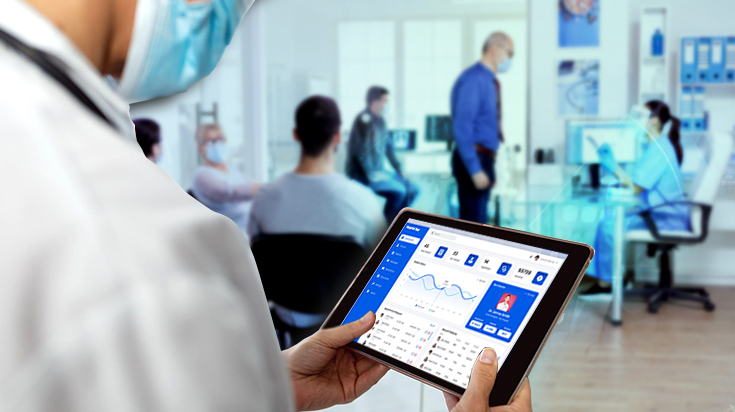
In Ohio’s highly competitive healthcare landscape, this hospital center, with a bed count of 225+ and annual visits of 80-100K, built a reputation for delivering exceptional life-saving care for emergency cases. But as the community grew, partly due to the pandemic, bottlenecks began to surface.
Manual, time-consuming registration and triage assessments that had worked previously were no longer sufficient. Boarding time surged. As a result, some patients left without being seen (LWBS). Staff, especially nurses, were frequently experiencing fatigue and burnout.
Despite multiple initiatives such as workflow redesigns and staffing adjustments, overcrowding persisted. Because the issue was never the lack of effort or inadequate staffing to begin with. Instead, there was no visibility into the constraints as they formed. Without it, the leadership team found it challenging to anticipate and respond to the rising footfall. This disrupted care delivery and patient experience.
What was needed was a more effective approach: real-time visibility into emergency department (ED) operations to streamline triage, discharge, and transfer processes, anticipate footfall, and manage boarding. A model that can facilitate coordination between teams, boost employees’ motivation, and enhance the overall patient experience.
To navigate these challenges without disrupting ongoing clinical workflows, this hospital center collaborated with Damco Solutions to implement a HIPAA-compliant, cloud-based real-time visibility model in its ED, integrating with existing Electronic Medical Records (EMR), on-prem CRM, and databases.
The solution monitors about 59 patient care and resource bottlenecks in real-time, previously hidden, unmanaged, and uncontrolled. This, in turn, is facilitating proactive decision-making across the leadership team, empowering them to identify and address unique ED challenges before they can impact operations, including rising visit volumes, patient complexity, and capacity constraints.
As a result, frontline teams aren’t feeling burdened because they’re assigned duties as needed, helping them provide exceptional care to high-risk, vulnerable patients.
By gaining real-time visibility into ED operations and workflows, the hospital center realized measurable improvements across staffing efficiency, patient throughput, and financial performance. High-value outcomes realized within three months of solution rollout:
“Patients care about how you treat them. To complement our staff in delivering that experience at scale, we adopted a solution that brought end-to-end, real-time visibility into our emergency department. This has made a huge difference in patient engagement, staffing productivity, and financial outcomes.”
ED overcrowding is not a staffing or effort problem. It is a byproduct of limited operational visibility. Through this initiative, the hospital center is now better positioned to: