

Executive Summary:
- Misaligned examples teach models the wrong correspondence. Volume does not fix this.
- Write the specification first, with volume stated by stratum, not as a total.
- Consent scope is the only item you cannot correct after collection.
- License what exists, collect what does not, synthesize only the tail.
- Contract cross-modal criteria upfront, or alignment becomes a delivery dispute.
The dataset arrived on time and in full. The model got worse.
If that has happened to you, you know the odd part. Nothing looked broken. The files played, the transcripts matched the audio, the counts were exactly what the contract promised. And the thing you bought it all for went backwards.
This is the ordinary way multimodal data collection fails, and it has very little to do with how much data you bought. Two things decide whether a dataset trains a model. Neither one is size.

The first is whether the pieces agree with each other. A video whose transcript describes one action while the frames show another does not teach the model less. It teaches the model something wrong. Collect enough of those and you have paid for a large dataset that produces a confused system.
The second is whether anyone wrote down what you needed before recording started. Which accents. Which lighting conditions. Which rare situations. What the people being recorded actually agreed their data could be used for. Skipping that document does not save time. It moves the cost later, to a second round of collection that arrives four months behind schedule at full price.
What follows is the order a buyer should work in. Write the specification first. Decide honestly whether to license, collect, or generate. Put the alignment checks in the contract instead of hoping for them. Keep the paper trail, because when someone eventually asks where the data came from, they ask whoever owns the model. Damco runs collection this way, and the criteria mentioned in the following sections are the ones we expect to be measured against ourselves.
What Is Multimodal Data Collection?
Multimodal data collection is the sourcing and creation of paired datasets spanning two or more modalities, typically audio, video, image, text, or sensor, where every example conveys consistent meaning across its modalities, for training models that reason across them.
The distinction from unimodal work is not additive. A speech dataset and an image dataset delivered separately are two datasets. A multimodal dataset is a set of relationships. Each example carries a claim that its audio, its frames, its transcript, and its labels are all describing the same event. When that claim fails, the example does not become less useful. It becomes actively harmful, because the model learns the wrong correspondence. A video whose transcript describes different actions than the frames show is worse for training than no example at all.
Alignment has two components, and buyers routinely contract for neither.
- Synchronization is temporal, whether the audio and the frames are aligned closely enough for the model’s task.
- Semantic consistency is about meaning, whether the caption, the transcript, and the label actually agree with what the modalities contain.
The consequences show up in production models, and Stanford’s 2026 AI Index1 puts the pattern plainly. In the same year that Gemini Deep Think reached gold-medal level at the International Mathematical Olympiad, the best model on ClockBench, a benchmark that tests whether a model can read an analogue clock, got it right 50.6% of the time. Humans score 90.1%. One frontier model managed 8.9% while scoring well on harder reasoning benchmarks. Stanford calls this the jagged frontier: capability that is superhuman in some places and below a child’s level in others.
Reading a clock is a correspondence task. The model has to connect what it sees to what the position means. More data did not close that gap, because it was never a volume deficit, and correspondence is a property of how a dataset was built rather than how large it is.
The working modality menu is short. Audio carries speech and acoustic events. Video carries actions, motion, and scene context. Images carry static visual content. Text carries language, and in most multimodal sets it also carries the pairing itself as captions, transcripts, and instructions. Sensor streams carry telemetry, depth, and position data where the model operates in physical space.
“At the heart of AI is data. The more complete the data on which an AI is trained, the more valuable will be the output.”
– Dave Friend, President & CEO, Wasabi Technologies, Inc.
How to Create a Multimodal Data Collection Specification?
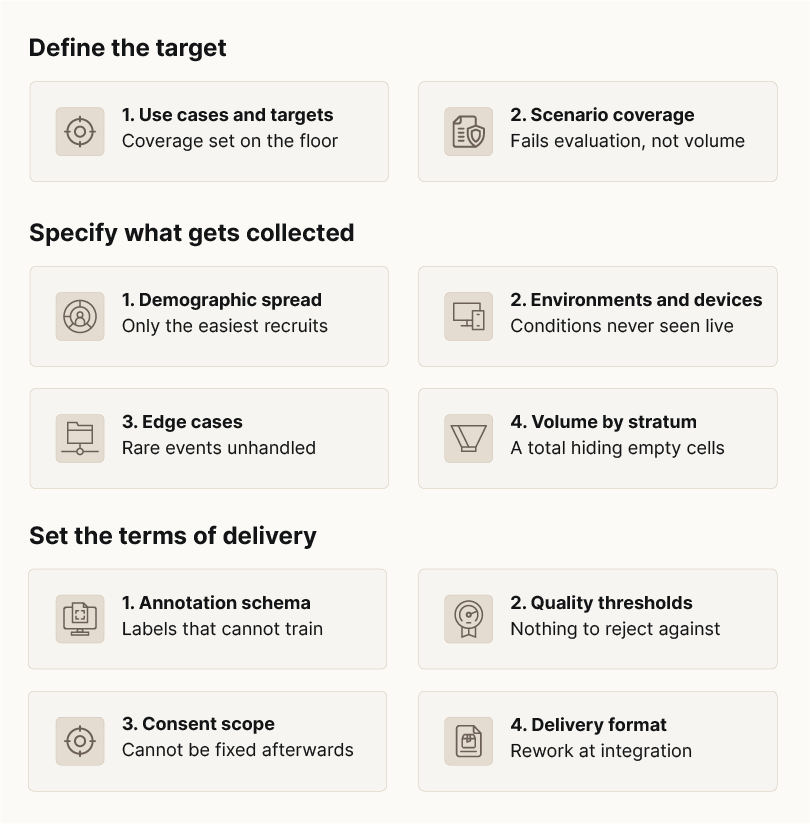
The specification is the cheapest document in the project and the only one that reliably prevents re-collection. Every ambiguity left in it becomes a change order, a dispute, or a second collection round. Ten items belong in it, and each maps to a specific failure it prevents.
- 1. Use cases and model targets: Name the model, the task, and the evaluation the dataset has to support. Without this, coverage decisions get made by whoever is closest to the collection floor.
- 2. Scenario coverage: The situations, events, and interactions the model will encounter. Underspecified scenarios are the most common source of a dataset that passes volume checks and fails evaluation.
- 3. Demographic and linguistic distribution: Ages, genders, regions, languages, accents, and dialects, stated as target proportions. Prevents a dataset that represents the easiest population to recruit.
- 4. Environments and devices: Acoustic conditions, lighting, weather, indoor and outdoor settings, capture hardware, sample rates, and resolutions. Prevents a dataset collected under conditions the model will never see.
- 5. Edge cases and negative examples: The rare events, failure modes, and near-misses the model needs to handle, plus examples of what the target class is not.
What Should a Multimodal Data Collection Specification Include?
- 6. Volume by stratum: Not a total. Counts per accent, per lighting condition, per scenario. A total is the number that gets quoted; strata are the numbers that determine whether the model works across its intended range.
- 7. Annotation schema and label definitions: Label taxonomy, boundary rules, and the adjudication process for disagreement. Prevents labels that are internally inconsistent and unusable for training.
- 8. Quality thresholds: The measurable gates each item must pass before it enters the deliverable.
- 9. Consent scope: What uses the contributor consent actually covers, including model training, commercial deployment, redistribution, and derivative datasets. This is the one item on the list that cannot be fixed retroactively. A dataset collected under consent that does not cover your intended use is not a quality problem you can remediate. It is a dataset you cannot use.
- 10. Delivery format: File structures, metadata schema, timestamp conventions, and manifest format.
Then pilot. Commission a small calibration batch against the specification before full-rate collection begins, review it against every gate, and treat disagreements as specification defects rather than vendor defects. A pilot that surfaces three ambiguities has paid for itself several times over, because each of those ambiguities would otherwise have propagated through the entire delivery.
What Are the Key Types of Multimodal Data?
The main types of multimodal data are audio, video, image, text, and sensor data, paired so that every example describes the same event across each modality. Audio carries speech and acoustic events. Video carries actions, motion, and scene context. Images carry static visual content. Text carries language, and in most multimodal datasets it also carries the pairing itself as captions, transcripts, and instructions. Sensor streams carry telemetry, depth, and position where the model operates in physical space.
Audio Data Collection
Audio data collection supports automatic speech recognition, voice assistants, speaker identification, emotion and paralinguistic modelling, and conversational AI. It is also the modality where coverage gaps are hardest to see in a delivery review, because a dataset can be acoustically clean, accurately transcribed, and still miss the population the model will serve.
The collection variables that belong in the specification are languages, accents and dialects, speaking styles, acoustic environments and noise profiles, devices and sample rates, and the split between scripted and spontaneous speech.
Accent and acoustic coverage are where speech datasets quietly fail, and the standard reflex is to treat that as a modelling problem to be fixed after delivery. A 2026 study presented at LREC2 tested that assumption directly. The researchers fine-tuned Whisper and Wav2Vec2-XLSR-53 on African-accented English from the AfriSpeech-200 dataset, covering Yoruba, Igbo, Swahili, and Hausa accents, using two different adaptation strategies. Both substantially reduced mean word error rate.
Neither consistently narrowed the gaps between accents, and when the general and clinical subsets were analyzed separately the gaps often widened, because the gains landed unevenly. The authors conclude that fine-tuning improves overall accuracy without addressing systematic bias across speaker groups, even when a model is specialized for an individual accent.
Treat that as a buying fact rather than a research finding. You cannot fine-tune your way into coverage you never collected, and per-accent specialization is not a dependable substitute either. Coverage has to be bought at collection time. That is the case for stating volume by stratum in the specification instead of one headline total, and the same logic applies to acoustic environments and to the split between scripted and spontaneous speech. Each is a stratum. Each needs a target rather than a mention.
Modality-specific QA is straightforward once specified: signal quality gates covering clipping, noise floor, and silence, transcript fidelity sampled and adjudicated, and speaker metadata verified against the recruitment record. Where audio is paired with transcripts or with video, the cross-modal criteria from the following section apply on top of these.
Video Data Collection
Video data collection supports computer vision, action and gesture recognition, object tracking, autonomous systems, and egocentric and robotics applications. The specification variables are scenarios and actions, lighting and weather, camera perspectives and motion, resolutions and frame rates, indoor and outdoor settings, and participant demographics.
Video’s specification instrument is the scenario matrix: actions crossed with conditions crossed with perspectives, with a target count in each cell. It is a deliberately uncomfortable document, because building it forces the team to state how many examples of a given action, under a given lighting condition, from a given camera angle, the model actually needs. Most projects discover at that point that they have been reasoning about totals instead of coverage. A dataset that fills the matrix outperforms a larger one that leaves cells empty, and the empty cells are exactly where deployment failures cluster.
The 2026 AI Index makes the case for taking the conditions axis seriously. Autonomous vehicles now operate at real scale in the United States and China, and remain limited to favorable conditions with remote human backup. Robots still fail close to nine in ten real household tasks. These are systems with substantial capital behind their data programmes, constrained by the envelope of conditions their training distributions actually cover. Your scenario matrix is the instrument that decides where your own envelope stops.
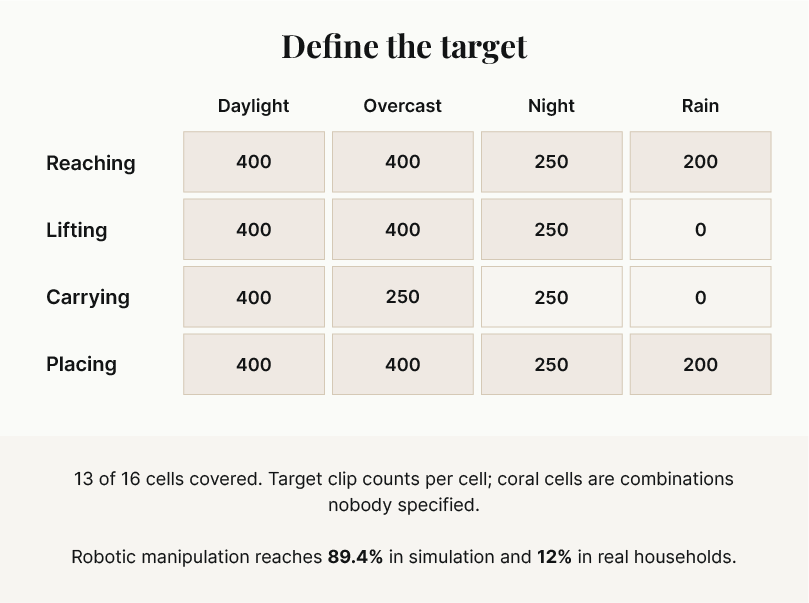
Modality-specific QA covers frame quality and stability, coverage audited cell by cell against the matrix rather than in aggregate, metadata completeness for camera, location, and timestamp, and privacy treatment of bystanders and identifiable environments. That last item is a specification decision, not a post-processing step. Whether bystanders are excluded, consented, or obscured determines the collection protocol, and retrofitting it means re-collecting.
Where video is captured alongside audio, the synchronization and cross-modal criteria in the following section apply.
Text Data Collection
Text data collection supports language model pretraining and fine-tuning corpora, domain and task datasets, conversational logs, and instruction and preference data. The specification variables are domains, languages and registers, formats, freshness, and provenance labelling that distinguishes human-generated from model-assisted content.
Text is the modality where rights, not volume, is the defining variable. It is also where dataset provenance disputes actually live, which makes source rights, license terms, and lineage labels the specification items that carry the most downstream risk. Three practices follow.
- Record the source of every corpus segment and the license under which it was obtained.
- Record the transformation history, because a derived corpus inherits the rights position of its source.
- Label model-assisted content explicitly, because a corpus that quietly mixes generated text into human text degrades in ways that are difficult to diagnose later and impossible to reverse without the labels.
Do not assume this documentation will arrive by default. Stanford’s 2026 AI Index notes that training code, parameter counts, dataset sizes, and training duration have stopped being disclosed for several of the most resource-intensive frontier systems. Organizations with dedicated data governance functions are publishing less lineage detail, not more. If you intend to be able to answer questions about your own corpus, the requirement has to be written into the collection agreement rather than inferred from vendor practice.
Modality-specific QA covers deduplication at the document and passage level, contamination checks against your evaluation sets, and toxicity and personally identifiable information screening with a stated remediation path for hits.
Text also functions as the pairing glue of most multimodal sets. Captions, transcripts, and instructions are the layer that carries the correspondence claim between modalities, which makes text quality a cross-modal concern rather than a contained one.
“Many companies struggle with AI, not because the technology isn’t available, but because they can’t connect it to business outcomes.”
– Mike Capone, Member Board of Director, Dynatrace
How Do You Verify Cross-Modal Alignment and Quality in Multimodal Datasets?
This is the section the shelf leaves empty. Alignment is defined correctly in several vendor guides and operationalized in none of them. Nobody publishes the sampling methods or acceptance criteria a buyer could put into an agreement, which leaves alignment as a concept the buyer agrees with and cannot verify.
The market has started to reprice this. A July 2026 market analysis of the AI training dataset sector found that the rise of multimodal language models has shifted demand toward synchronized cross-modality data, with significant growth specifically in complex annotation and cross-modal quality assurance, and the market transforming toward complex data evaluation rather than labelling alone. Cross-modal QA is becoming a procurement line item. Most buyers have not yet written it as one.
i. Synchronization
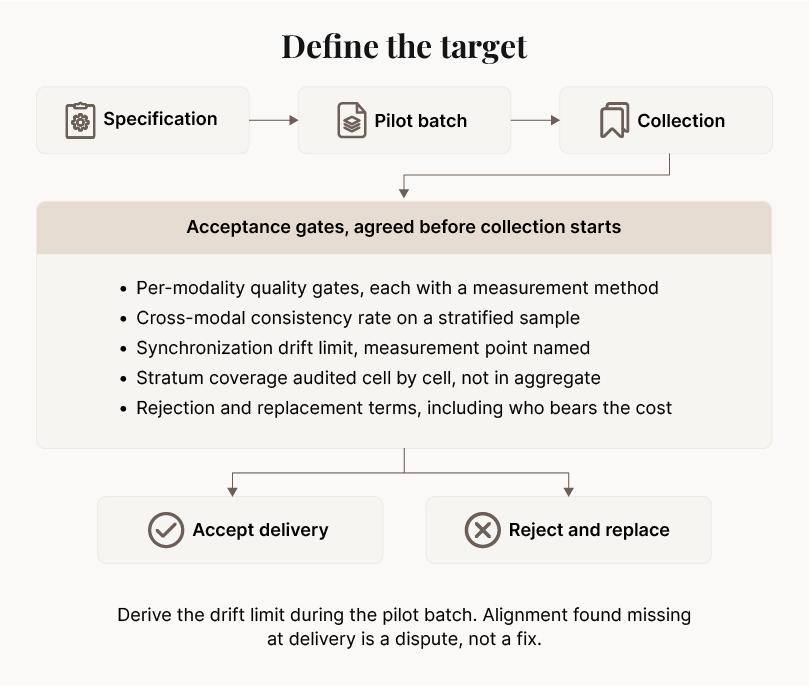
For paired audio and video data collection, specify the timestamp convention, the reference clock, and the acceptable drift for your model’s task. Task tolerance varies by orders of magnitude. Lip-sync-dependent models need tight temporal correspondence; scene-level action recognition tolerates far more. Derive your figure during the pilot batch by degrading alignment deliberately and measuring where evaluation starts to move, then write that number into the agreement. Device clock discipline is the operational half of this: multi-device capture without a synchronized reference clock produces drift that cannot be corrected after delivery.
ii. Semantic consistency
Sample the delivery and check whether the modalities agree. Does the transcript match the audio. Does the caption match the frames. Does the label match both. Specify the sampling rate, the stratification of the sample so that it covers your thinner strata rather than the easy ones, and human adjudication on the sampled set. Automated consistency scoring narrows the review; it does not replace it.
iii. Acceptance criteria as contract language
Five clauses, and they are the reusable part of this guide:
- 1. Per-modality quality gates, each with a measurable threshold and a measurement method.
- 2. Cross-modal consistency rate, expressed as a minimum percentage on a stratified sample of stated size.
- 3. Synchronization tolerance, stated as a numeric drift limit with the measurement point named.
- 4. Stratum coverage against the specification, audited cell by cell, with aggregate totals explicitly not sufficient.
- 5. Rejection and replacement terms, including who bears the cost of re-collection when a stratum fails.
Put these in the agreement before collection starts. Alignment discovered missing at delivery is a commercial dispute. Alignment specified in advance is a deliverable.
License, Collect, or Synthesize: Which Approach is Right?
Most guidance on this decision comes from an author who sells exactly one of the three options. Here are the honest win conditions, listed in the order a buyer should test them.
| Source | Wins When | What the Buyer Has to Do | How It Fails |
|---|---|---|---|
| Licensed and off-the-shelf datasets | Coverage genuinely exists for your distribution. Cheapest, fastest, and the correct default. | Confirm the rights scope covers commercial deployment and derivative work. Test coverage against your own strata rather than the dataset card’s summary. | Rights narrower than the intended use. Coverage that looks broad in aggregate and runs thin in the strata that matter. |
| Custom collection | Your scenarios, demographics, environments, domains, or paired-modality capture do not exist off the shelf. | Put the specification from Section 3 and the acceptance criteria from Section 7 into the agreement before work starts. | Open-ended engagement with no contracted criteria. Re-collection billed as new scope rather than remediation. |
| Synthetic generation | Real examples are rare, dangerous, or expensive to stage. Best used as edge-case fill around a real core. | Validate against held-out real examples. Label synthetic content explicitly in lineage records. | The generated tail diverges from the real one. Recursive training on generated content compounds the drift. |
The synthetic validation burden is heavier than it is usually described. The compounding degradation that follows recursive training on generated content for purely synthetic pipelines are the risky case rather than mixed ones. And custom collection is the point at which multimodal data collection services earn their cost, which is also the point at which the specification and the acceptance criteria stop being good practice and become the buyer’s only protection.
The sequence, then: license what exists, collect what does not, synthesize the tail, and validate all three against one specification. License-first is the advice a collection vendor has no commercial reason to print, which is why it sits at the top of the table rather than somewhere inside it. A dataset assembled from three sources against three different quality standards is three datasets in one directory.
Contract Your Alignment Criteria Upfront, Then Hold the Delivery to Them
How Do Data Provenance and Consent Affect AI Compliance?
Vendor compliance badges certify the vendor’s process. They do not transfer. The obligation to document where training data came from attaches to the party that owns the model, which means the audit is addressed to you.
The regulatory position as of August 20263 has two layers, on two different timelines, and they are worth separating carefully. Under Article 53(1)(d) of the EU AI Act4, providers of general-purpose AI models have been required to publish a sufficiently detailed summary of training content since 2 August 2025, using the template the Commission adopted on 24 July 2025. The Commission’s own guidance confirms that using the template is mandatory, that the AI Office gained enforcement powers on 2 August 2026, and that non-compliance can reach 3% of worldwide annual turnover or EUR 15 million, whichever is higher.
The second layer moved. The Digital Omnibus on AI, Regulation (EU) 2026/1744, was published in the Official Journal on 24 July 2026 and entered into force on 27 July 2026. It sets fixed application dates of 2 December 2027 for standalone high-risk systems under Annex III, and 2 August 2028 for AI embedded in products already covered by EU product safety law under Annex I. The data governance requirements for high-risk systems sit inside that deferred package. That is a planning window rather than a reprieve.
Most organizations are not using it. McKinsey’s 2026 AI Trust Maturity Survey5, covering roughly 500 organizations between December 2025 and January 2026, found only about a third reporting maturity of three or higher in strategy, governance, and agentic AI governance, with governance consistently lagging data and technology capabilities across every region measured.
The buyer’s artifact list is short and worth building before it is requested: consent records matched to actual use scope, contributor demographic documentation, dataset lineage covering sources, transformations, and versions, an archive of licensing terms as they stood at acquisition, and a data governance summary in the form a conformity assessment would ask for. Obligations vary by jurisdiction and by system classification, and GDPR and sector rules apply alongside the AI Act rather than underneath it, so treat the above as the category-level shape of the requirement and take specifics from counsel. Damco’s published position on Trustworthy AI sets out the governance frame these artifacts sit within.
Where Damco Fits
Damco provides multimodal data collection services as an AI engineering practice rather than a crowd. In practice that means four things.
- Specification workshops that produce the document before any sourcing decision is made, including the consent scope conversation that most projects defer.
- Managed collection across audio, video, and text, run against that specification with volume tracked by stratum.
- Cross-modal QA against the acceptance criteria, contracted in advance, with the synchronization tolerance derived from your model’s task during a pilot batch rather than assumed.
- Provenance documentation produced as a deliverable, structured so that it answers the relevant questions rather than requiring reconstruction later.
Collection is paired with the practices the datasets ultimately serve: data engineering for the pipelines the data lands in, and AI development for the models it trains, under the published Trustworthy AI governance frame. That pairing matters mainly because a dataset delivered without a place to put it and a governance position to sit under is a project that stalls after delivery.
The credibility test we would apply to any vendor on this shortlist, including ourselves, is whether they will put the five acceptance criteria clauses into the agreement before collection starts, and accept the rejection and replacement terms that go with them. A vendor unwilling to be measured against criteria they agree with is telling you something useful.
Concluding Notes
Most of the cost in a multimodal dataset is committed before anyone starts recording, which means most of the leverage sits in the weeks before the contract is signed. Four things are worth settling in that window.
Write the specification and treat it as a contract document rather than an internal note. State volume by stratum, not as a total. Name the consent scope explicitly, because it is the only item on the list you cannot fix afterwards.
Test the licensed options honestly before commissioning collection. If coverage genuinely exists for your distribution, buying it is the cheaper and faster answer, and the effort belongs in verifying rights and testing strata rather than in running a collection programmed you did not need.
Put the alignment criteria in the agreement. Cross-modal consistency rate, synchronization tolerance, stratum coverage, and rejection terms. Discovered at delivery, these become commercial arguments. Agreed in advance, they are simply deliverable.
Keep the paper trail from day one. Consent records, lineage, and licensing terms are cheap to capture during collection and expensive to reconstruct after it.
None of this requires a larger budget. It requires the decisions to be made in the right order.
References:
- 1. Stanford University
- 2. ACL Anthology
- 3. European Union
- 4. European Commission
- 5. McKinsey
Frequently Asked Questions
Multimodal data teaches a model how modalities correspond, which unimodal data cannot supply. A paired dataset shows the model that a transcript, its frames, and its labels describe the same event, and that correspondence is where production systems fail. Stanford's 2026 AI Index found frontier models reading an analogue clock correctly only 50.6% of the time against 90.1% for humans.
Ten items: use cases and model targets, scenario coverage, demographic and linguistic distribution, environments and devices, edge cases, volume by stratum rather than totals, annotation schema, quality thresholds, consent scope, and delivery format. Consent scope matters most, because it is the only item that cannot be corrected afterwards.
Alignment, coverage, and consent are the three that cause re-collection. Misaligned examples, where the transcript, frames, and labels disagree, teach the model the wrong correspondence and are worse than missing data. Coverage fails quietly when volume is stated as a total instead of by stratum. Consent scope is the only gap that cannot be fixed after collection.
License first when coverage genuinely exists for your distribution, then verify the rights scope and test coverage against your own strata. Collect custom when your scenarios, demographics, or paired-modality requirements do not exist off the shelf. Synthesize only for edge cases, labelled as synthetic and validated against real examples.
Two timelines apply. General-purpose AI providers have had to publish a training-content summary on the Commission's template since 2 August 2025, enforceable from 2 August 2026. High-risk data governance duties were deferred to 2 December 2027. Hold consent records, lineage, and licensing archives regardless, and confirm specifics with counsel.
Write the specification first, with volume stated by stratum and consent scope named explicitly. Run a pilot batch against it and treat disagreements as specification defects. License what exists before commissioning collection, and synthesize only the edge-case tail. Put cross-modal consistency, synchronization tolerance, and rejection terms into the agreement before work starts, and keep consent and lineage records from day one.


