

Key Takeaways:
- The real constraint on IBM i is not aging technology; it is isolation from the digital systems that now drive revenue.
- API enablement exposes proven RPG business logic and DB2 for i data as reusable services, without replatforming the core.
- A governed API layer turns IBM i into an integration hub for cloud, mobile, partner, and AI ecosystems.
- AI and analytics initiatives stall when enterprise data stays locked behind green screens, and APIs remove that barrier.
- An API-first approach, summarized here as UNLOCK, sequences modernization from workload assessment to composable architecture, lowering risk at each step.
- API enablement modernizes the business now and lays an incremental, lower-risk path off IBM i, instead of forcing a single high-risk cutover.
Most modernization conversations start in the wrong place. They open with a question every technology leader has heard in a budget meeting: how long can the business keep running on IBM i? The framing assumes the platform is the problem. It rarely is.
IBM i still processes orders, settles transactions, and manages inventory for thousands of distribution, manufacturing, finance, and logistics enterprises. The RPG programs and DB2 for i databases at the center of those operations are stable, fast, and deeply tuned to the business. The real constraint is not the technology, but the fact that it has been speaking only to itself.
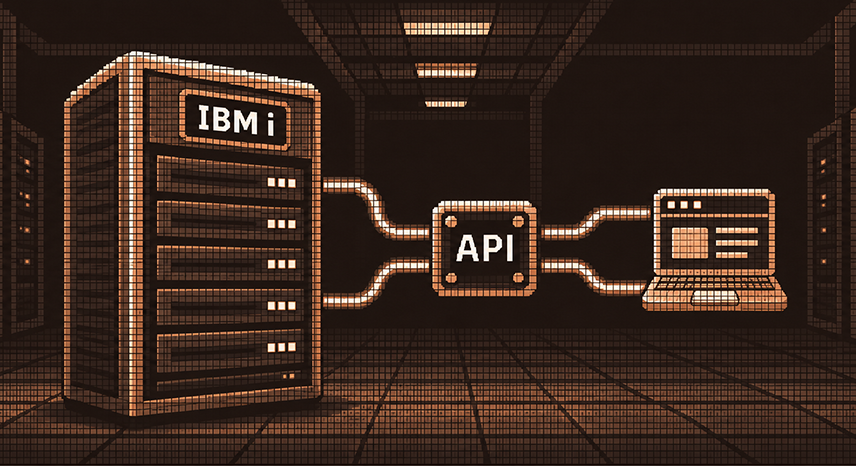
That distinction changes the entire modernization strategy. Few enterprises will run IBM i forever. Most technology leaders frame IBM i modernization as a cutover: migrate the RPG estate, rehost, retire the platform. That is why most programs stall before they start. The core does not need to move. Expose RPG logic and DB2 for i data as governed APIs, and cloud-native services and AI workflows consume it in place, modernizing the business one service at a time. API enablement is the lever.
This article examines what actually happens, technically and commercially, when IBM i applications start exposing their logic and data as APIs.
What’s Really Holding Your Business Back: IBM i or the Integration Gap?
The instinct to rip and replace comes from a misread. Leaders see green screens and assume the underlying system is obsolete. The interface is dated; the engine is not. The genuine risk sits one layer up, in the integration gap between IBM i and the cloud platforms, mobile channels, and partner systems that customers now expect every business to support.
According to Fortra’s 2026 IBM i Marketplace Survey 1, only 17% of organizations run IBM i as their sole platform, which means more than four in five operate it alongside Windows, Linux, and cloud workloads. IBM i already lives in a mixed estate. The unresolved question is whether it participates in that estate as a connected service or sits beside it as an island, reachable only through nightly batch files and brittle screen-scraping scripts.
Isolation carries a compounding cost. Every digital initiative that needs IBM i data, a new customer portal, a real-time inventory feed, or a fraud model, inherits the integration debt first. Teams spend their budget building one-off connectors instead of capabilities. Over time, the platform earns an undeserved reputation as the blocker, when the real blocker is the absence of a clean way in and out. Solving access first, rather than starting with a full replacement, is where the near-term leverage lives. For most enterprises, that work begins with focused IBM i application modernization services rather than a full rebuild.
In practice, this breaks down into a handful of focused moves, each one closing a specific gap between IBM i and the systems around it.
- API Enablement: Expose core RPG and COBOL logic as clean, reusable services.
- Data Access: Replace nightly batch files with real-time, governed data feeds.
- Interface Refresh: Move users off green screens onto modern web and mobile front ends.
- Cloud Connectivity: Link IBM i securely to cloud apps without shifting the core off-platform.
- Integration Layer: Standardize how partner systems read from and write to IBM i.
What API Enablement of IBM i Actually Means
API enablement of IBM i means making the business logic inside your RPG and DB2 for i applications callable by any authorized system over standard web protocols, without it needing to know RPG exists. The core stays in place, but any authorized system in your estate can now call those APIs.
From Monolithic RPG Logic to Reusable Business Services
Decades of RPG development have encoded hard-won business rules, including pricing logic, credit checks, order validation, and tax handling, into programs that run reliably every day. The problem is packaging, not quality. That logic is trapped inside monolithic programs designed for screen interaction, so it cannot be reused outside the green screen. This is the same coupling that legacy application modernization programs spend years trying to unwind.
API enablement extracts discrete units of that logic and exposes them as services. A credit-check routine becomes a service any channel can invoke. An order-creation program becomes an endpoint that a mobile app, a partner system, or a cloud workflow can call. The business rule is written once and reused everywhere, which removes duplication and the silent risk of the same rule being reimplemented, slightly differently, in three other systems.
Secure Access to DB2 for i Without Exposing the Core
Data access is where governance and architecture meet. DB2 for i holds the transactional truth of the business, and direct database connections from external applications are both a security liability and an integration trap. APIs introduce a controlled boundary in place of that exposure.
Instead of opening the database, an API exposes a defined contract: specified inputs, validated outputs, and nothing more. Field-level authority, row-level filtering, and audit logging are enforced on the platform. OAuth 2.0 and TLS govern who calls the service and how. The result is real-time access to IBM i data for the systems that need it, with a smaller attack surface than the batch-file exchanges and shared credentials many enterprises still rely on. Security improves while access expands, which inverts the usual tradeoff.
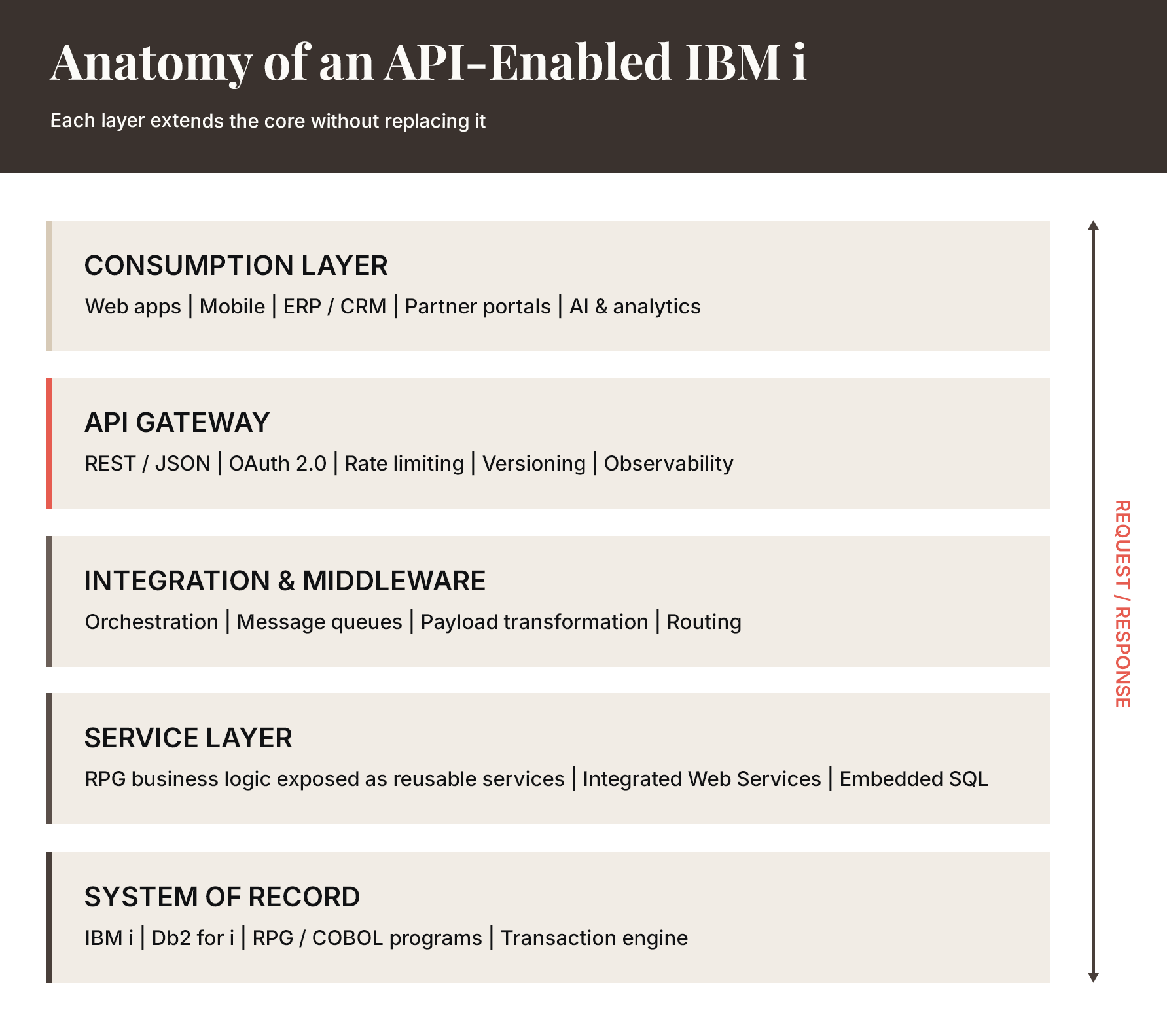
REST, Middleware, and Integration Layers in Plain Terms
The architecture may seem complex at first, but the concept is straightforward. A REST API uses standard HTTPS requests and responses to exchange data in JSON, a format modern applications already understand. IBM i exposes these through Integrated Web Services or a dedicated API gateway. A middleware or integration layer sits between the gateway and the consuming systems, handling orchestration, message routing, and payload transformation when formats differ.
For business leaders, the value of REST and JSON lies in the operational benefits they deliver. They allow developers on any technology stack to integrate with IBM i without specialized platform knowledge, widening the talent pool at a time when IBM i skills are scarce. The gateway means access is governed, versioned, and observable, which reduces operational risk. The integration layer means new systems connect to a stable contract instead of the underlying program, so the core can evolve without breaking everything attached to it.
| IBM i Asset | What the API Exposes | Business Outcome |
|---|---|---|
| RPG pricing and discount logic | A pricing service returning real-time quotes | Consistent pricing across web, mobile, and partner channels |
| Order-entry program | An order-creation endpoint with validation | New digital and partner order channels without re-coding rules |
| DB2 for i inventory tables | A read service with row-level filtering | Live stock visibility for ecommerce and fulfillment |
| Customer master file | A governed customer-lookup service | Unified customer data for CRM and service tools |
| Credit-check routine | An on-demand credit-decision service | Faster onboarding and automated approvals |
How API Enablement Supports Modern Enterprise Architecture
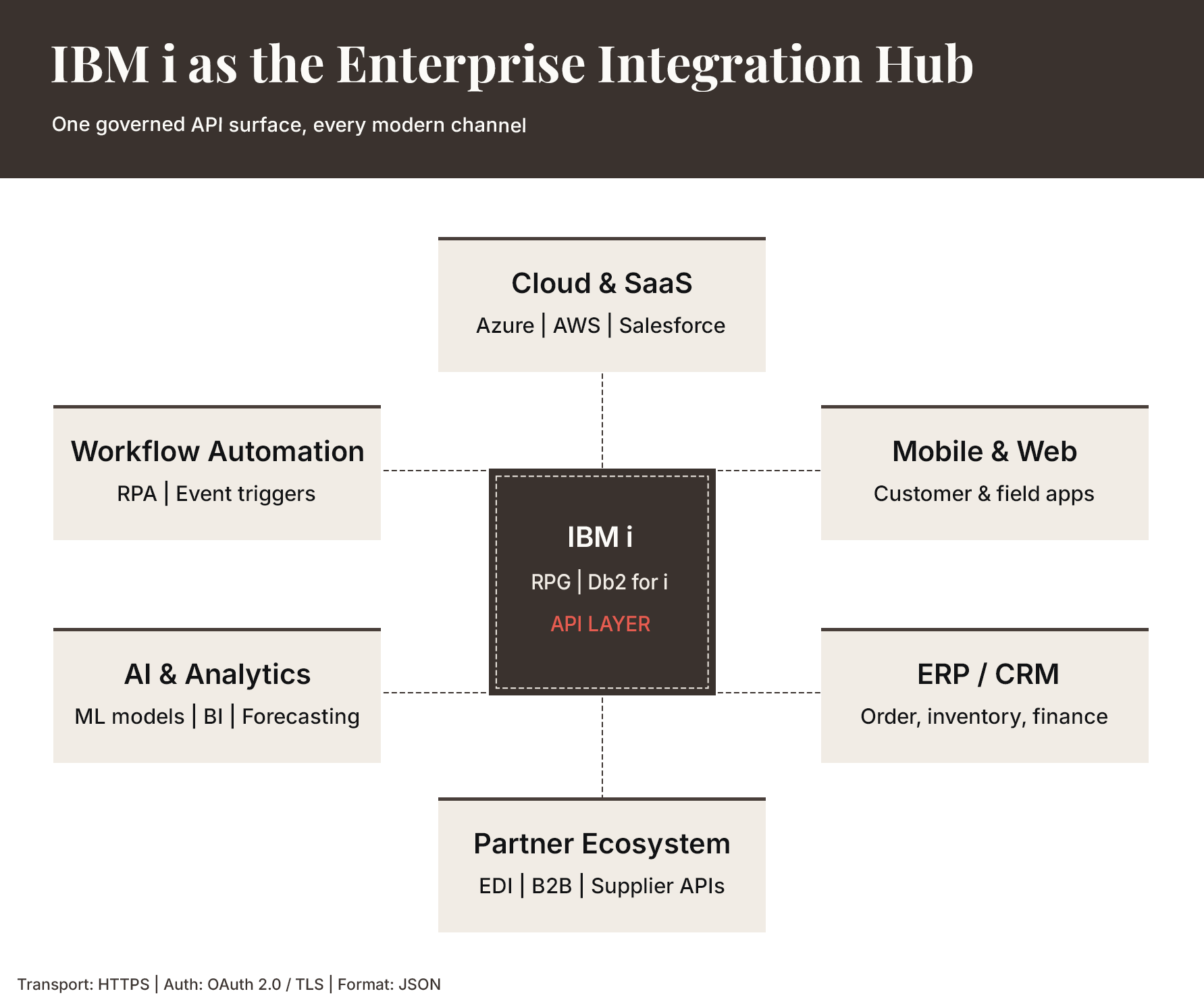
Once IBM i speaks REST, its role in the architecture changes. The platform stops being a back-office system that other systems work around and becomes a participant that other systems build on. Three shifts follow.
First, IBM i joins cloud-native ecosystems. Its services appear in the same catalog as cloud and SaaS APIs, so a workflow in Azure, a function in AWS, or a process in Salesforce calls IBM i logic directly, in real time. The platform contributes its strengths, transactional reliability, and decades of refined business rules to architectures it was never originally designed to join.
Second, omnichannel experiences become possible without a rebuild. Web storefronts, mobile apps, ERP modules, and partner portals all consume the same governed services, so the customer sees consistent data and behavior regardless of channel. The business adds channels by composing existing services rather than rewriting logic.
Third, IBM i becomes a real-time operational intelligence source. APIs remove the batch delay between an event happening on the platform and the rest of the enterprise learning about it. Inventory, orders, and financial state become queryable on demand, which is the precondition for both live dashboards and automated decisions.
“With the state of the world, every company is now a software company.”
– Satya Nadella, Chief Executive Officer, Microsoft
For an IBM i enterprise, becoming a software company does not mean abandoning the platform that runs the business. It means making that platform programmable, so its capabilities can be assembled into new products, channels, and experiences instead of staying locked inside the systems that already hold them.
See How Damco Connects Isolated IBM i Systems to Cloud, Mobile, and Partner Ecosystems Through Governed, Reusable APIs
The UNLOCK Approach: A Lower-Risk Path to IBM i Modernization
API enablement fails when it is treated as a one-off integration task instead of a discipline. Teams expose a handful of programs, skip governance, and recreate the same tangle they set out to fix, now in JSON. A disciplined, API-first approach avoids that trap. The approach below, summarized as UNLOCK, gives any enterprise a sequence where each step lowers risk and compounds value, moving from a single API toward a composable architecture.
The premise is API-first: the lowest-risk modernization starts by connecting the core, then expands outward as confidence and reusable services accumulate. The sequence keeps the business running throughout, because workloads are exposed and later re-platformed one at a time, rather than rewritten in a single cutover.
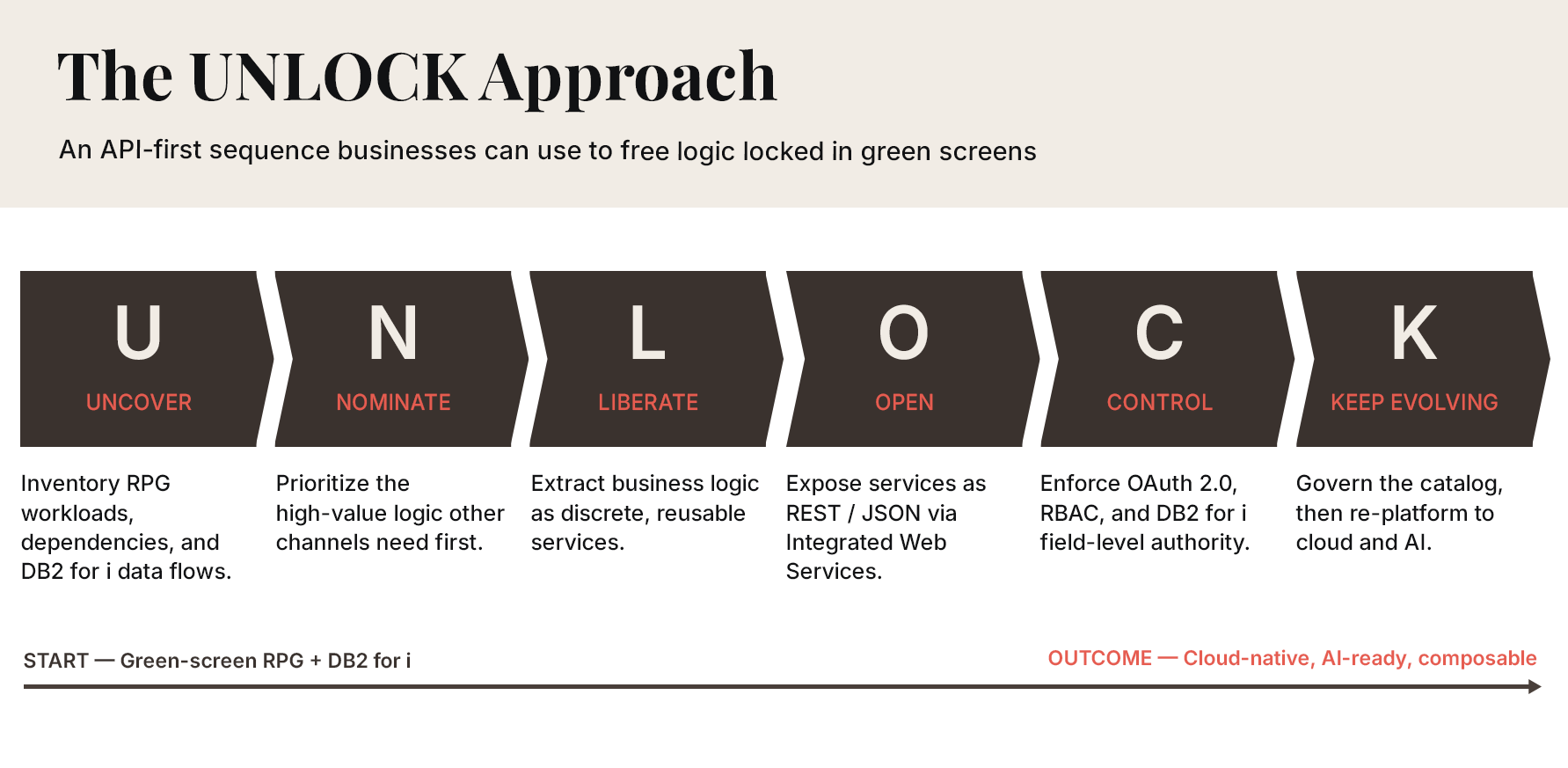
The UNLOCK approach is an API-first sequence that helps businesses free the logic trapped inside legacy green screens. It moves step by step through Uncover, Nominate, Liberate, Open, Control, and Keep Evolving, turning RPG and DB2 for i workloads into discrete, reusable services exposed as secure REST/JSON APIs. The result is a shift from rigid green-screen systems to a cloud-native, AI-ready, and composable architecture without a risky full rewrite.
Prioritization is the step most programs get wrong. Not every RPG program deserves an API, and exposing the wrong ones first creates effort without payoff. High-value targets share three traits: they hold logic other channels need, they touch data that drives revenue or service, and they carry manageable dependencies. The matrix below shows how that judgment translates into sequencing.
| Workload | API Value | Effort and Risk | Recommended Sequence |
|---|---|---|---|
| Order and quote logic | High | Moderate | First wave |
| Inventory and stock queries | High | Low | First wave |
| Customer and account lookups | Medium | Low | Second wave |
| Pricing and credit rules | High | Moderate | Second wave |
| Reporting and batch extracts | Low | Low | Later, if justified |
| Deeply coupled legacy modules | Medium | High | Refactor before exposing |
This is also the point where modernization stops being a one-time project and becomes an operating capability. Each governed service an enterprise publishes becomes a reusable asset, and a candidate to be re-platformed later behind the same contract, which is why API enablement so often precedes broader cloud migration work rather than competing with it.
What API Enablement Looks Like in Practice
Frameworks are easier to trust with a concrete picture. Consider a representative scenario, drawn from common patterns across distribution and manufacturing enterprises rather than a single client.
A distribution business runs order management, inventory, and pricing on IBM i. Customers ask for a self-service ordering portal and real-time stock visibility. The existing approach exports data overnight, so the portal would always show yesterday’s inventory, and every new partner integration takes weeks of custom file mapping. The platform is not slow; the access pattern is.
API Enablement in Action: A Food Distribution WMS on IBM i
A US-based company headquartered in Dakota had spent two decades building warehouse management software for grocery, food-service, c-store, and produce distributors, all running on legacy IBM i. The platform was reliable, but its dated interfaces and manual, batch-bound processes slowed daily operations and made onboarding new customers costly.
Damco revamped the core WMS capabilities, including inventory management, product management, and replenishment, and exposed them through an AWS API Gateway layer so the proven IBM i logic could support modern, real-time workflows. A native mobile app added barcoding and RFID for selection, cycle counts, and put-away, while a new dock-door scheduling platform enabled truck drivers to manage appointments and inbound logistics through drag-and-drop controls.
The result: a 35% improvement in operational efficiency and lower customer onboarding costs, without abandoning the IBM i core that already ran the business.
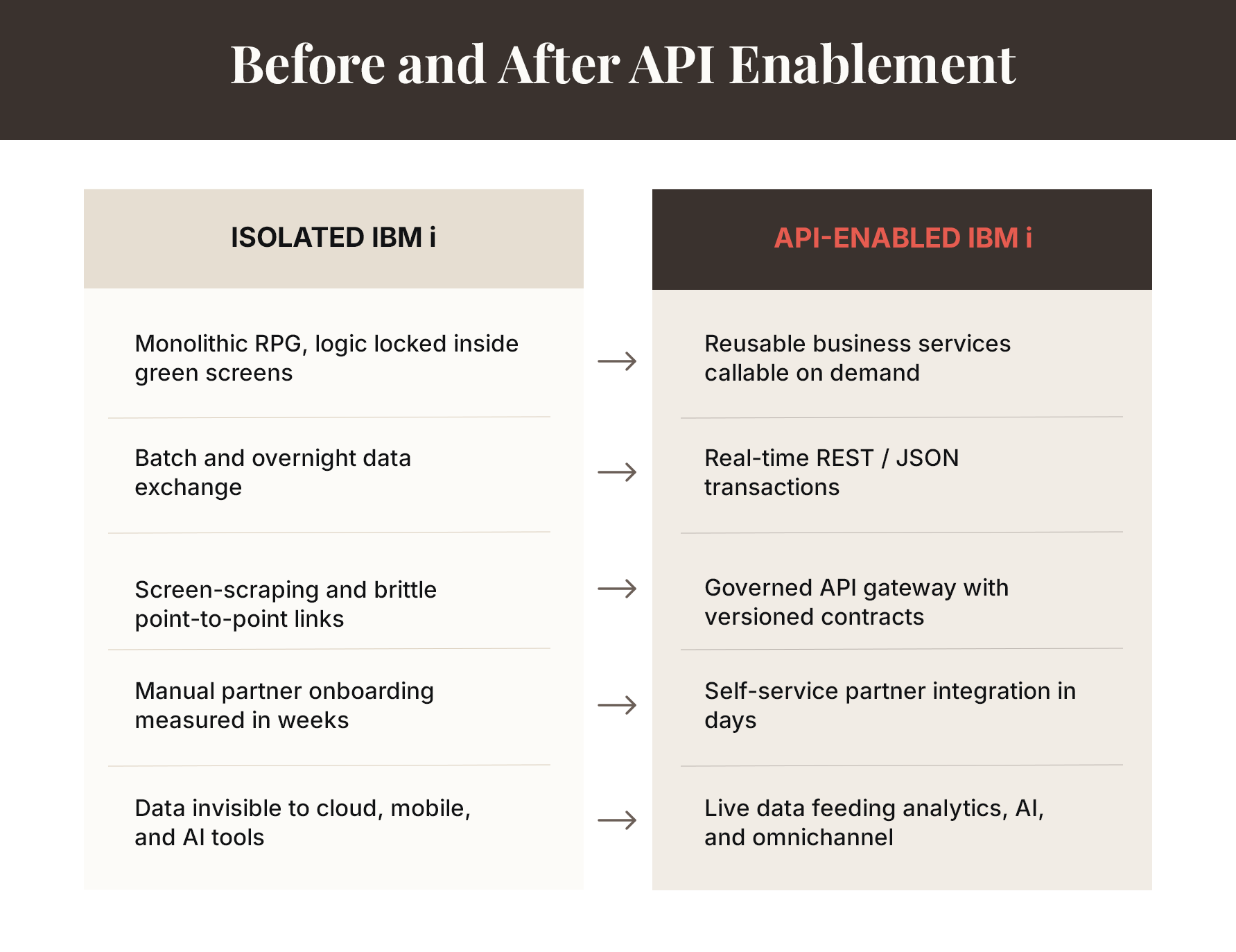
API enablement reframes the build. The team exposes inventory as a read service, order creation as a transactional endpoint, and pricing as an on-demand service, all behind a governed gateway. The portal now calls live IBM i data. Partners are onboard with a documented API contract instead of a bespoke file format. The same services later feed a demand-forecasting model, because the data is finally reachable in real time. No core program is rewritten; the business simply becomes connectable.
Create a Smarter Path Beyond IBM i Through Modernization
The strongest argument for API enablement is what it makes possible next. Every emerging capability the business will want, including AI, advanced analytics, and intelligent automation, depends on one thing: reachable data. Models cannot learn from records they cannot access, and automation cannot act on a system it cannot call.
This is where many AI programs quietly stall. The model is ready, the data is not reachable, and the project stops at proof of concept. APIs resolve the bottleneck by turning IBM i into a live data source that AI and analytics platforms query directly, which is why API enablement is better understood as AI enablement by another name.
The commercial case extends well beyond efficiency. McKinsey 2 found that one organization built a library of standardized, reusable APIs and cut traditional product development IT costs by 41% while achieving a 12-fold increase in new releases. This is the kind of reuse dividend an API enabled IBM i can deliver. An API-enabled IBM i positions the enterprise to capture a share of that value by exposing services to partners, monetizing data access, and composing new offerings from capabilities that already exist.
This is also how the eventual move off IBM i becomes manageable. Once consumers call stable API contracts instead of the underlying programs, the business can re-platform functionality one service at a time, retiring legacy code in increments while the channels above never notice the change. The migration runs in the background; the modernization is felt immediately. For most enterprises pursuing enterprise digital transformation, that combination of modern capability now and a low-risk path off the platform later is the entire point.
Get a Free IBM I Modernization Assessment.
Modernization Beyond Integration
IBM i has powered the business reliably for decades, but that dependability has also made difficult modernization decisions easier to postpone. Meanwhile, RPG expertise is dwindling, integration workarounds are multiplying, and the cost of leaving the estate unchanged rises each year—even without a visible outage.
Most organizations cannot rework a core estate in one cycle, which is where API enablement earns its place. Surfacing RPG logic and DB2 data as services lets new channels, AI initiatives, and partner integrations move at their own pace while the underlying platform is unwound in stages. One high-risk cutover becomes a sequence of smaller steps, each of which can be reversed if it goes badly.
Worth holding onto through all of it: the destination still sits beyond the platform. APIs create room to get there at a sensible pace once that direction is agreed. Damco helps technology leaders sequence that work through IBM i API enablement and modernization services that open up the platform now while moving the business toward a future that no longer depends on it.
References:


