

Key Takeaways:
- AI speeds up coding, not software delivery. The biggest delays often occur after the code is written.
- AI amplifies your existing delivery process. Strong CI/CD and DevOps practices determine its impact.
- Verification is the new bottleneck. More time is spent on testing, reviews, and integration than on code generation.
- Speed without stability creates technical debt. Poor-quality AI-generated code increases failures and maintenance.
- Context is the real constraint. AI cannot replace clear requirements or eliminate communication gaps.
- Continuous Ownership enables end-to-end delivery. Fewer handoffs, shared accountability, and early validation turn AI output into production-ready releases.
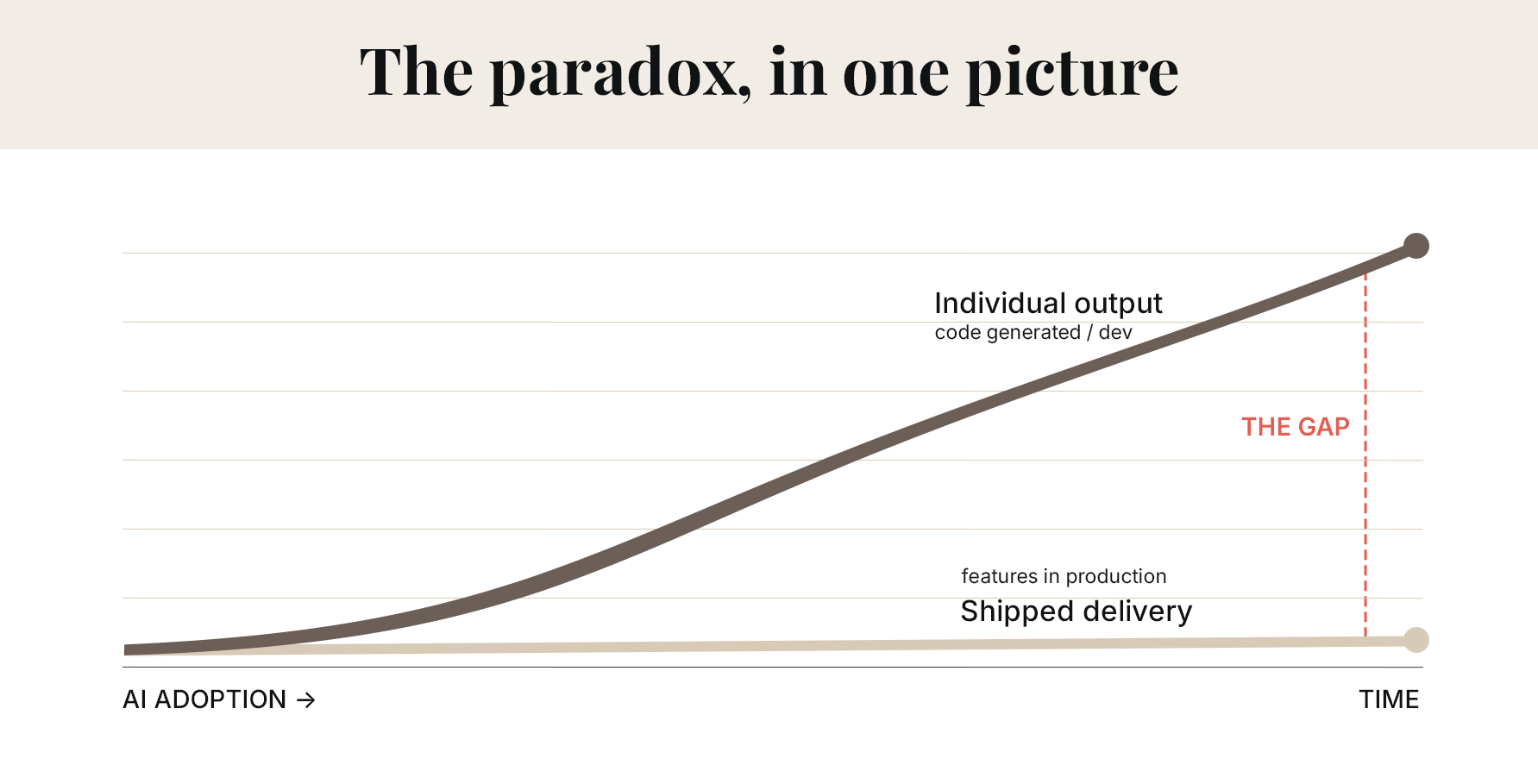
A junior engineer now produces in an afternoon what once took a senior developer days. Dashboards glow green. Pull requests pile up. And yet, for many enterprises, the date a feature actually reaches customers has not moved. This is the central tension inside modern AI-assisted software delivery: individual output has surged while the speed of shipping working software has stayed flat or quietly slipped backward.

The instinct among technology leaders is to assume the tools were oversold. The evidence points somewhere far more uncomfortable. The coding layer got faster exactly as promised. Everything around it (review, validation, coordination, and deployment) did not. AI exposes that gap.
This blog will help you understand why AI alone cannot accelerate software delivery and how context, ownership, and validation determine real engineering productivity.
| Statistic | Finding | Source |
|---|---|---|
| 62.3% | Of professional developers already use AI in their development process | STACK OVERFLOW 20241 |
| ?7.2% | Estimated drop in software delivery stability as AI adoption rose | DORA 20242 |
| ?1.5% | Estimated drop in delivery throughput over the same period | DORA 20243 |
What Is the AI Productivity Paradox in Software Delivery?
The AI productivity paradox describes a simple, repeatable pattern: AI raises the productivity of the individual developer while leaving, or worsening, the performance of the delivery system as a whole. The 2024 DORA research2, drawn from roughly 3,000 technology professionals, found that as AI adoption climbed, delivery throughput and stability both moved in the wrong direction. The report’s own conclusion was blunt.
This is not an argument against AI coding tools. The individual gains are real and measurable, but the bigger question is where they go. When code is generated faster than the surrounding system can review, test, and release it, the surplus becomes inventory, work in progress that queues, ages, and competes for the same downstream attention.
Why Doesn’t Faster Code Mean Faster Delivery?
Writing code is one stage in a long chain. A feature still has to be reviewed, tested, integrated, secured, approved, and deployed before a customer sees it. Speeding up a single stage does not speed up the chain; it just moves the queue. The bottleneck relocates rather than disappearing.
Three mechanics drive the slowdown:
- The verification tax. DORA’s2 later research describes how time saved in writing code is frequently re-spent on auditing it. Generation is cheap; trust is expensive. Reviewers now face more code, written faster, by an author who may not fully understand it either.
- More code, more surface area. Larger changes are harder to review, harder to test, and more likely to introduce defects; the opposite of the small-batch discipline that high-performing delivery depends on.
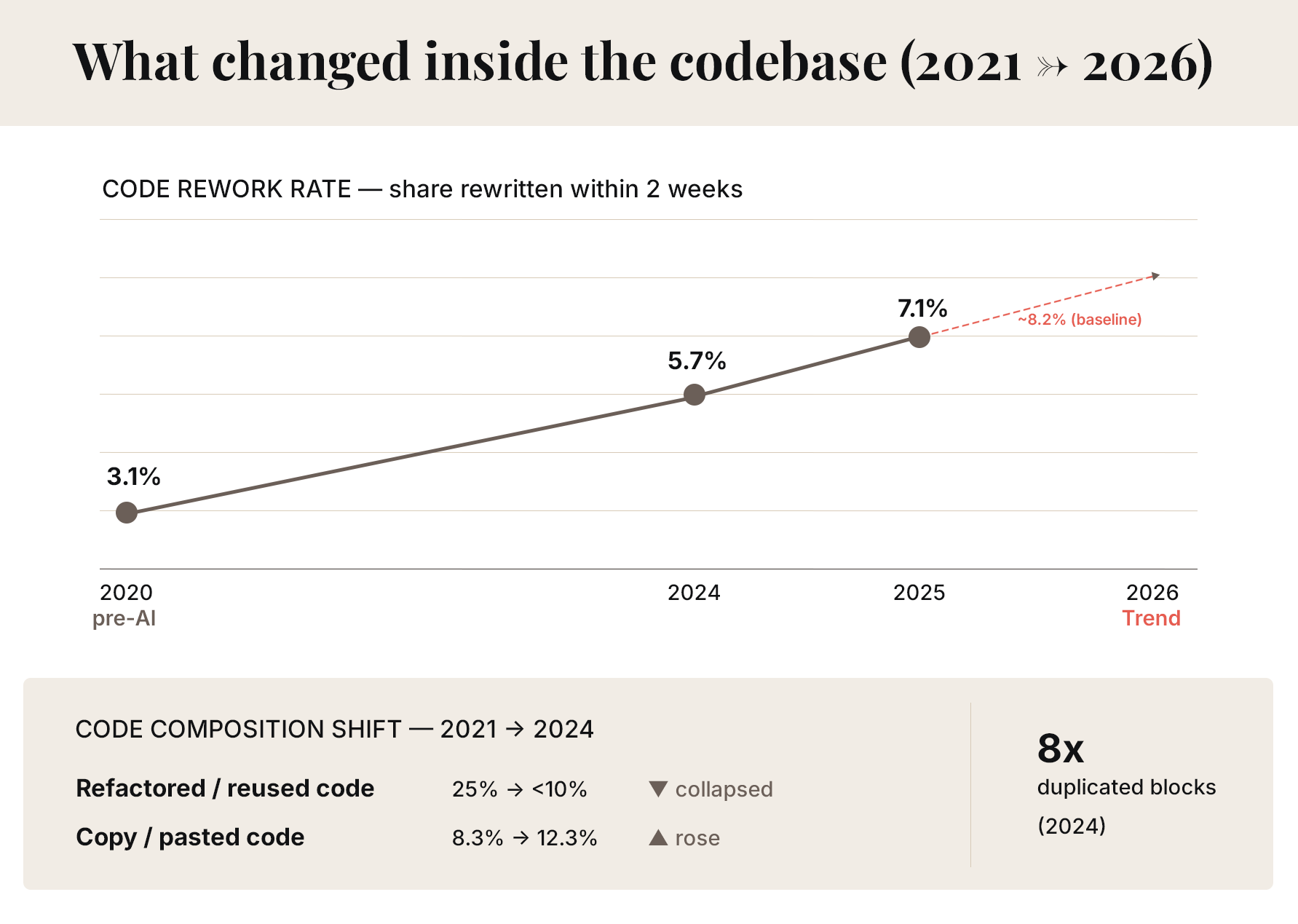
- Quality drifts in the codebase itself. Independent analysis of 211 million4 changed lines found refactoring collapsing while duplication climbed, a structural signal that speed is being bought with future maintenance debt.
Is the Problem the Tools, or the Way Teams Are Organized?
The most important lesson from the last few years is that AI rarely creates new problems. Instead, it amplifies the ones that already exist. Organizations with strong engineering practices see AI accelerate delivery, while those with fragmented workflows, technical debt, and disconnected systems often experience greater instability.
As AI adoption continues to grow, faster code generation alone does not guarantee faster software delivery. Without modern delivery processes and resilient engineering foundations, machine-speed output simply exposes existing bottlenecks at a larger scale.
“Automation applied to an inefficient operation will magnify the inefficiency.”
– Bill Gates, Co-founder of Microsoft
The reality is straightforward. Layering AI onto a delivery model built for human-speed coordination creates a faster front end feeding the same constrained pipeline.
When engineering practices, governance, and deployment workflows fail to evolve alongside AI adoption, gains made during code generation are often lost in testing, approvals, integration, and release. Development may finish sooner, but the software still waits for the rest of the delivery system to catch up.
Where Does the Original Intent Get Lost?
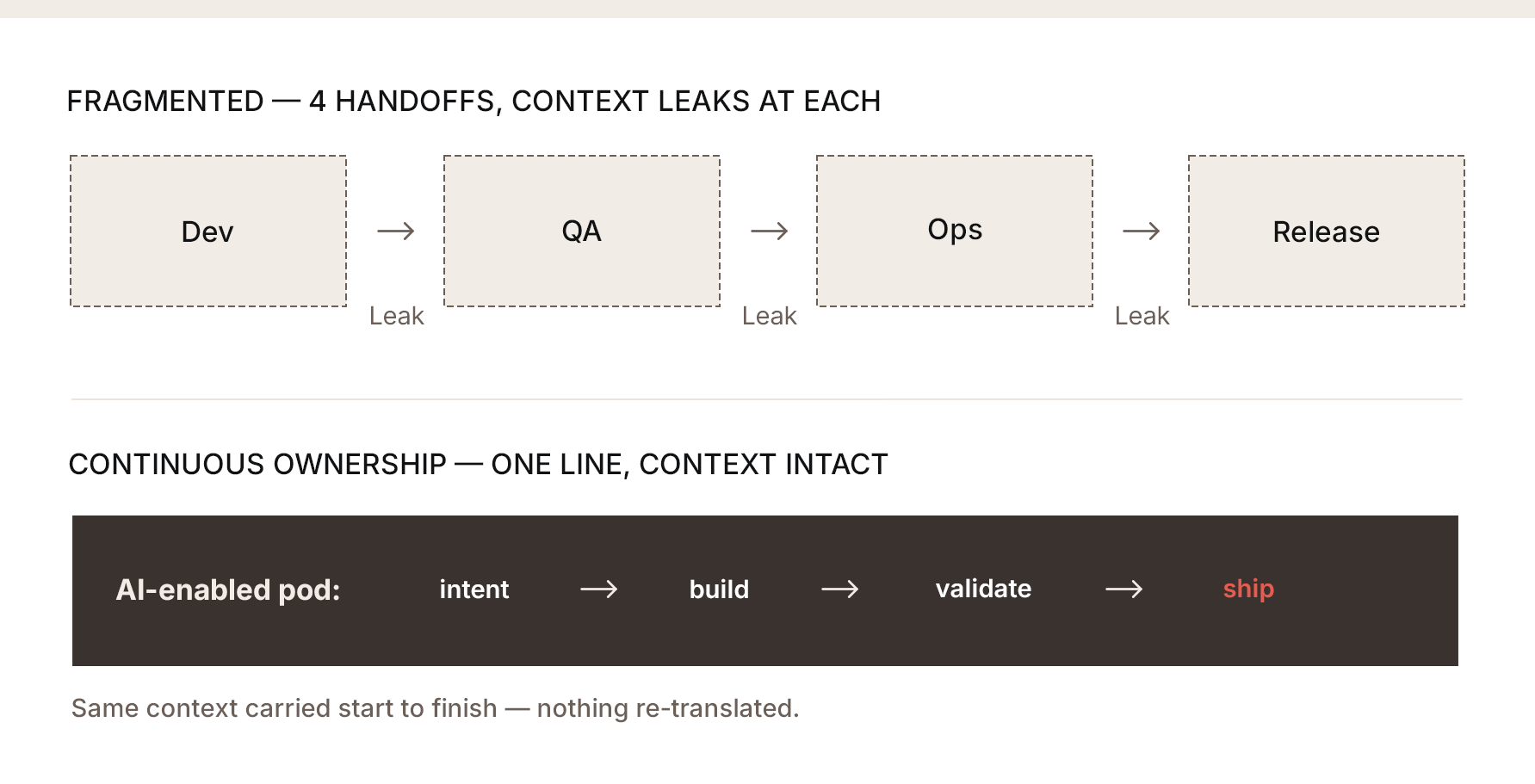
Every handoff is a translation, and every translation loses something. A business goal becomes a requirements document. The document becomes a design. The design becomes a ticket. The ticket is generated by code. By the time AI is producing output, the why behind the work has been compressed several times over, and AI cannot recover the intent that was never handed to it. It optimizes the instruction it received, not the outcome the business wanted.
The result is code that is syntactically correct and contextually wrong: technically valid, but misaligned with the business logic, the architecture, or the edge cases that only the original owner understood. Faster generation makes this worse, because misaligned work now arrives sooner and in greater volume.
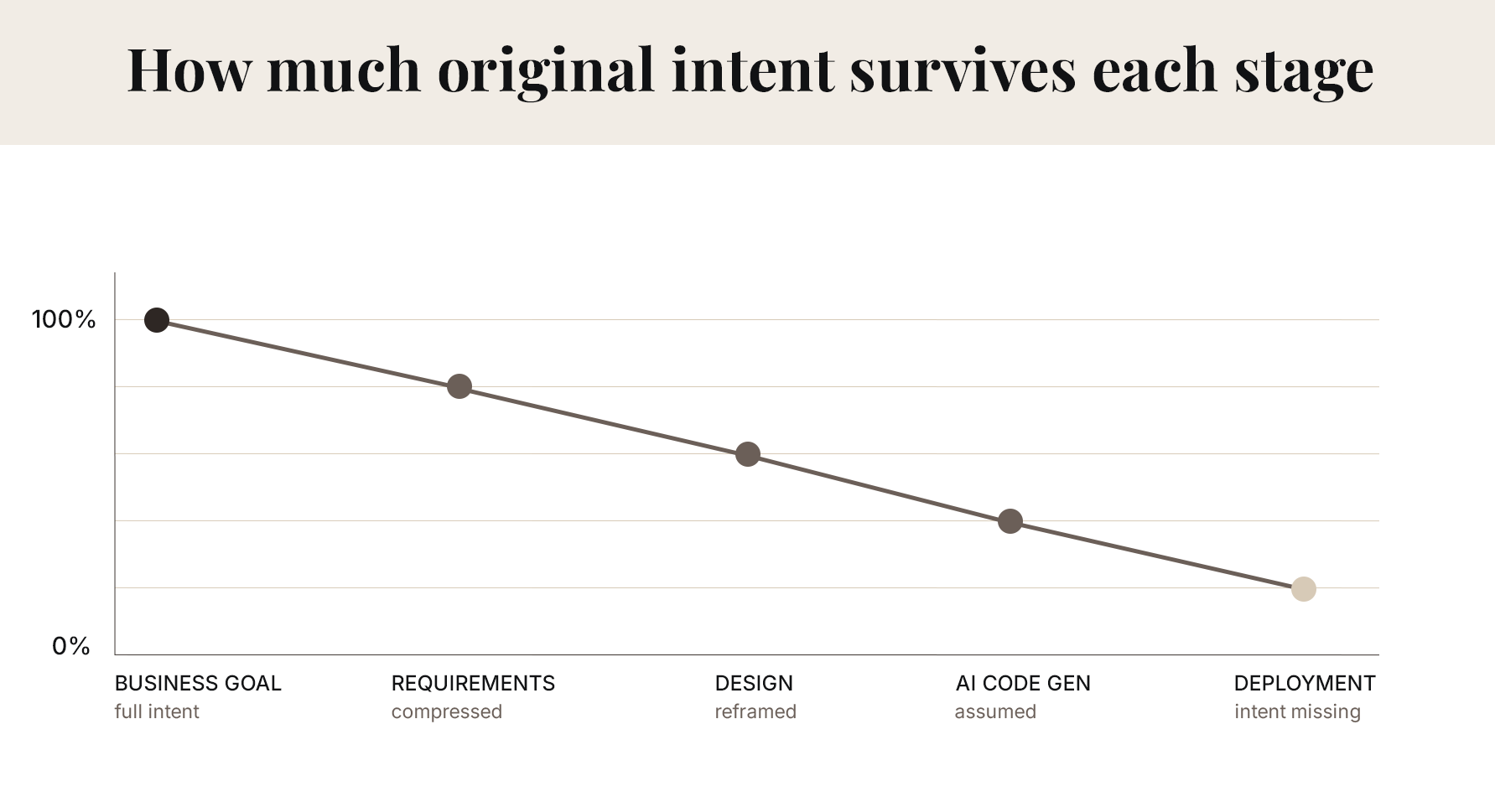
This reframes what is actually scarce. The bottleneck is no longer code generation, which is now abundant. The scarce resource is context: the preserved understanding of intent, architecture, and constraint that lets AI-generated output land correctly the first time.
Is Your Delivery System Ready for Machine-Speed Output?
Can You Measure Why AI Speed Disappears?
It helps to have a plain way of describing where the speed goes. Damco uses a simple diagnostic lens, the Delivery Drag Equation, not a precise formula, but a way to reason about why raw AI output so rarely converts into shipped value.
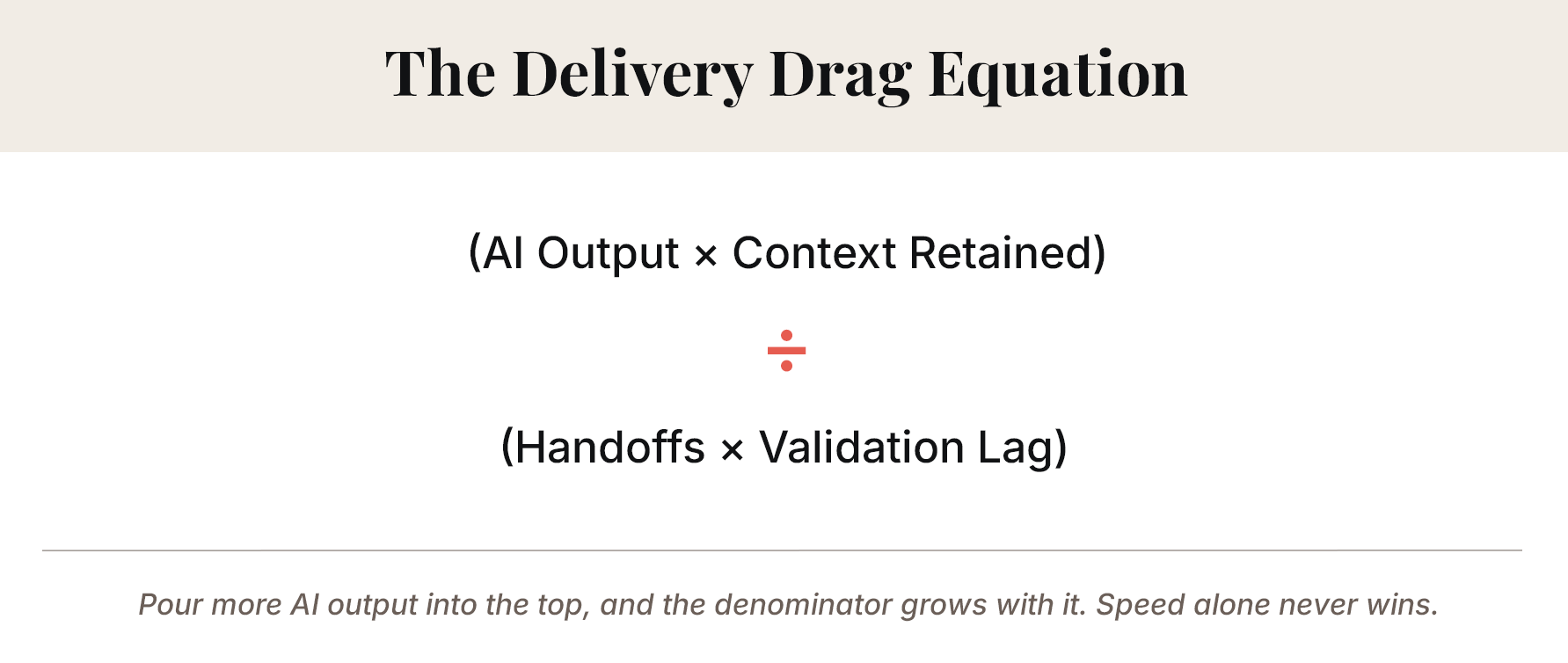
The lens makes the trap obvious. Most enterprises spent the last two years raising one variable (AI output) while leaving the denominator untouched. More handoffs, the same validation lag, and shrinking context retention quietly cancel the gain. The path forward is not more output. It is a smaller, cleaner denominator.
What Does an AI-Ready Delivery Model Actually Look Like?
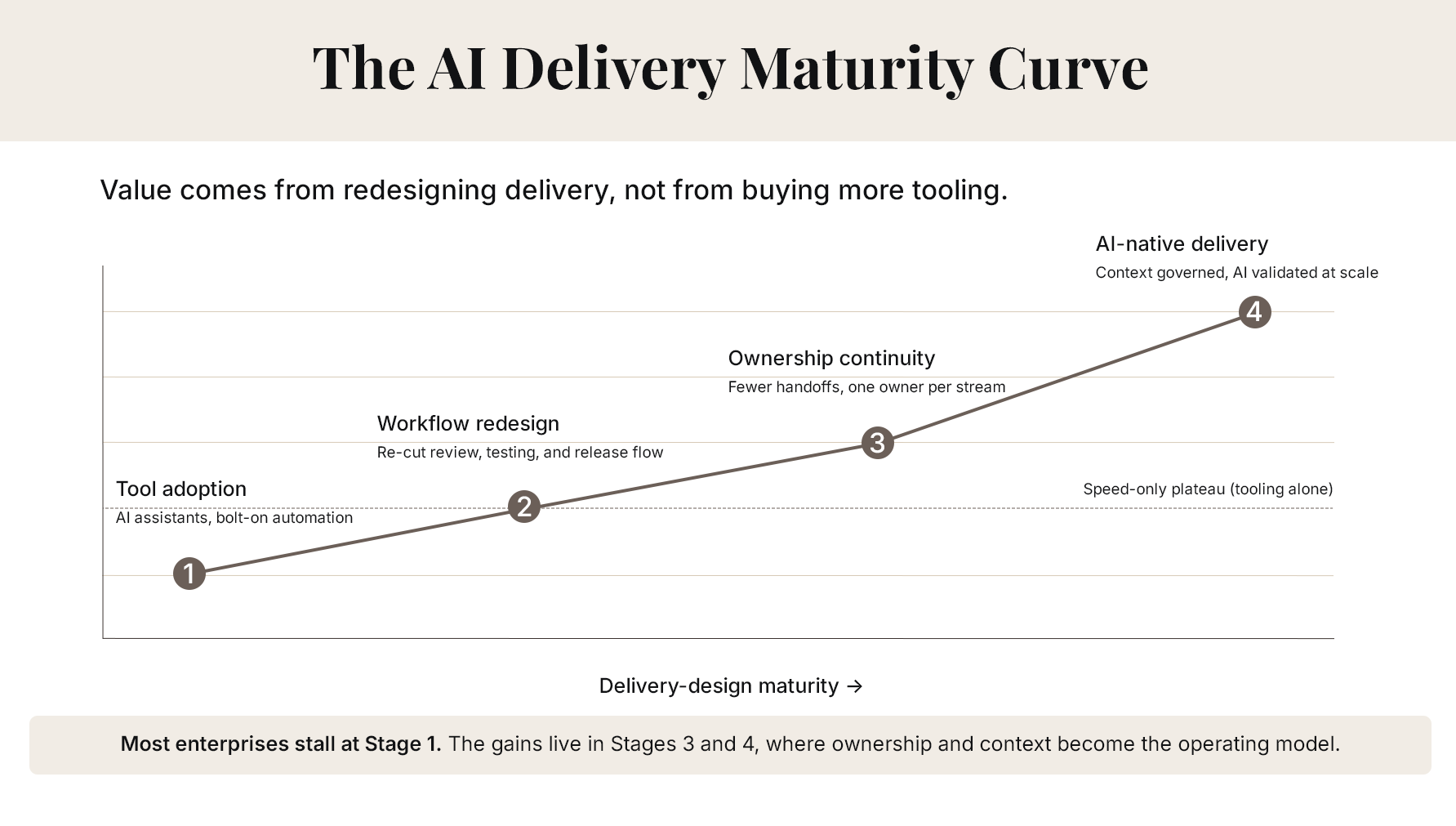
The organizations pulling real delivery gains from AI share a pattern. They stopped optimizing the coding stage and started rebuilding the operating model around it. Damco describes this shift as moving toward Continuous ownership, a delivery model built on two principles: fewer handoffs and unbroken context.
- One accountable line, not a relay race. A small, AI-enabled pod carries a piece of work from intent to production. Ownership does not change hands at every stage, so context is never re-translated for a new team.
- Context travels with the work. Business intent, architectural constraints, and edge cases are captured as durable, AI-accessible artifacts, not locked inside one senior engineer’s head or lost in a ticket queue.
- Validation moves to the point of creation. Automated testing, security, and compliance checks run as code is generated, not weeks later in a separate approval cycle that the AI sprint already outran.
- Smaller batches, by design. Leaner pods ship smaller, reviewable changes, restoring the small-batch discipline that delivery performance has always depended on.
| Dimension | Fragmented handoff model | Continuous Ownership |
|---|---|---|
| Accountability | Splits across dev, QA, ops, business | Held end-to-end by one pod |
| Context | Re-translated at every stage | Preserved with the work |
| Validation | A downstream approval cycle | Built into the moment of creation |
| Effect of AI | Amplifies the bottleneck | Amplifies the flow |
| Batch size | Large, hard to review | Small, reviewable |
How Does Damco Apply This to AI-Assisted Software Delivery?
Damco treats the AI productivity paradox as an operating-model problem and addresses it with an approach it calls Context-owned Delivery. The goal is simple to state and hard to retrofit: keep business intent and AI output under one accountable owner, and remove the handoffs where meaning leaks out. The approach rests on five operating principles.
- 1. Single-stream ownership. One pod owns a change from business conversation to production, so intent never gets relayed.
- 2. Context capture. Business rules and architectural intent are recorded as living artifacts that travel with the work.
- 3. Paired AI validation. Every AI-generated change is checked against architecture and business logic, not just tests.
- 4. Flow over batch. Small, frequent releases keep change-failure risk and review load low.
- 5. Delivery telemetry. Throughput and stability are measured together, so speed is never bought at the cost of reliability.
- 6. Communication-aware AI. AI should have access to the latest client conversations, decisions, and updates, so every recommendation reflects the current business context, not just the codebase.
This is where modernization and AI meet. Damco’s AI development services and AI application development practice pair generation with validation, while its application modernization services and legacy modernization services remove the fragmented systems that force handoffs in the first place. Delivered through enterprise application services, the result is a delivery design where AI speed actually reaches production.
Validation is the part most programs skip. Generating code is the easy half. The hard half is proving that the output respects the architecture, the data contracts, and the business rules it was never told about. Context-Owned Delivery makes that proof a standing step rather than an afterthought, which is what keeps speed from turning into silent risk.
Damco in Practice
A U.S. refinery with 80+ years of operations ran production-facing workflows on aging, disconnected applications that crashed routinely. Damco re-engineered the monolith into modular, cloud-native .NET Core services on Azure and introduced CI/CD pipelines with automated testing and phased rollouts.
The results were measured, not promised: 40% lower system downtime, 3x faster reporting cycles, 25% better supply-chain accuracy, and 30% lower maintenance costs.
AI Delivers Value When Your Delivery Model Is Built for It.
Can AI Make the Right Change Without the Latest Business Context?
AI-generated code is only as accurate as the context available at the time of generation. A repository can tell an AI system what the software does, but it cannot reliably tell it what the client decided yesterday, which business rule changed during the latest call, or which requirement was superseded after implementation began.
Communication-aware AI closes that gap by treating client communication as an active engineering input. Meeting transcripts, emails, tickets, approvals, requirement changes, and decision logs should become structured, versioned context that AI can retrieve alongside architecture documentation, APIs, code, and test specifications.
Technically, this creates a continuously synchronized context layer rather than a static prompt. When a client changes a rule, the change should be traceable from the communication artifact to the requirement, affected components, validation criteria, and generated code.
The result is not simply better AI output. It is context-consistent generation, where AI recommendations reflect the latest business intent and remain traceable to the decisions that shaped them.
What Should Engineering Leaders Do Next?
Stop measuring engineering by how fast code appears. Start measuring how fast intent becomes working software in production. Those are different numbers, and the gap between them is the whole story.
The organizations that pull ahead will not be the ones with the most AI licenses. They will be the ones who redesigned delivery around ownership and context, then let AI run inside that design. Productivity in this era is systemic, not individual. A faster developer inside a slow system is still a slow system.
None of this argues against AI. The technology is not the variable that decides the outcome. The variable is whether the delivery system around it can absorb the speed without losing meaning.
The real work in AI application development is rebuilding the path from idea to production so that nothing valuable is lost on the way. Treat context as infrastructure and handoffs as risk.
Sources:


