

Key Takeaways:
- Green uptime dashboards hide undocumented logic and untested disaster recovery plans.
- Real de-risking requires documenting business logic, not just monitoring system uptime.
- Single-person dependency creates severe risk when veteran AS400 developers hold all knowledge.
- Power9 and IBM i 7.4 deadlines in 2026 demand urgent lifecycle planning.
- AI tools speed up documentation, but engineers must verify extracted outputs.
- Choose providers who retire risk contractually, not vendors who just rent maintenance.
What does a green dashboard prove?
Most AS400 managed services contracts report green every month. Uptime stays high. Tickets get closed. Patches go out on schedule. But while all of this happens, organizations drift toward risk they cannot see.
IBM i is remarkably stable, and that stability makes the problem invisible.
Because the system rarely fails, the managed-services conversation collapses into monitoring, patching, and ticket response. Business logic goes undocumented. Key-person dependencies deepen. Disaster recovery plans sit untested for years. Nobody raises an alarm because the uptime numbers look fine.

This is the uptime trap: a system kept running is not a system de-risked.
AS400 support that only keeps the lights on defers everything else. De-risking is the actual deliverable. And most providers are not delivering it.
What AS400 Services and Managed Services Actually Cover
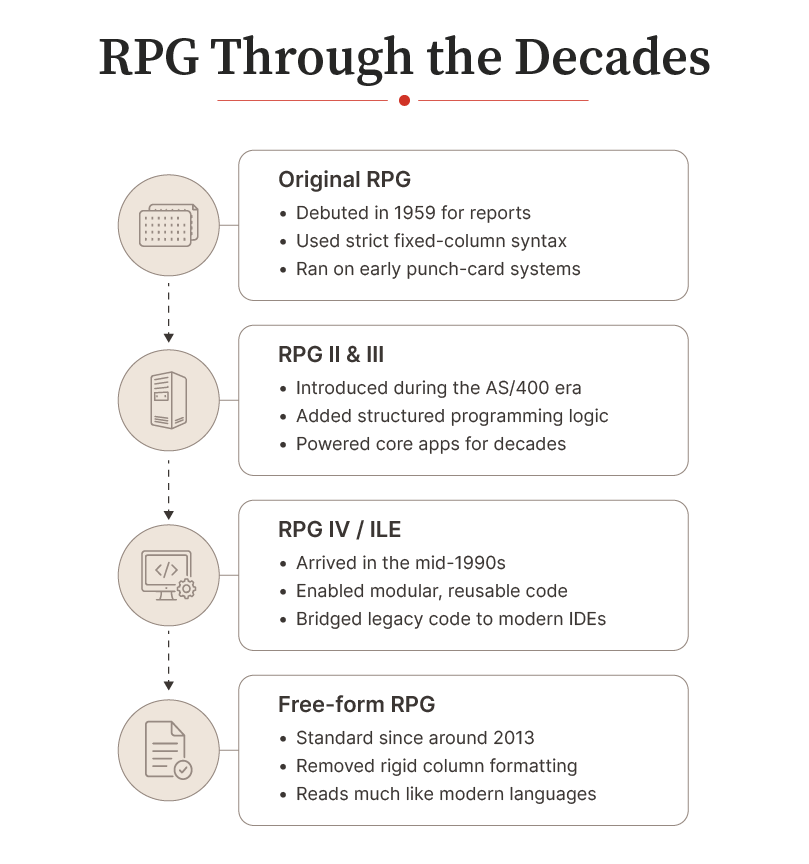
Most AS400 managed service providers offer a similar set of services. The scope has stayed consistent across the industry for years. But knowing what is on that list is only half the picture. The more important question is what the list does not address, and that is where your evaluation has to begin.
1. Monitoring and Administration
Providers offer 24/7 system monitoring that tracks uptime, performance metrics, and system health. Their teams update firmware and fine-tune performance based on regular reviews. They also plan for future capacity needs. The monitoring runs continuously, so issues get caught before they cause outages.
2. RPG/CL Application Support
This service keeps IBM i software functional. Providers fix bugs, apply patches, and make small enhancements as business needs change. Support covers the vital business logic written in CL, COBOL, and various generations of RPG, from legacy RPG II and III to modern ILE and Free-form RPG.
3. Modernization
IBM i AS400 modernization starts with assessment and discovery. Providers evaluate the existing setup to identify bottlenecks. They create roadmaps and assign resources for migrating systems to the cloud. Then, they modernize applications step by step, testing each change to ensure data stays accurate and performance does not suffer.
4. Integration
Integration links the IBM i environment to external applications, databases, and cloud platforms. Providers use APIs, middleware, and ETL tools to enable real-time data exchanges that sync information across different business departments. This keeps the whole digital ecosystem working as one.
5. Security
Security management covers user access controls, authentication protocols, and vulnerability assessments. Providers run penetration tests, apply security patches quickly, and set up encryption, firewalls, and VPNs to protect against expanding threat surfaces. These measures become even more critical as IBM i environments age.
6. Disaster Recovery
Disaster recovery provides automated backups, replication to a secondary site, and fast restoration. Providers run failover drills to make sure businesses can recover quickly during an actual outage. Their cloud-based backups with off-site replication give organizations options for data center, cloud, or hybrid recovery architectures.
While these services keep systems operational, they do not eliminate the risks that build up over years of patches and changing business needs. This matters because most organizations evaluating iSeries managed services simply check off this standard list. The real question they should ask is: which provider retires risk, rather than just renting out daily system maintenance?
Here’s Why AI Only Acts as a Strategic Assistant in IBM i Modernization
The Real Risk Is Deferred, Not Retired
IBM i systems run reliably, and that reliability makes the risk inside them easy to underestimate.
Beneath their green dashboards remain decades of business rules written in RPG programs by developers who knew the system well but documented almost nothing. The real question here is: does the organization still understand how it works?
Research tells us that 71%1 of small businesses rely on one or two key individuals for organizational success. And when they retire, institutional knowledge leaves with them.
The gap this approach creates shows up in daily work. A change request takes too long because nobody can trace its downstream effect. Likewise, an RPG modernization project stalls because the team cannot safely verify what the old code does.
A standard monitoring-and-patching contract keeps the system running. But it does not fix undocumented logic. And it does not remove key-person dependency. An AS400 consulting company that reports green every month can still leave businesses with hidden complexity and fading expertise.
The Four Risks a Real Engagement Retires
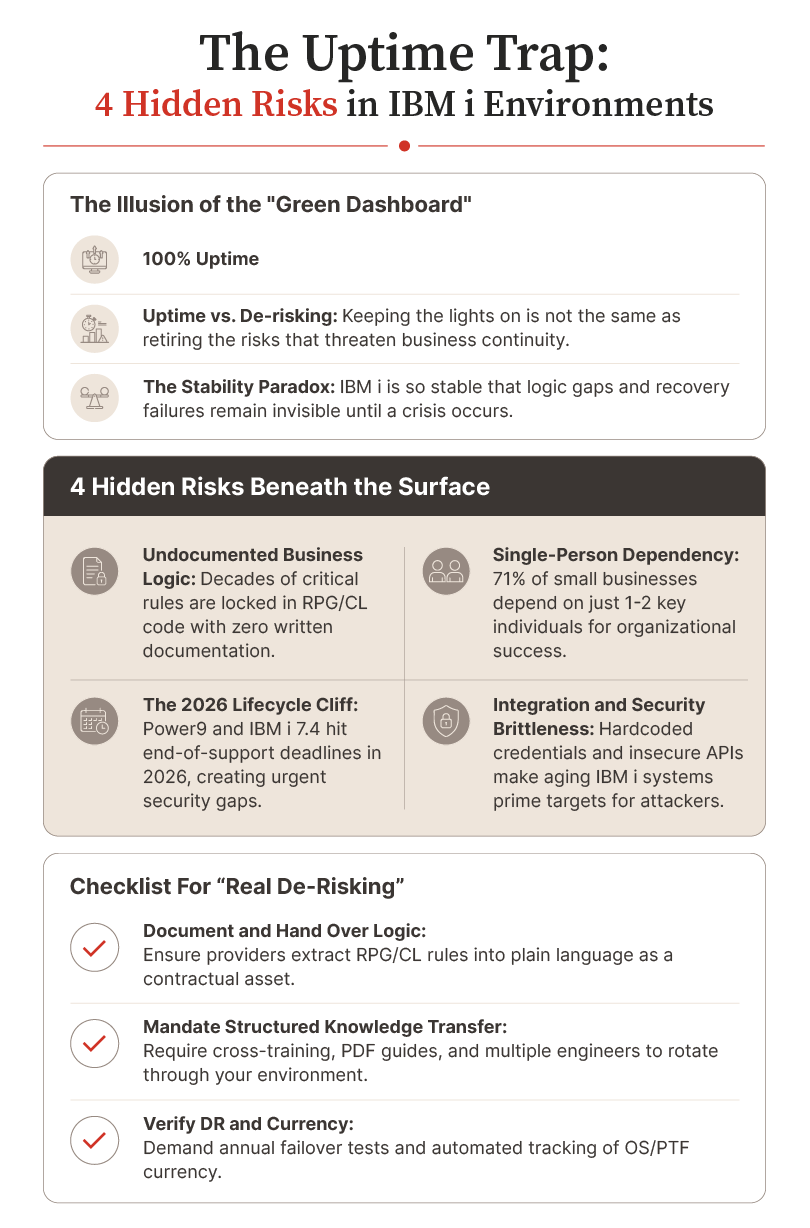
Real de-risking addresses four specific risks that monitoring never touches. Each requires work that goes beyond daily administration.
I. Undocumented Business Logic Locked in RPG/CL
RPG and CL programs hold decades of decision rules, edge cases, and operational know-how. The older developers understood it all, so they never wrote it down. Newer teams cannot read it like plain English.
AI tools can now extract business rules from legacy code and generate documentation. But experienced IBM i engineers must review and confirm every output, as business rules are subtle, and a single extraction error can cause production failure. When done right, business teams get documented requirements, clear use cases, and onboarding materials that move knowledge to hard copies.
II.Single-Person Dependency
Severe operational risk accumulates when critical workflows depend on one or two veteran AS400 developers. Retiring this risk requires a structured knowledge transfer program. Organizations should identify and document service processes. They should maintain PDF guides with screenshots for fundamental tasks and implement cross-training.
Engineers must pair up on live development tasks and hold regular knowledge-sharing sessions. All this builds sufficient coverage to keep operations stable when an RPG developer leaves.
III. Lifecycle and Disaster Recovery (DR) Gaps
Calendar events in 2026 are creating intense pressure:
- Power9 systems reached the end of standard IBM support on January 31, 2026 2.
- IBM i 7.4 transitions to expensive Extended Service coverage on September 30, 2026 3.
Organizations that continue on IBM i 7.4 beyond that date may face a deteriorating security posture, reduced compatibility with future hardware, and a higher cost of recovery when something goes wrong.
The DR picture is equally concerning. Very few IBM i shops have deployed comprehensive DR solutions.
Unfortunately, regular monitoring does not fix any of this. Addressing these gaps requires proactive upgrade planning and regular failover testing to replace outdated recovery assumptions.
IV. Integration and Security Risks
IBM i systems were built for isolated operations, not for the API economy. As they connect to external platforms, the attack surface grows. Because APIs have now become a prime target for attackers, storing hardcoded IBM i credentials on external systems spreads security risks across the network.
Modern authentication systems use revocable tokens instead of sending passwords with every request. A secure API layer verifies every user and limits access based on role and sign-on information. It enables live data exchange while giving teams a central place to monitor all access.
What to Demand from an AS400 Consulting Company
Most buyers evaluate AS400 managed services using standard RFPs focused on hourly rates and response-time SLAs. With that approach, they may select the cheapest monitoring vendor who measures daily operational efficiency but does not reduce real risk.
Use the following checklist to evaluate your next IBM AS400 consulting company:
1. Will you document business logic and hand over the documentation?
Knowledge transfer is the hardest part of any consulting engagement. Ask whether the provider will extract business rules from RPG and CL code, document them in plain language, and deliver that documentation as a contractual asset. If the answer is vague or if they treat documentation as an ongoing service, the engagement creates a new dependency instead of retiring risk.
2. How do you eliminate single-person dependency?
Single-person dependency becomes a real threat when critical knowledge sits with one individual. Ask for specifics:
- How will they cross-train the in-house team?
- What is the knowledge transfer cadence?
- How many engineers will rotate through your environment?
If one contractor becomes your sole point of contact, they will be recreating the same problem under a different name.
3. What is your DR testing cadence?
Disaster recovery plans should be tested at least once per year, with quarterly tests for critical systems. Ask for documented test results, clear RTO and RPO targets, and incident logs showing actual recovery performance. If testing happens “when needed” or lacks documentation, your DR plan is theoretical.
4. How do you handle OS and PTF currency?
Ask how the provider tracks system currency and schedules updates. For example, do they use automated tools like SYSTOOLS.GROUP_PTF_CURRENCY to compare your installed patches against current IBM releases? Also, ask how they are managing the 2026 lifecycle deadlines, like the Power9 end-of-support and IBM i 7.4 transition?
5. What is your modernization path, and does it preserve business rules?
RPG modernization should extract and preserve existing business logic, not discard it. Ask whether the IBM AS400 consulting company documents current rules before migrating them, uses AI-assisted extraction under engineer validation, and delivers documented requirements that can be verified independently.
Logistics Company Realized $4 Million in Projected Savings with IBM i Modernization
AI-Assisted De-Risking, with Humans in the Loop
Extracting decades of business logic from RPG and CL code used to take months, sometimes years. Specialized AI tools have changed that.
IBM watsonx Code Assistant4 for i now provides context-aware code explanations within the developer’s IDE. The tool uses IBM’s Granite model, fine-tuned for RPG. It shortens the learning curve for new programmers and speeds up work for experienced ones. Likewise, IBM Bob reverse-engineers undocumented code and runs verified upgrades.
Modern business rule extraction tools capture conditions, formulas, and dependencies. They output plain-language rules and structured requirements ready for review.
But AI functions only as an accelerant. Automated extraction without oversight might cause businesses to miss critical edge cases. Wrong extraction can lead to unexpected software behavior. For this reason, experienced IBM i engineers must verify every output.
Engagement Models: Matching the Model to the Risk
Three main models dominate IBM i services delivery. Each addresses a different set of risks. The right fit depends on where an organization’s exposure lies: in staffing, in execution, or in strategic control.
Fully managed services transfer complete IT responsibility to the provider. They cover infrastructure, operations, monitoring, backups, and recovery. This model suits enterprises exiting physical data centers or companies without an internal IT staff who require expert engineers to run the environment.
Co-managed models keep internal IT leadership in place. The provider fills immediate capacity and expertise gaps. For instance, the partner might handle tier-one support and security monitoring while the internal team focuses on strategy. Staff augmentation takes this a step further. It places external specialists under the client’s direct management. That way, companies can boost engineering capacity quickly without hiring delays.
Project-based engagements deliver defined outcomes like modernization or migration. The vendor owns all delivery milestones and contractually absorbs the execution risk.
When to Outsource Completely and When to Avoid It
Fully outsourcing retires infrastructure and operational risk when organizations lack internal capacity. But it does not necessarily eliminate knowledge-transfer risk. If the vendor builds new custom logic without providing documentation, it creates a new single point of failure.
Co-managed models work best when businesses have internal teams that need help with security, monitoring, or after-hours coverage. This hybrid approach keeps operations stable without draining the staff’s institutional knowledge.
The Damco Approach to IBM i/AS400 Services
A lot of IBM i engagements start with a generic statement of work. Damco starts with a diagnostic question: what does this environment contain, and what would it cost if something went wrong?
Our IBM i services begin with a focused codebase assessment that eliminates guesswork. We map out every legacy RPG, COBOL, and CL program in the architecture. Batch jobs and schedules, DB2 files and data dependencies, APIs, file transfers, and external system integrations all get documented. This produces a clear view of the entire IBM i environment.
Our roadmap distinguishes active business-critical code from dormant programs and dead code that runs without delivering value. This alone reduces modernization scope, cost, and risk. Our effort estimates are based on structural complexity, integration depth, and business criticality, and not arbitrary assumptions.
Our teams use AI-assisted codebase analysis to map complex dependencies and verify project scope. But we do not let AI run on autopilot. Seasoned IBM i practitioners review and confirm every automated output to ensure accuracy. Because Damco operates across all legacy architectures, we design modern software solutions that fit specific organizational needs. Also, we roll out updates incrementally to prevent business disruptions.
Damco’s track record reflects this rigorous approach. Our client engagements span manufacturing, insurance, and healthcare. We modernize systems while treating compliance, auditability, and operational continuity as non-negotiable baselines, not just an afterthought. Our experts focus on retiring long-term risks and not just billing companies for basic system uptime.
Conclusion
A green uptime dashboard does not mean your IBM i environment is safe. Monitoring keeps systems running, but it does not fix undocumented logic, key-person dependency, or untested disaster recovery. These are the risks that threaten your business.
Real de-risking requires active work: documenting business rules, cross-training teams, testing DR regularly, and securing integrations. Choose an IBM AS400 consulting company that delivers these outcomes, not just monthly reports. Because a system that stays up is not the same as a system you can safely update, recover, and sustain.
References:
- [1]: https://workflawless.com/articles/business-process-management/key-person-risk-explained/
- [2]: https://serviceexpress.com/resources/power9-end-of-service-life-eosl-what-comes-next/
- [3]: https://covenco.com/insights/blog/technical-bulletin-critical-update-on-ibm-i-7-4-lifecycle-planning-for-version-7-6-migration/
- [4]: https://www.ibm.com/new/announcements/introducing-the-upcoming-ibm-watsonx-code-assistant-for-i
- [5]: https://dev.to/aairom/things-you-can-do-with-ibm-bob-if-you-dont-want-to-code-c33
Frequently Asked Questions
AS400 managed services provide continuous, third-party oversight of your IBM i systems. Instead of managing IT in-house, an external partner handles 24/7 performance monitoring, software patching, data backups, and security hardening. This arrangement keeps core applications running smoothly while letting your internal team focus on strategic tasks.
No, the platform is not obsolete, but it is evolving rapidly. While the original physical hardware is legacy, the modern operating system, now called IBM i, runs mission-critical enterprise workloads. However, organizations face pressing 2026 calendar deadlines, including Power9 hardware end-of-support, which makes proactive modernization critical.
Look beyond cheap hourly rates and basic uptime promises, which often mask hidden operational risks. Choose a partner that contractually delivers plain-language documentation of your legacy RPG code, removes single-person dependencies, and proactively manages hardware and operating system upgrades rather than just renting you monitoring time.
Staff augmentation provides external experts on a temporary basis to increase your capacity under your direct management. This model leaves operational risk with you. Managed services, on the other hand, transfer complete operational responsibility and technical oversight to a partner who takes full ownership of system health, data recovery, and long-term risk reduction.


