

Executive Summary:
- Enterprise is a discipline, not a size, built on six governance layers.
- Match the build approach to each workload: pro-code, low-code, hybrid, or buy.
- AI reshapes both applications and development, and each needs its own governance.
- AI assistance compresses typing, not discipline, so senior engineering still matters most.
- Integration depth and compliance drive cost, which makes flat-rate price tables misleading for buyers.
- Test a partner’s neutrality by asking what they recommend when their own approach loses.
A lot of guides on enterprise application development quietly end in a platform pitch. Their cost tables disagree. Not because vendors are dishonest, but because they skip the first question: what makes development enterprise in the first place?
That question matters more than any framework comparison or pricing benchmark. Without an answer, organizations compare approaches without seeing the discipline layer underneath. That layer separates enterprise work from ordinary application work at any scale. Enterprise is a discipline, not a size.

This guide covers the full terrain: what makes an application enterprise, the build-approach spectrum, how artificial intelligence has shifted both what applications do and how they get built, the real cost drivers behind different quotes, and a vendor evaluation rubric that tests for neutrality.
What Makes Application Development Enterprise-Grade?
Six layers separate enterprise-grade application development from departmental builds. Each layer adds discipline that scales past the original deployment.
1. Identity and Permissions Layer
Applications inherit the organization’s access model through single sign-on, role-based access control, and least-privilege permissions. Service principals and delegated permissions let applications act on behalf of users without exposing credentials. Every access decision must be auditable.
Identity Access Flow:
User ➜ Identity Provider ➜ Authentication ➜ Authorization ➜ Application
2. Integration Contracts and APIs
Enterprise applications connect to existing systems through standardized interfaces governed by formal contracts. APIs define how data moves between environments and which operations each system can perform. They also establish who bears liability when an integration fails. That risk is real: Verizon’s 2025 Data Breach Investigations Report1 found that third-party involvement in breaches doubled to 30%, up from 15% the year before.
Enterprise Integration Flow:
Application ➜ API Gateway ➜ APIs ➜ Enterprise Systems ➜ Data Exchange
3. Compliance and Auditability Requirements
Regulated industries need proof that their applications handle data in line with GDPR, HIPAA, SOC 2, or PCI DSS standards. Compliance frameworks require documented policies, role-specific training, and continuous control monitoring that holds up under audit. Organizations must show traceability through data lineage and keep audit logs that record who accessed what data and when. They must also be able to produce that evidence on demand.
Compliance Control Flow:
Data Collection ➜ Processing ➜ Encryption ➜ Audit Logging ➜ Monitoring
4. Data Governance Foundations
Data governance establishes who owns data assets, who can access them, and how their accuracy stays verifiable over time. Data owners define usage policies; data stewards enforce quality standards, and sensitivity labels restrict access to personally identifiable information. Definitions, quality rules, and lineage must hold up as the application grows.
Data Governance Lifecycle:
Data Creation ➜ Classification ➜ Storage ➜ Access ➜ Retention ➜ Deletion
5. Resilience and Scalability
Applications must handle varying workloads without performance degradation and keep running when components fail. Autoscaling provisions resources based on demand metrics. Fault tolerance and redundancy across availability zones remove single points of failure, and load balancers redirect traffic away from failed servers. Disaster recovery plans set recovery time objectives that define acceptable downtime windows.
Application Request Flow:
User Request ➜ Load Balancer ➜ Application Servers ➜ Cache ➜ Database ➜ Response
6. Lifecycle Operations and Ownership
Enterprise applications require defined ownership beyond the development team that built them. Organizations must assign at least two application owners who manage configuration, monitor certificate lifecycles, and authorize schema changes. They should also have provisioning systems to automatically create and remove user identities as roles change.
Upgrade paths, backward compatibility requirements, and decommissioning procedures should be treated as contractual obligations rather than technical afterthoughts.
Application Lifecycle Flow:
Plan ➜ Develop ➜ Test ➜ Deploy ➜ Monitor ➜ Optimize ➜ Govern
Which Build Approach Fits an Enterprise Application?
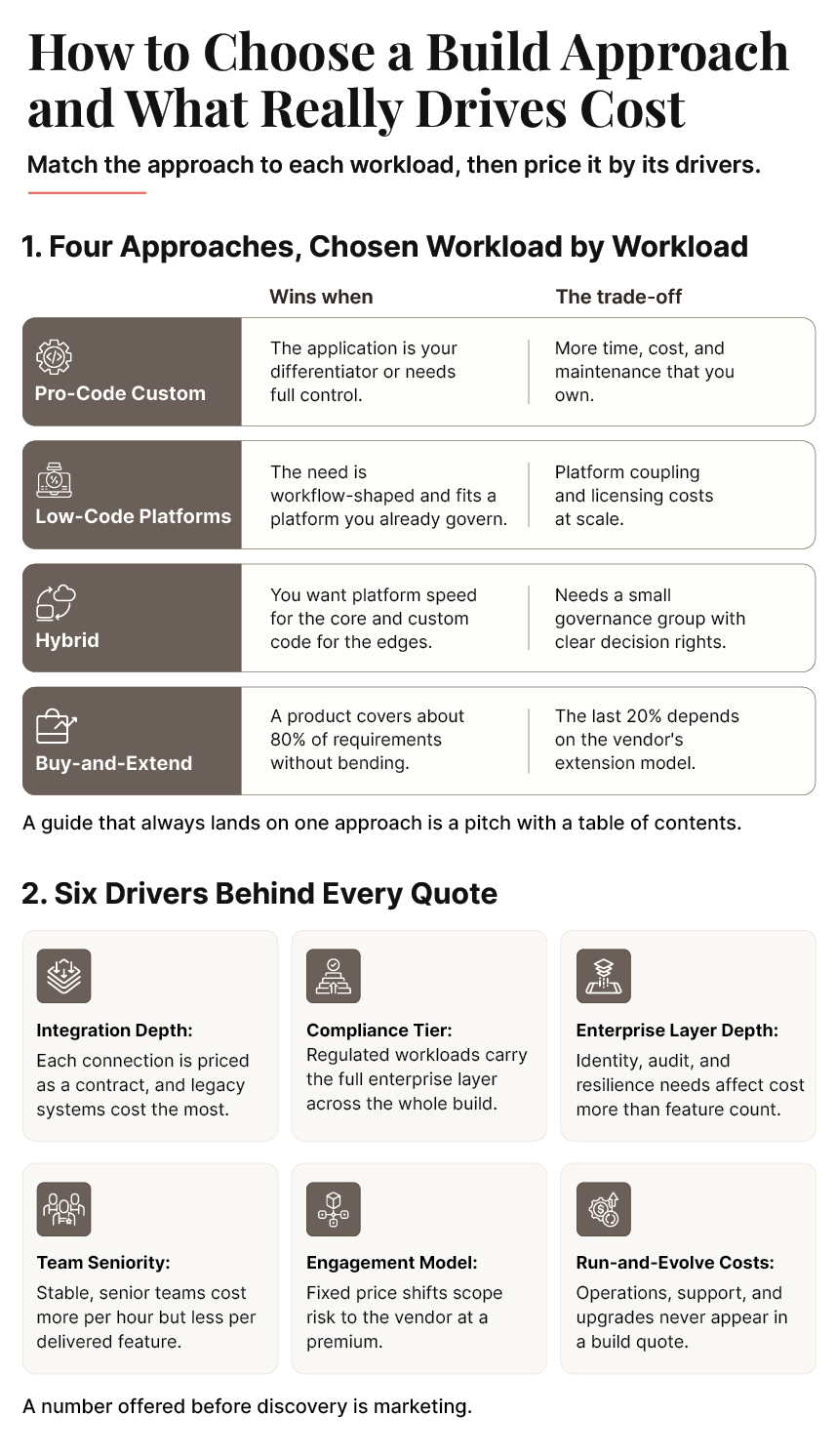
The right answer depends on the workload. Organizations can choose from a spectrum of development methods, each suited to different requirements, timelines, and ownership models.
I. Pro-Code Custom Development
Pro-code development involves writing applications from scratch using programming languages like Java, Python, or C#. Professional developers maintain complete control over functionality, design, and scalability. This approach delivers unmatched flexibility for complex applications that need custom APIs, performance optimization at the granular level, or compliance with regulations that require specific encryption and data transmission protocols.
In this case, organizations own the codebase. They also avoid vendor lock-in and recurring license fees. But they must invest time and money in building and maintaining the application.
II. Low-Code Platforms
Low-code platforms provide visual development environments where users create applications with minimal hand-coding, using drag-and-drop interfaces and prebuilt components. Platforms like OutSystems, Mendix, and Microsoft Power Apps now enable both professional and citizen developers to build applications faster than traditional coding permits.
Low-code offers far less flexibility than pro-code, but it cuts development time considerably for applications that fit within its capabilities.
III. Hybrid Approach
Hybrid is where most enterprises honestly land. It uses platform speed for the bulk of workflow needs and reserves pro-code for the capabilities that set the business apart. In short, buy or configure the core, then build the edges. Well-run hybrid estates also keep a small governance group of businesses, architecture, and security leads, with clear rights over which approach each workload gets.
IV. Buy-and-Extend Solutions
Buy-and-extend fits when a platform covers roughly 80% of requirements, and the remaining 20% can be customized through the vendor’s extension model. Extensibility takes several forms: API-first platforms built to be extended, in-platform low-code overlays like Salesforce Flow or ServiceNow App Engine, or composable architectures connecting third-party AI models to existing landscapes.
Not sure where your workload sits? Ask Damco to run the spectrum against it, and let the analysis choose the approach.
How Is AI Changing Enterprise Application Development?
AI enters enterprise applications through two distinct paths. The first embeds intelligence inside applications where business decisions occur. The second accelerates how those applications get built. Each path demands its own evidence standards, and organizations that conflate them underestimate the governance both require. That confusion explains many failed AI investments.
“Right now, people talk about being an AI company. There was a time after the iPhone App Store launch when people talked about being a mobile company. But no software company says they’re a mobile company now because it’d be unthinkable not to have a mobile app. And it’ll be unthinkable not to have intelligence integrated into every product and service. It’ll just be an expected, obvious thing.”
– Sam Altman, co-founder and CEO, OpenAI
1. AI in the Application: Intelligence at the Core
Applications now predict outcomes and generate content with human oversight. They execute multi-step workflows autonomously using organizational data. Enterprise AI adoption has delivered significant productivity and efficiency gains, but those gains are spread unevenly across three capability tiers.
- Prediction and recommendations analyze patterns and suggest the next actions. Procurement systems, for example, detect supply risks and propose sourcing alternatives based on inventory, logistics, and finance data evaluated together. CRM platforms score leads automatically and predict customer churn. The application interprets data, but humans retain decision authority.
- Generative AI with human review creates content that must be validated before use. Organizations apply this tier to report generation, proposal writing, meeting summaries, and customer support responses. Risk tolerance determines where this capability fits.
- Agentic applications perform tasks using organizational data with limited human intervention. Agentic operations tools are a fast-growing custom category, and their engineering discipline is covered in our guide on how to build enterprise AI agents.
These applications add evaluation, guardrail, and human-judgment requirements to the discipline layer. Humans own judgment wherever money, coverage, care, or rights are decided, and governance defines how automated decisions get audited.
2. AI in the Development Process
AI assistance generates code suggestions, automates testing, and produces documentation across the development lifecycle. The effort savings are real, especially for well-defined projects.
But this assistance compresses typing, not discipline, and the code it produces still needs careful review. In one developer survey, 38%2 of respondents said AI-generated code takes more effort to review than a colleague’s code. Veracode’s Spring 20263 testing found that only 55% of AI-generated code passed its security tests.
The teams benefiting most already maintain strong engineering practices, including code review culture, automated testing, and clear coding standards. AI amplifies existing quality instead of creating it, so the senior-engineering share of a build rises instead of falling.
For buyers, the lesson is to scope AI capability by the decision it touches and the evidence it must earn, not by the demo.
Low-Code or Custom Development?
What Are the Stages of the Enterprise Development Process?
The development process runs through five gated stages: discovery, iterative build, hardening, launch, and operations. Each gate produces an artifact a sponsor can verify.
I. Discovery and Architecture
Discovery runs for a few weeks and produces four concrete deliverables before production code gets written: a data model, API contracts, an integration dependency map, and a risk register with mitigation plans.
Organizations that skip this phase spend considerable time resolving architectural disagreements during active development. The gate closes when stakeholders have signed off on the architecture, and the risk register contains no unmitigated critical items.
II. Iterative Build and Integration
A mid-size enterprise application with 10-20 core modules and five to eight external integrations commonly takes six to eight months of active development, depending on scope and compliance needs. Teams build modular components in time-boxed sprints and hold weekly demos for stakeholders.
Integration testing runs parallel to feature development and catches permission gaps and data quality issues before they reach production. The artifact delivered at this stage is working software deployed to staging environments with real-life organizational data.
III. Hardening and Security Review
Hardening reviews compare actual configurations against approved security baselines and identify unsafe settings attackers could exploit even on fully patched software. Reviewers examine access controls, encryption standards, and privileged permission scope. The assessment prioritizes findings by exposure and exploitability and produces a remediation plan listing affected assets and verification methods.
IV. Launch Preparation
The final few weeks before go-live focus on end-to-end integration testing, user acceptance testing with actual end users, performance testing under realistic concurrent load, and formal compliance validation. Teams verify that staging environments mirror production, finalize rollback strategies, and confirm monitoring systems are operational.
V. Operations and Evolution
Applications require defined ownership beyond the team that built them. Organizations assign application owners who manage configuration, monitor dependencies, and authorize changes. Performance monitoring, user support, and system maintenance become ongoing responsibilities, not post-launch afterthoughts.
Should You Build, Buy, or Extend Enterprise Software?
The decision is made per workload, not per organization. To see which path actually pays, compare the first invoice with the full cost over three to five years.
1. When to Buy Off-the-Shelf Software
Packaged software fits when the process is common, and the product was built for it. Accounting and payroll are classic examples. Buy when a product covers 80% or more of your requirements without bending. A bought product bent past its design intent is the worst of both worlds.
2. When Custom Application Development Wins
Custom application development makes sense when the process creates competitive advantage, or no product fits without heavy compromise. Otherwise, workarounds around standard products become the actual system, and nobody controls it in full. Proprietary algorithms and heavy manual data movement between systems signal the need for purpose-built solutions.
3. When Extending Existing Systems Makes Sense
Keep standard products for common functions, build custom for processes that set the organization apart, and connect both through APIs. Price the difference honestly: the 20% you build versus the 100% you then own. For transforming an existing estate, see our application modernization guide.
How Much Does Enterprise Application Development Cost?
There is no reliable category price. Cost depends on integration, compliance tier, discipline-layer depth, team seniority, engagement model, and ongoing run costs.
I. Scope and Integration Count
Integration depth drives cost variance more than feature count does. A modern, documented API is a small task. A legacy system or heavily customized ERP instance can cost more than all the features around it. Price each integration as a contract.
II. Compliance Tier Requirements
Compliance premiums apply to the whole build, not to individual sections. Regulated workloads carry the discipline layer at full depth. Programs that discover their requirements after the architecture has hardened pay the premium twice.
III. Discipline-Layer Depth
Identity, audit, and resilience requirements affect cost more than feature count does. Enterprise applications need solutions architects and security specialists that mid-market projects often skip.
IV. Team Seniority and Model
A rate card shows only part of the picture, because a low hourly rate doesn’t mean a low cost per delivered feature. Dedicated teams with stable membership usually cost more per hour than rotating pools, but less per outcome. That’s because of continuity compounds: a stable team builds knowledge with every sprint. Turnover erases that knowledge, and each new team member must rebuild it.
V. Geography and Engagement Structure
Onshore, nearshore, and offshore rates differ widely for equivalent seniority. Fixed-price contracts transfer scope risk to the vendor at a premium. Time-and-materials avoids that premium but requires active management from the buyer.
VI. Run-and-Evolve Costs
No build quote shows the cost of operations, support, infrastructure, licensing, and the evolution backlog. Programs that ignore three-year run costs make architectural decisions that clear approval at first but surface true expense a few budget cycles later.
Think in tiers rather than price tags: a workflow tool, a departmental platform, or an enterprise product. Then ask for a driver-based estimate against your itemized requirements.
The Economics of Application Development Costs in the Age of AI
How Do You Choose an Application Development Company?
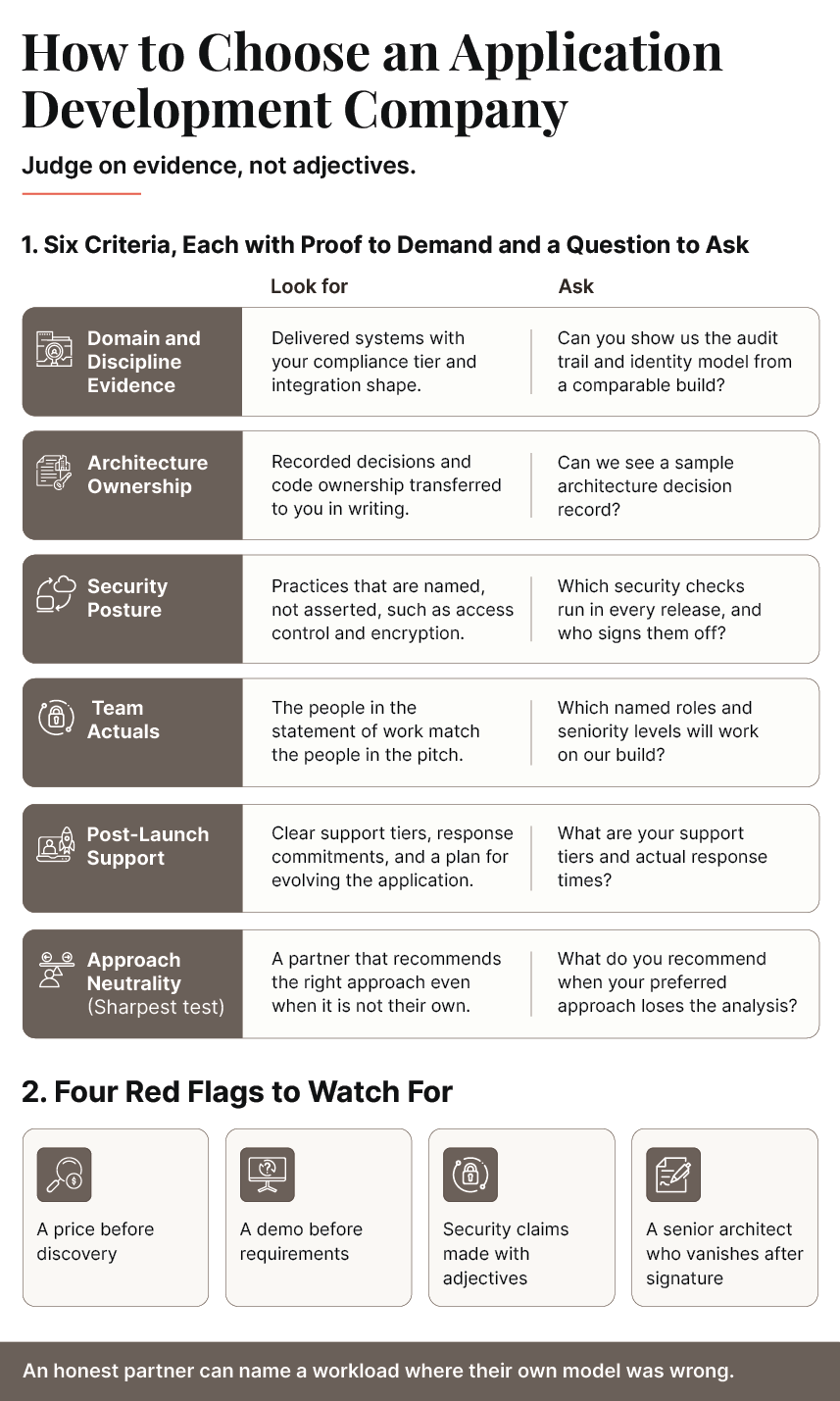
Judge an application development company on evidence, not adjectives: comparable delivered systems, recorded architecture decisions, named security practices, real team actuals, and approach neutrality.
Evaluate any custom application development company against six criteria, each with an evidence standard and one revealing question.
1. Domain and Discipline Evidence
Vendors with domain expertise recognize industry-specific challenges before they become project risks. Healthcare, for example, requires role-based access and audit trails built into the architecture. Experience at comparable complexity matters more than high-profile unrelated projects.
Ask: Can you show us the audit trail and identity model from a comparable build?
2. Architecture Ownership
Strong partners own architectural decisions without becoming bottlenecks. They anticipate risks and propose alternatives. Unclear scopes get handled through structured action. Code ownership must transfer to the client in writing, covering repository access and infrastructure accounts.
Ask: Can we see a sample architecture decision record?
3. Security Posture
Reliable enterprise partners implement role-based access control and encryption for data in transit and at rest. They also provide compliance validation and security checks throughout development. Zero-trust approaches require identity verification and least privilege access.
Ask: Which security checks run in every release, and who signs them off?
4. Team Composition and Actuals
Agencies presenting senior talent during sales often assign junior developers to actual work. Compare the people in the statement of work with the people in the pitch.
Ask: Which roles and seniority levels will work on our build?
5. Post-Launch Support
Support covers corrective fixes, adaptive changes, performance optimization, and security patching. Retainer models, dedicated teams, and service-level agreement commitments address different needs.
Ask: What are your support tiers and actual response times?
6. Approach Neutrality
Many custom application development service providers push a single approach to protect their internal capabilities rather than prioritizing client outcomes. Approach-neutral vendors assess requirements first and then propose optimal development methods.
Ask: What do you recommend when your preferred approach loses the analysis?
How Does Damco Approach Enterprise Application Development?
Damco delivers enterprise applications across pro-code, low-code, hybrid, and extend approaches. It sells no platform and engineers the discipline layer into every build.
Damco’s application engineering practice puts the spectrum in this guide into operation. Its teams run pro-code product builds, low-code delivery with platform governance built in, hybrid programs that configure the core and build the edges, and extend engagements on existing estates, backed by the modernization practice.
Whatever the approach, the discipline layer is the deliverable: identity, integration contracts, audit trails, and operations engineered in from discovery onward. Damco builds AI-enabled applications and agentic workflows with humans owning judgment where it matters and uses AI-assisted engineering inside a senior-led review culture.
Drawing on over three decades of enterprise delivery, Damco offers application development services and custom application development services that start from your workload, not from a product to sell. Because there is no platform to protect, its recommendation changes when the analysis does.
Talk to Damco’s application engineering practice about the build, the platform, the hybrid, or the extension, with the discipline layer engineered in whichever path you choose.
Conclusion
Enterprise application development is a discipline, not a matter of scale. What sets enterprise work apart from ordinary app building is its foundation: identity, integration contracts, compliance, data governance, resilience, and lifecycle ownership. Pick your build approach based on the workload, treat AI as two distinct shifts, and evaluate costs through drivers rather than tables. Finally, test every partner for neutrality. Any guide that always lands on one approach is simply a pitch with a table of contents.
References:
- 1. Verizon
- 2. IEEE Spectrum
- 3. Veracode
Frequently Asked Questions
Enterprise application development involves building software that meets company-wide standards for identity, integration, compliance, data governance, resilience, and ongoing operations. Enterprise is a discipline, not a size. A small internal tool that handles regulated data needs the same safeguards as a large customer platform.
Custom describes how software is built: written for your specific requirements rather than bought. Enterprise describes the discipline the software must meet. A custom app can skip the enterprise layer, and a configured packaged platform can meet it.
It depends on the workload. Low-code fits workflow-shaped applications on platforms you already govern. Custom fits applications that are your differentiation or need full control. A guide that always lands on one approach is a pitch with a table of contents.
There is no honest category price. Cost depends on integration count, compliance tier, discipline-layer depth, team seniority, engagement model, and run costs. Insist on a driver-based estimate after discovery.
Ask for evidence, not adjectives: comparable builds, a sample architecture decision record, named security practices, the actual team, and a clear support model. Then ask what they recommend when their preferred approach loses.


