

Introduction
Most of us spend our days tethered to our laptops and smartphones, immersed in an endless stream of intuitive digital experiences. After all, these devices empower us to do nearly everything digitally whenever we want. While tech enables this convenience, ecommerce giants like Amazon have accelerated adoption, reshaped consumer behavior, and reset expectations. As a result, people now expect frictionless experiences, convenience, speed, and transparency from brands across industries and NOTHING LESS. This phenomenon is referred to as the “Amazon Effect.”
This even has profound implications for how insurance brokerages operate, especially while issuing Certificates of Insurance (COIs). COIs serve as proof of coverage in commercial lines. Without these, businesses will have a hard time securing projects, as partners may not want to assume the risk of costs that might be incurred during the work. That’s why, when these certificates/documents are issued late, it directly affects the client’s ability to operate and onboard partners, affecting revenue timelines and business continuity. A traditional 24–48-hour turnaround is no longer well received in the market, where people are accustomed to instant gratification.

In this article, we discuss measures insurance brokers can take to deliver an Amazon-like experience, i.e., issuing COIs faster and at scale without overhauling existing workflows.
The Amazon Effect: How Personalization Is Shaping the New Normal
Amazon has fundamentally rewritten the rules of retail and other sectors worldwide. Whether a person lives in the suburbs of Chicago or is stationed in a mountainous city in Northern Thailand, Chiang Mai, they can order from a wide range of Amazon products and have them delivered in a day or two without paying a high shipping fee. If unsatisfied, they can place a return request in just a few clicks and have the amount credited within a few minutes of the pickup. They can download an invoice in just a few clicks, contact customer support 24/7, and do so much more.
Thanks to this frictionless digital-first experience that empowers customers with greater control, Amazon continues to grow its market share year after year. Customers today expect the same level of convenience, speed, and comfort from insurance. This is reflected in the JD Power 2025 U.S. Insurance Digital Experience Study. It highlights that 47% of auto insurance shoppers now purchase their policies through digital channels, underscoring the burgeoning importance of self-service digital portals.
Customers increasingly prefer the flexibility to access documentation and policy details on demand, including generating COIs in commercial lines. They would no longer appreciate having to get on a call/emailing a customer service representative just to obtain what is essentially theirs the next day.
Key Takeaway: Digital experience is redefining the insurance landscape, and brokerages must modernize their workflows to stay relevant.
What Makes COIs Such a Critical Operational Touchpoint?

Source: Investpedia
Certificates of Insurance (COIs) are used to prove insurance coverage in commercial lines. Small business owners and mid-sized contractors often request a COI from their broker that protects against liability for workplace accidents or injuries. For instance, a business or concerned party may reach out to a subcontractor to carry out restoration work on their construction site or a building, such as electrical or roofing repairs. As part of the process, this subcontractor must submit a COI for liability insurance to the property owner (business), which must include details such as the specific project location, additional insured status, and a waiver of subrogation.
So that the project owner is satisfied that the contractor will be responsible for any damage, injury, or substandard work. It basically protects their interests. Without a COI, a contractor may have difficulty securing jobs. The same principle applies to other sectors, such as vendor risk management, logistics, and real estate, where COI requests are consistent throughout the policy term, as every new project requires a separate COI. These administrative assignments can add to your team’s workload, requiring them to be quick and agile in their delivery.
Because clients are continuously evaluating your responsiveness. Their expectations are already shaped by Amazon-like service delivery, and if they experience consistent delays in COI issuance, they may switch to another broker. And it’s not just about the experience; it’s about revenue. A project stalled due to a COI holdup can create a ripple effect across their business, impacting revenue, productivity, and deadlines. Thus, the need to transition from manual, email-based workflows to self-service, digital-first portals couldn’t be overstated.
Key Takeaway: Every new job requires a separate COI. And relying on email-based workflows can create delays, frustrate clients, and risk revenue.
Automating COIs Issuance to Reduce Friction and Improve Client Satisfaction

Instant COIs are expected today. Not as a premium service but a basic expectation. And manually preparing and delivering accurate COIs at the speed clients demand can prove to be a mammoth task. It requires a large workforce; even then, the risk of errors remains significant, as high-volume manual handling can trigger errors, leading to inconsistencies and revisions. This is where modern technology comes in. It can transform how a brokerage firm operates by automating COI management and tracking. Some of the advantages are outlined below:
Automatic Commercial COI Generation
Enables policyholders to generate and access COI instantly through a secure self-service portal. This reduces back-and-forth on emails for both customers and brokers. Your team can focus more on project delivery instead of constantly managing insurance.Vendor Compliance Management
Subcontractors (policyholders) can directly maintain and download their COIs through a secure, centralized system. Coverage details are automatically validated against unique project requirements, ensuring compliance before they step onto the job site.Issuance Tracking
Reduces your team’s administrative burden by automating the creation, storage, management, and sharing of COIs. Policyholders can generate and track multiple COI requests in one place at their will, fostering confidence and trust.
Where Does this Leave Brokers?
This does not mean the broker agent channel is going anywhere, especially for complex risks. Software cannot interpret contractual nuance the way a broker can. They will continue to play a critical part in coverage structuring, contract review, risk transfer advisory, claims advocacy, and managing other strategic responsibilities.
Key Takeaway: Automate COI management and tracking, so that your teams can focus more on strategic advisory assignments.
From Administrative Burden to Operational Efficiency
| Manual Process | Automation |
|---|---|
|
Email chains |
Instant issuance (depending on the complexity) |
|
Delays (24-48 hours) |
Auto validation |
|
Revisions |
Centralized tracking |
|
Increased team workload |
Increased productivity |
|
Compliance risk |
Compliance assurance |
Selecting the Right Solution for Modernizing COI Workflows
Does choosing new technology for brokerage feel overwhelming? It doesn’t have to be. As you evaluate the software options available in the market, think of this exercise not merely as adopting new technology, but as a catalyst for operational growth. The right solution should simplify insurance certificate issuance and management, strengthen client experience, and increase internal efficiency while meeting regulatory compliance. Consider the following factors:
Self-Service Portal
The platform should facilitate seamless, on-demand COI generation without manual broker intervention. As with Amazon, policyholders should be able to log in to the platform and use a web-based COI request form to submit accurate information, ensuring the correct certificate is issued for specific jobs.
Integration with Existing Systems
A modern system must not disrupt existing processes; instead, it should uplift your operations by integrating seamlessly with your on-prem policy management and brokerage systems.
Scalability for High Volumes
Check whether the system can handle bulk demand and renewals without increasing manual workload.
Visibility and Tracking
Features such as a centralized repository and real-time tracking help instill confidence by increasing transparency for both clients and teams.
Ultimately, the right technology should remove administrative friction from COI issuance and management and BrokerEdge can support you on this journey. As a next-generation insurance broker platform, it simplifies COI workflows while unifying client data for faster, more accurate issuance.
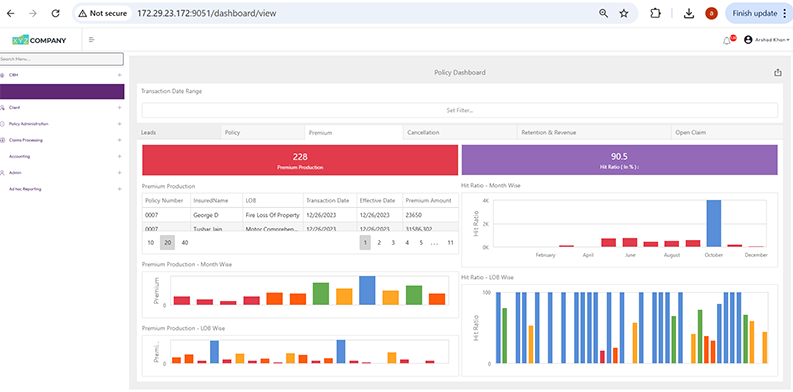
Source: BrokerEdge Dashboard
Key Takeaway: A self-service digital portal powered by BrokerEdge enables clients to generate COIs faster, bringing transparency and driving stronger client retention.
Ready to Modernize Your Insurance Brokerage? Discover how BrokerEdge can help you scale faster and smarter.
Final Word: Ready to Deliver Amazon-like Experience?
The Amazon Effect has introduced consumers to an almost completely frictionless digital experience with near-immediate results. As a result, their preferences have skyrocketed while patience levels have grown thinner. The shift is evident even in sectors that offer complex services, including insurance. Organizations are feeling pressure across the insurance lifecycle, such as underwriting, policy issuance, onboarding, claims processing, and COI delivery. Policyholders operating in construction, real estate, vendor risk management, and logistics often require multiple COIs a month, and they need them fast.
Slow turnaround damages trust faster than pricing. It can lead to revenue leakage, lost productivity, and missed deadlines. For brokerage leaders, the imperative is clear: invest in modern systems that help them move beyond stacks of certificates cluttering the office or hours spent chasing requests through phone calls and emails. The right solution can help generate commercial COI instantly, centralize tracking of multiple requests, and automate validation of coverage details against job requirements. This is not a premium service, but a basic consumer’s expectation. Are you ready to make the transition?


